AQA A-Level Psychology Revision Notes, Flashcards & Evaluation Prompts
Aripsy turns your AQA A-Level Psychology notes, study summaries, evaluation paragraphs, or research methods material into revision notes, flashcards, and practice prompts. Check which AQA Psychology specification your cohort uses, then paste one topic at a time for clearer revision.
AQA
A-Level
Specification topics
Psychology
Exam questions
A-Level
Psychology
hard
AQA
Turn one focused source into structured notes, key concepts, and recall prompts, then continue in the full study tool.
Short answer
How can Aripsy help me revise AQA A-Level Psychology?
Aripsy turns your AQA A-Level Psychology notes, study summaries, evaluation paragraphs, or research methods material into revision notes, flashcards, and practice prompts. Check which AQA Psychology specification your cohort uses, then paste one topic at a time for clearer revision.
Best input
Memory: the multi-store model separates sensory register, short-term memory, and long-term memory. Evaluation may include supporting evidence from case studies, lab studies, and criticisms about oversimplifying memory processes.
Responsible use
Use Aripsy alongside the AQA Psychology specification for your cohort, class notes, textbooks, studies, and mark schemes. Check study details, evaluation wording, and assessment objectives before revision.
How Aripsy helps you study this material
Aripsy turns your AQA A-Level Psychology notes, study summaries, evaluation paragraphs, or research methods material into revision notes, flashcards, and practice prompts. Check which AQA Psychology specification your cohort uses, then paste one topic at a time for clearer revision.
Why use this tool?
How to create study notes from your material
Common Questions
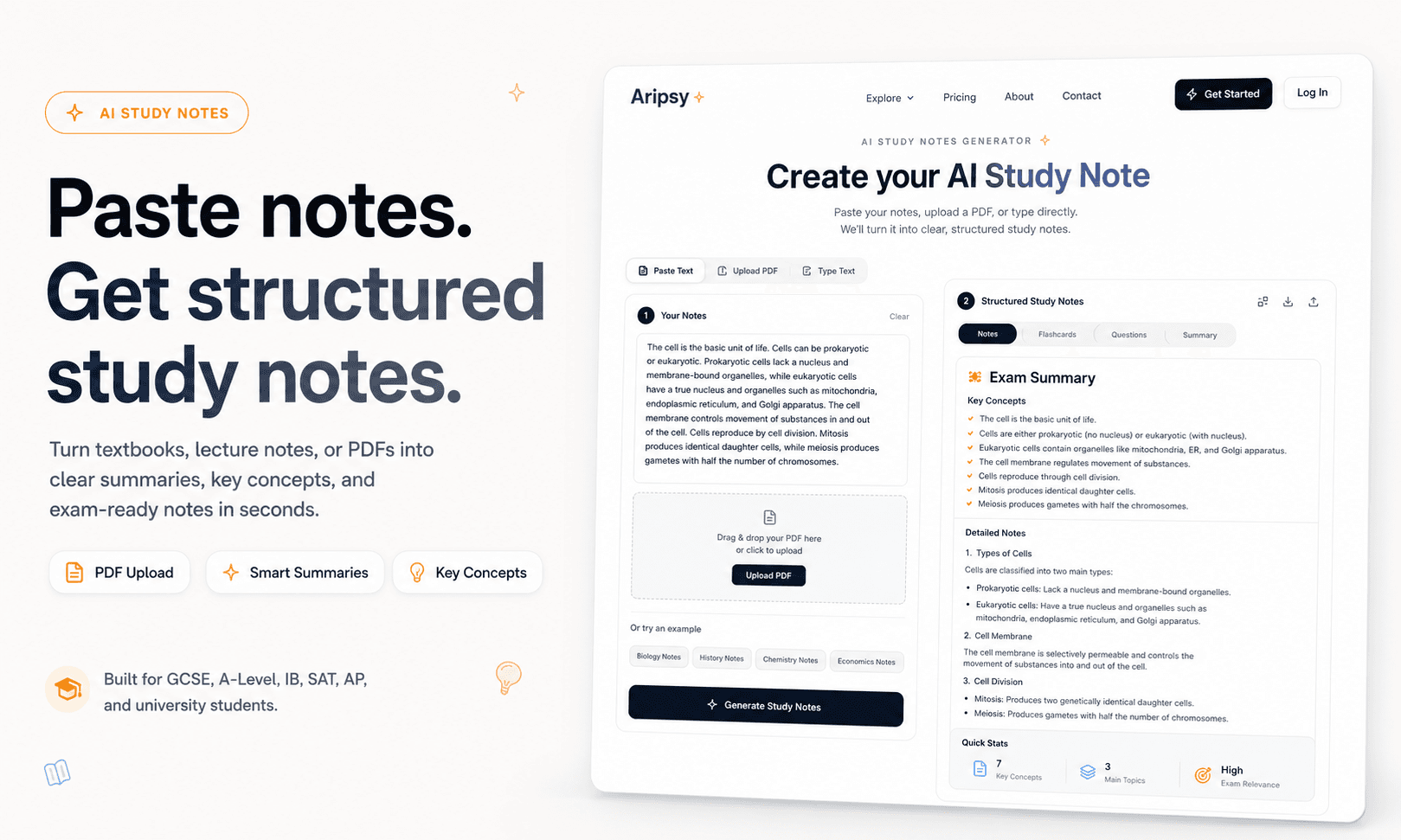
Product workflow preview
What the workflow looks like in Aripsy
A-Level Psychology requires precise recall of studies, researchers, evaluation points, and methodological terminology for essay-based assessment. The screenshot shows the same Aripsy workflow students use to add material, choose study settings, generate notes, then build recall practice from the saved session.
What is covered in AQA A-Level Psychology?
AQA A-Level Psychology revision usually includes core topic knowledge, research methods, approaches, issues and debates, optional topic areas, and essay-style evaluation. Aripsy helps students turn their own notes into clearer AO1, AO2, and AO3 revision prompts.
Research methods and statistics revision
Useful inputs include notes on experimental design, variables, sampling, ethics, validity, reliability, correlations, observations, content analysis, descriptive statistics, and inferential tests. Generated notes should be checked against your specification and class examples.
Sample Psychology flashcards
Example cards include: What is AO3 evaluation? Credit for analysis, interpretation, discussion, and judgement of psychological knowledge. What is a strength of controlled lab studies? They can improve control of extraneous variables, but may reduce ecological validity.
Common mistakes to check before revising
Students often mix study details, write generic evaluation, miss application to the scenario, or describe research methods without linking them to validity and reliability. Generated notes should be checked against course materials and mark schemes.
How to revise AQA Psychology with Aripsy
Use one topic, study, or evaluation theme at a time. Generate notes, verify the details, then create flashcards for definitions, studies, strengths, limitations, and application prompts.
Current and updated specification checks
AQA has current and updated Psychology specification information. Students should confirm which version their school is teaching before using any revision list, especially if they are preparing for exams after a specification transition.
Useful student workflows
Study Detail Flashcards
Convert notes on key studies (Milgram, Asch, Bowlby, Ainsworth, Bandura) into structured cards covering aim, method, results, conclusions, and evaluation points.
Approach Comparison Tables
Generate comparison revision sheets for the six approaches (biological, cognitive, behaviourist, social learning, psychodynamic, humanistic) with key assumptions, methods, and evaluation.
Research Methods Terminology
Create precise definition flashcards for experimental designs, sampling methods, ethical guidelines, and statistical tests used in AQA A-Level Psychology.
Why Psychology pages need assessment-objective detail
A-Level Psychology revision is not only memorising studies. Students need AO1 knowledge, AO2 application, AO3 evaluation, research methods, and accurate study details. A useful page should help separate those demands and remind students to check which specification applies to their cohort.
What to paste for better AQA Psychology notes
Strong inputs include one topic summary, one study table, a set of evaluation paragraphs, a research methods handout, or feedback on an essay plan. Include named studies, sample details, method details, and mark-scheme corrections where possible.
Turning Psychology notes into active recall
After checking notes, turn definitions into flashcards, studies into method-finding-conclusion cards, evaluation into strength-and-limitation prompts, and research methods into scenario-based questions. This makes revision more active than rereading essay plans.
Understanding AQA A-Level Psychology Assessment
The AQA A-Level Psychology specification (7182) is assessed across three papers. Paper 1 covers Introductory Topics (Social Influence, Memory, Attachment, and Psychopathology). Paper 2 covers Psychology in Context (Approaches, Biopsychology, and Research Methods). Paper 3 covers Issues and Options, where students choose three option topics from areas including Relationships, Schizophrenia, Forensic Psychology, and Addiction. Each paper contains a mix of short-answer questions, application questions, and extended-response essays (either 12 or 16 marks). Success requires both precise factual recall and the ability to construct balanced evaluative arguments. Aripsy helps by converting dense psychology notes into targeted recall cards that separate descriptive knowledge (AO1) from evaluative analysis (AO3).
Building Evaluation Chains for Psychology Essays
AQA Psychology essays award the highest marks for detailed, elaborated evaluation rather than listing brief strengths and limitations. A strong evaluation point follows a chain: state the point, explain why it matters, provide evidence or a counter-argument, and conclude with an implication. Aripsy can generate evaluation flashcards from your class notes by structuring each point into this chain format. For example, rather than a single card saying "Milgram lacked ecological validity", Aripsy would generate a card that prompts the full chain: the artificial setting, why this affects generalisability, how Hofling replicated in a real hospital, and what this means for the conclusion about obedience.
Research Methods as a Cross-Cutting Skill
Research Methods appears explicitly on Paper 2 but also underpins application questions across all three papers. Questions may present an unfamiliar study scenario and ask students to identify the experimental design, explain a sampling method, or justify a statistical test. Use Aripsy to build a comprehensive set of research methods flashcards covering definitions, advantages, limitations, and application contexts for every method in the specification. Strong research methods knowledge is often the difference between grade A and grade B because it earns marks across multiple papers rather than just one topic area.
Sources and further reading
These independent education resources inform the study habits discussed on this page. Always follow your teacher, tutor, specification, or official exam guidance first.
AQA A-Level Psychology Specification (7182)
Official specification with topic content, study requirements, and assessment objectives.
British Psychological SocietyBritish Psychological Society: Getting started
Professional psychology body providing guidance on studying psychology and psychology careers.
The Learning ScientistsRetrieval practice
Explains why pulling answers from memory is usually stronger than rereading notes.
Topics supported
Ready to revise with less friction?
Start with your own material and build a clearer revision workflow.
Turn one focused source into structured notes, key concepts, and recall prompts, then continue in the full study tool.
Supported Subjects
Biology, Chemistry, Physics, Mathematics, History, Geography, Economics, Business, Psychology, Computer Science and English Literature.