AQA GCSE English Literature Revision Notes & Quote Flashcards
Aripsy turns your AQA GCSE English Literature notes, quote banks, marked class feedback, or anthology annotations into revision summaries, flashcards, and practice prompts. Paste one text, theme, character, poem, or essay plan at a time so the output stays focused and easy to check.
AQA
GCSE
Subject topics
English Literature
Exam practice
GCSE
English Literature
GCSE / SAT
AQA
Turn one focused source into structured notes, key concepts, and recall prompts, then continue in the full study tool.
Short answer
How can Aripsy help me revise AQA GCSE English Literature?
Aripsy turns your AQA GCSE English Literature notes, quote banks, marked class feedback, or anthology annotations into revision summaries, flashcards, and practice prompts. Paste one text, theme, character, poem, or essay plan at a time so the output stays focused and easy to check.
Best input
Macbeth theme notes: ambition drives Macbeth to murder Duncan after the witches predict he will be king. Lady Macbeth challenges his masculinity, but guilt and fear grow after the murder. Shakespeare presents unchecked ambition as destructive.
Responsible use
Use Aripsy alongside your set texts, marked class feedback, anthology, class notes, and mark schemes. Check quotations, context, and interpretations before revision.
How Aripsy helps you study this material
Aripsy turns your AQA GCSE English Literature notes, quote banks, marked class feedback, or anthology annotations into revision summaries, flashcards, and practice prompts. Paste one text, theme, character, poem, or essay plan at a time so the output stays focused and easy to check.
Why use this tool?
How to create study notes from your material
Common Questions
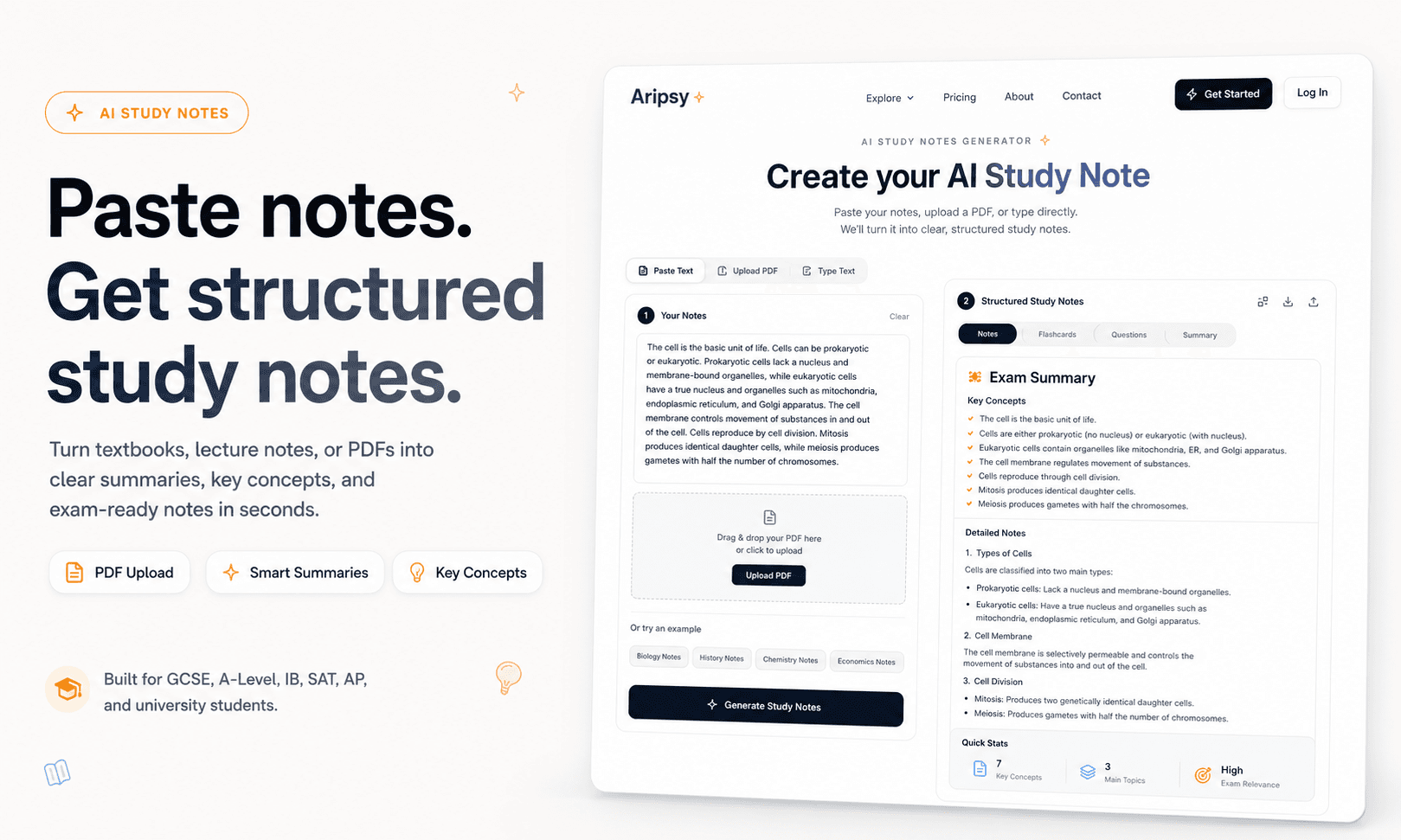
Product workflow preview
What the workflow looks like in Aripsy
English Literature revision requires linking precise quotations with themes, characters, and authorial methods for analytical essay writing. The screenshot shows the same Aripsy workflow students use to add material, choose study settings, generate notes, then build recall practice from the saved session.
What is covered in AQA GCSE English Literature?
AQA GCSE English Literature revision usually covers a Shakespeare text, a 19th-century novel, modern prose or drama, poetry anthology comparison, and unseen poetry. Aripsy helps students organize their own notes into theme summaries, quote prompts, and essay-plan checks. Students studying Shakespeare can start with the GCSE Macbeth summary before moving into character, theme, and essay analysis.
Text, theme, and character revision
Useful inputs include class notes on a key scene, a character mind map, marked feedback on an essay, or a short quote bank. Aripsy can turn these into revision notes that separate argument, evidence, method, context, and possible exam questions.
Sample English Literature flashcards
Example cards include: What can a Macbeth ambition paragraph argue? Shakespeare presents unchecked ambition as psychologically destructive and politically destabilising. What should a quote flashcard include? The quote, speaker, moment, method, and why it supports an interpretation.
Common mistakes to check before revising
Students often memorise inaccurate quotations, retell the plot instead of analysing methods, bolt on context without linking it to the argument, or compare poems by listing similarities only. Generated notes should be checked against the text and marked class feedback.
How to revise English Literature with Aripsy
Use one focus at a time. Paste your notes, generate a structured summary, check quotes and interpretations, then create flashcards for quotations and practice prompts for essay planning.
Using AI without losing your own interpretation
English Literature marks depend on your argument and evidence. Use Aripsy to organize revision material, but keep your own interpretations, class discussion, and marked class feedback at the centre of the essay plan.
Useful student workflows
Set Text Character Analysis
Convert class notes on characters from Macbeth, An Inspector Calls, A Christmas Carol, or Jekyll and Hyde into structured character development cards with key quotations.
Theme & Context Revision
Generate theme-based revision sheets linking social, historical, and cultural context with relevant quotes and authorial intention.
Poetry Anthology Comparison
Summarize Power and Conflict or Love and Relationships poems into method-effect-context cards for comparison essay preparation.
Why Literature pages need text-aware revision guidance
A useful AQA GCSE English Literature page should not pretend one generic template fits every text. Students need reminders to verify quotations, connect methods to meaning, compare poems directly, and use context only where it supports interpretation. That makes the page more useful than a thin "English notes generator" page.
What to paste for better Literature notes
The best input is focused and grounded: a quote bank, annotated extract, character notes, theme table, marked class feedback, or a paragraph plan. Pasting a whole set text is less useful than pasting the scene, theme, poem, or essay plan you are actively revising.
Turning Literature notes into active recall
After checking generated notes, turn quotations into recall cards, interpretations into explanation prompts, and common essay mistakes into self-check questions. For poetry, make comparison cards that ask for a shared theme, one similarity, one difference, and the methods used by each poet.
Understanding AQA GCSE English Literature Assessment
The AQA GCSE English Literature specification (8702) assesses students across two papers. Paper 1 covers Shakespeare and the 19th Century Novel (Macbeth, Romeo and Juliet, The Merchant of Venice combined with A Christmas Carol, The Sign of Four, Jekyll and Hyde, Frankenstein, or Pride and Prejudice). Paper 2 covers Modern Texts and Poetry (An Inspector Calls, Blood Brothers, The History Boys, or others, combined with the AQA Poetry Anthology and Unseen Poetry). Crucially, this is a closed-book exam—students cannot take texts into the exam hall, making quotation recall and analytical framework preparation essential. Aripsy helps students organise their class annotations into quotation banks linked to characters, themes, and essay structures.
Building a Quotation Bank with Active Recall
The most common mistake in English Literature revision is passive rereading of highlighted study guides. Students feel familiar with quotes but cannot recall them accurately under exam pressure. Aripsy converts your quotation annotations into two-sided flashcards: one side presents a theme or character prompt, the other side reveals the quotation with a brief analytical note on language, structure, or form. By testing yourself daily—writing out quotes from memory before flipping the card—you build the precise recall that earns top marks in the extract and essay questions. Focus on short, versatile quotes (five to ten words) that can be applied across multiple essay themes.
Connecting Context to Analysis for AO3 Marks
AQA awards marks for showing how texts relate to their social, historical, and cultural context (AO3). Students often bolt context onto essays as an afterthought. Instead, integrate contextual knowledge into your flashcards by linking each quote to its relevant context point. For example, pair Lady Macbeth commanding language with Jacobean gender expectations, or pair Mr Birling confidence with Priestley criticism of Edwardian capitalism. When Aripsy generates your revision cards, add a brief context sentence to each one so you practise weaving context into analysis from the start.
Sources and further reading
These independent education resources inform the study habits discussed on this page. Always follow your teacher, tutor, specification, or official exam guidance first.
AQA GCSE English Literature Specification (8702)
Official specification with set text lists, assessment objectives, and paper structure.
BBC BitesizeBBC Bitesize AQA GCSE English Literature
Set text revision guides and poetry anthology analysis aligned to the AQA specification.
The Learning ScientistsRetrieval practice
Explains why pulling answers from memory is usually stronger than rereading notes.
Topics supported
Ready to revise with less friction?
Start with your own material and build a clearer revision workflow.
Turn one focused source into structured notes, key concepts, and recall prompts, then continue in the full study tool.
Supported Subjects
Biology, Chemistry, Physics, Mathematics, History, Geography, Economics, Business, Psychology, Computer Science and English Literature.