Evidence-Informed Study Techniques for Better Revision
A practical student guide to active recall, spaced practice, interleaving, and mistake review, with honest limits and no grade guarantees.
 Aripsy Study Team
In this article16
Good revision is not about finding one perfect technique. It is about building a routine that makes you retrieve information, check mistakes, and return to hard topics before you forget them.
This guide focuses on evidence-informed study techniques that students can actually use for GCSE, A-Level, IB, AP, SAT, university, and professional exams. They can improve the quality of your revision, but they do not guarantee a grade. Your result still depends on starting point, time, subject difficulty, feedback, health, and exam-day performance.
Key takeaways
- Use retrieval practice to check what you can recall, rather than relying only on familiar-looking notes.
- Spaced practice works better than cramming when you need to remember material later.
- Mix related question types once you can attempt each type on its own.
- Mistake logs turn lost marks into a clear next revision task.
- AI tools can help draft notes, flashcards, and questions, but important points should be checked against reliable sources.
A review of learning techniques by Dunlosky and colleagues rated practice testing and distributed practice highly across the evidence it examined. That supports using them as a starting point, not promising a particular result or treating every technique as equally established.
1. Active recall: test before checking
Active recall means trying to answer from memory before looking at the source. It feels harder than re-reading because your brain has to retrieve the information, not just recognise it.
Use it like this:
- Read a short section of your textbook or class notes.
- Close the source.
- Write what you remember.
- Compare your answer with the source.
- Turn gaps into flashcards or practice questions.
For example, a Biology student might close their notes and write the steps of mitosis from memory. A History student might explain causes of an event without looking. A Maths student might solve a question, then explain the method in words.
If you use Aripsy, paste your own notes and generate flashcards or practice questions from the material. Then edit the output so each card tests one idea clearly.
2. Spaced practice: return before you forget
Spaced practice means reviewing material across several sessions instead of cramming it into one long session. The schedule below is a starting example, not an optimal interval for every learner or exam:
| Review | When to do it |
|---|---|
| First review | Same day |
| Second review | Next day |
| Third review | Three days later |
| Fourth review | One week later |
| Later reviews | Before topic tests and exams |
This is especially useful for definitions, formulas, dates, vocabulary, processes, anatomy, law cases, and quotes. If a card is difficult, bring it back sooner. If it is easy several times, space it out.
3. Interleaving: mix question types
Interleaving means mixing related topics or question types in one revision block. It is useful because exams rarely announce the exact method you need.
For Maths, that might mean mixing algebra, geometry, and graphs. For Chemistry, it might mean balancing equations, calculating moles, and explaining bonding in the same session. For English Literature, it might mean comparing two themes instead of revising one character for an hour.
Do not interleave everything at once. Start with topics that are connected enough to compare.
4. Mistake logs: make errors useful
A mistake log is one of the simplest ways to improve revision quality. After a quiz or past-paper question, write down:
- The question or topic.
- What went wrong.
- Whether the problem was knowledge, method, wording, timing, or careless detail.
- What you will do next.
Example:
| Topic | Mistake | Next action |
|---|---|---|
| Photosynthesis | Forgot limiting factors | Make 3 flashcards and answer one exam question |
| Simultaneous equations | Substitution step error | Redo 5 similar questions |
| Macbeth | Quote remembered but not analysed | Write 2 paragraph plans |
This stops revision becoming vague. You are not just “doing Biology”; you are fixing a specific weakness.
5. Dual coding: combine words and visuals carefully
Dual coding means using words and visuals together. It can help when a topic has processes, structures, timelines, graphs, or relationships.
Good uses include:
- Biology diagrams with labelled functions.
- Timelines for History.
- Formula triangles or worked examples for Physics.
- Mind maps for essay themes.
- Flowcharts for legal reasoning or medical pathways.
The visual should make the idea clearer. A colourful page that hides the logic is not automatically good revision.
6. Practice testing: use past papers properly
Past papers and practice questions are strongest when you review them carefully. Do not only mark the score and move on.
Use this loop:
- Answer under timed conditions where realistic.
- Mark with the official mark scheme or course guidance.
- Identify why marks were lost.
- Create a follow-up task from each mistake.
- Re-answer a similar question a few days later.
For exam-board subjects, check current specifications and mark schemes. AI-generated questions can help you practise, but they should not replace official material.
Choose the technique for the problem
| What happens when you practise? | Try next | Check whether it helped |
|---|---|---|
| You recognise the notes but cannot explain them | Close the source and answer one focused question | Explain it without cues, then check accuracy |
| You remember today but forget later | Revisit the topic in another session | Answer a new question after a delay |
| You know each formula but choose the wrong one | Mix a few already-learned question types | State why you selected each method |
| You repeat the same error | Write the cause and one correction task | Retry without looking at the correction |
For one Biology topic, use a short exam note to explain a process, flashcards for terms you need to recall, and a practice question to check whether you can apply the idea. If you cannot explain the process yet, clarify the note first. If you understand it but forget key terms later, review the cards. If you remember the terms but lose marks applying them, work through a question and check the marking guidance. You do not need to turn every sentence into every format.
A 20-minute session you can adapt
Spend five minutes answering a few questions without notes, five checking and correcting them, and ten applying the difficult ideas to new questions. Record one topic to revisit. These timings are a planning example, not a tested prescription. If you are learning the material for the first time, begin with an explanation and a worked example before testing yourself.
For a longer workflow, see how to use past papers effectively. For the notes you will test yourself on, use the four-part exam-note structure.
Worked session: learn the method, then choose it yourself
Consider a student who can follow an algebra solution but freezes when a question appears without a worked example. The next task is to find out where the difficulty begins.
First, study one worked solution and explain why each operation is valid. Then cover it and solve a similar question. If the first step is missing, revisit that step before adding more question types. If the method works on a similar question, try a small mixed set where you must decide which method applies.
Write a short reason beside each answer: “I used substitution because…” or “I expanded the brackets first because…” Mark the reasoning as well as the result. A correct answer reached by an unreliable method still needs attention.
The next session should contain a fresh question, not only the one whose answer you now remember. Keep the original worked example available for feedback after the attempt. This separates understanding a demonstration from choosing and carrying out a method independently.
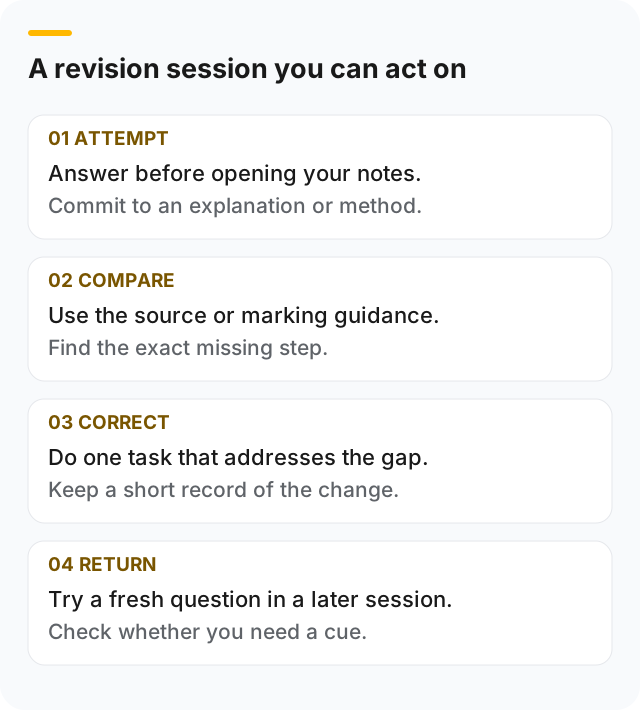
Move through the cycle for one small topic. A mistake determines the next task; it does not require rewriting every note.
Adapt retrieval to the subject
Biology: retrieve relationships as well as labels
Draw a simple process from memory, label it, then explain what each arrow means. Compare it with your course diagram and correct missing stages. Follow with a question about what would change if one condition changed. A labelled picture alone may not show that you can explain the process.
English Literature: practise an argument
Choose a question, write a claim, select evidence you can verify in the text, and explain how it supports that claim. Check whether your paragraph answers the question rather than retelling the plot. The Macbeth revision guide can help orient a topic, but check quotations in the play itself.
University lectures: start with the learning outcome
Turn “understand this week’s lecture” into a task such as “compare these two explanations using one example each.” Attempt the comparison before rereading the slides. Record whether the gap was a missing fact, an unclear relationship, or an example you could not explain. Those gaps call for different follow-up work.
Build a week you can actually repeat
Start with the time you have, then select a manageable number of outcomes. The plan below is an illustration of distributing attempts, not a research-tested schedule or a promise about memory.
| Session | Main task | What carries forward |
|---|---|---|
| First | Learn one small topic and attempt a question | A checked explanation and one identified gap |
| Next available session | Answer again before opening notes | Any point still missing |
| Later in the week | Mix that topic with a related, learned topic | Errors in choosing or applying a method |
| End of the week | Attempt a relevant exam-style question | One priority for the following week |
If you miss a session, resume with a short attempt and adjust the remaining plan. Do not double every task to “repay” the missed day. If the exam is near, prioritise gaps in required material and realistic question practice rather than building an elaborate new note system.
Troubleshoot revision that feels busy but goes nowhere
You repeatedly recognise a flashcard answer. Make sure the answer is hidden until you have committed to a response. Say or write the answer, then compare. Familiarity while reading is a different task from producing it.
Every question feels impossible. The set may be too broad or you may need an initial explanation. Return to one worked example, attempt one part, and gradually remove the support. Testing is not a replacement for being taught unfamiliar material.
Your mistake log is growing without changing your sessions. Choose one entry and do its correction task. Recheck it later before archiving it. A log is useful only when it changes the work you do next.
You spend most of the session formatting. Keep only formatting that helps you locate, compare or test an idea. The exam-note guide provides a compact template so note design does not become the whole activity.
AI keeps generating more material than you can review. Work with one outcome at a time and verify the answers before practising. Use the AI-output checking guide when a generated explanation or citation is uncertain.
Measure what you can do after a delay
At the end of the week, choose a few comparable questions and attempt them without notes. Record whether you answered independently, needed a cue, or needed the worked solution. Compare your explanation with the source or marking guidance, including units, conditions and reasoning.
This is a practical self-check, not a controlled test of a study method. Different question difficulty, prior knowledge and available time affect the result. Its purpose is to decide what to practise next. Pages read, hours seated and cards created can describe effort, but they do not establish that you can use the material.
How Aripsy fits into this workflow
Aripsy can turn pasted study material into notes and flashcards. Signed-in Free users have a document-upload trial; ongoing PDF, PowerPoint and Word uploads are available on Pro. Check the current plan details before choosing a workflow. Document text extraction can miss complex visuals or formatting, so compare the result with the original.
A safe workflow is:
- Start from your own notes, textbook extract, or class material.
- Generate a first draft of notes or recall questions.
- Check important facts against the source.
- Edit weak cards or vague questions.
- Practise retrieval and update your mistake log.
AI reduces friction, but judgement still matters.
Sources and further reading
- Dunlosky and colleagues: Improving Students’ Learning With Effective Learning Techniques
- The Learning Scientists: Six Strategies for Effective Learning
FAQ
What is the best study technique for exams?
There is no single best technique for every student or subject. Active recall, spaced practice, and past-paper review are usually a strong starting point because they make you retrieve and apply information.
Is re-reading notes useless?
No. Re-reading can help you understand a topic at first, but it should not be the whole revision plan. After reading, test yourself and check what you missed.
Can AI study tools improve my revision?
AI tools can help create notes, flashcards, and practice questions from your material. They should be used as a study aid, with important facts reviewed against your source material, syllabus, or mark scheme.
Keep exploring
Learning Science
Use active recall, spaced practice, flashcards, and mistake review as parts of a realistic revision routine.
Explore Learning Science guides
Written by
Aripsy Study Team
The Aripsy Study Team creates practical revision guides designed to support learning, source checking, and active practice.