AI Textbook to Flashcards Generator
Convert heavy textbook chapters into atomic active recall flashcards. Upload text-based PDF sections on Pro or paste text on Free, then export verified cards as an Anki-importable tab-separated .txt file on Pro.
Paste
Free text
3 formats
PDF · PPTX · DOCX
Export
By plan
Free includes limited flashcards; Pro has no separate flashcard cap within the 300 monthly AI-generation allowance.
Auto-detect
Auto
General
Free includes limited flashcards; Pro has no separate flashcard cap within the 300 monthly AI-generation allowance.
Short answer
How does Aripsy turn textbook sections into flashcards?
Convert heavy textbook chapters into atomic active recall flashcards. Upload text-based PDF sections on Pro or paste text on Free, then export verified cards as an Anki-importable tab-separated .txt file on Pro.
Best input
Paste a chapter section, lecture notes, article extract, or copied PDF text that you want to turn into study notes.
Responsible use
Use Aripsy as revision support alongside your source material, specification, or mark scheme.
How Aripsy helps you study this material
Convert heavy textbook chapters into atomic active recall flashcards. Upload text-based PDF sections on Pro or paste text on Free, then export verified cards as an Anki-importable tab-separated .txt file on Pro.
Why use this tool?
How to create flashcards from notes
Common Questions
Can Aripsy convert textbook PDFs into flashcards?
Can I export textbook flashcards to Anki?
Should I upload an entire textbook at once?
How many flashcards can I generate?
Can Aripsy turn a textbook document into flashcards?
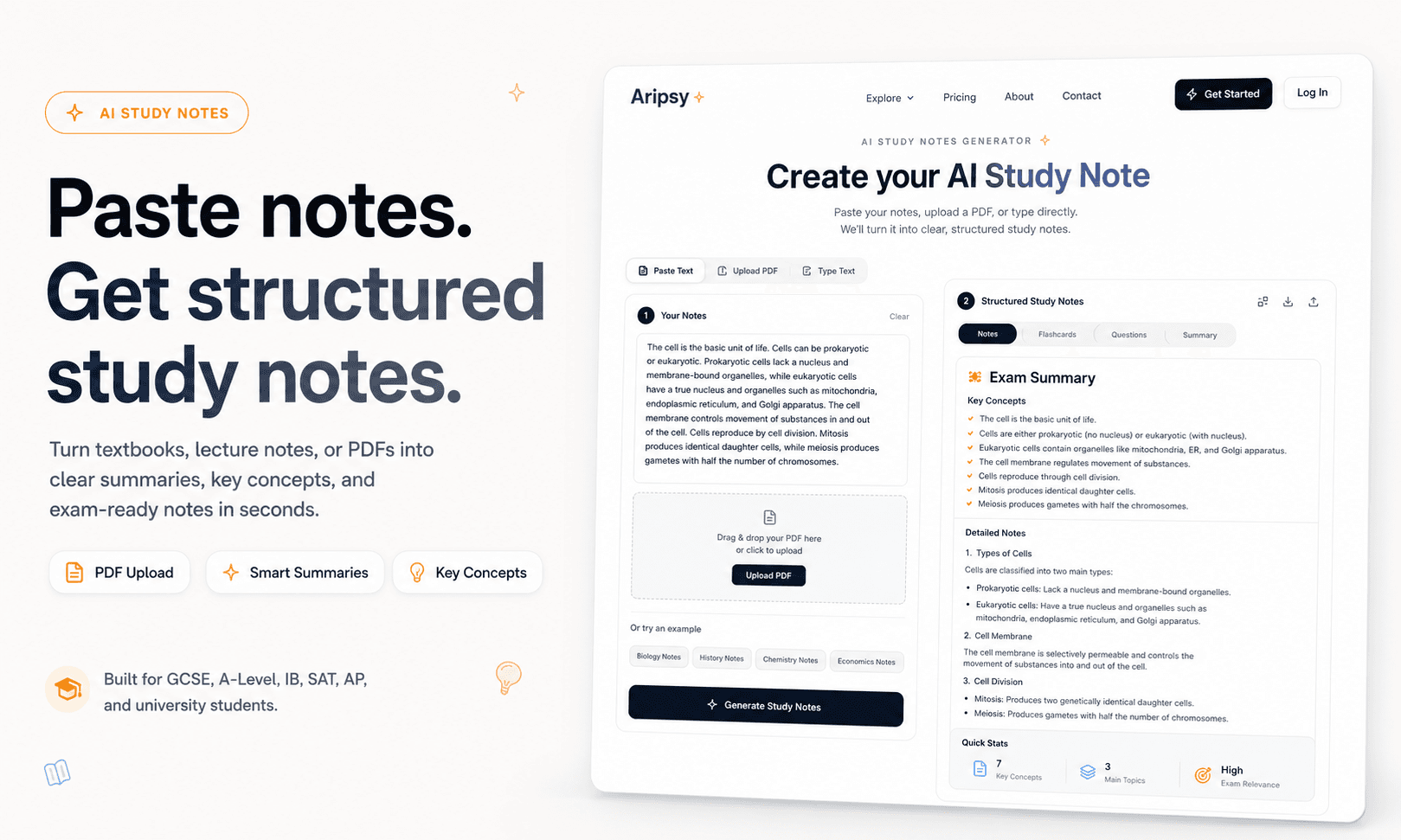
Product workflow preview
What the workflow looks like in Aripsy
Convert dense textbook chapters and reading extracts into active recall flashcards with automated card generation and an Anki-importable tab-separated .txt export on Pro. The screenshot shows the same Aripsy workflow students use to add material, choose study settings, generate notes, then build recall practice from the saved session.
Why convert textbook chapters into flashcards?
Textbooks are built for comprehensive reading, not rapid revision. Highlighting or rereading 50-page chapters builds false familiarity without strengthening memory. Converting chapters into atomic flashcards isolates core definitions, process steps, formulas, and named studies for active testing.
How Aripsy processes textbook material
Aripsy analyzes your textbook text or PDF chapter extract, identifies testable concepts, and creates front-and-back flashcard prompts. Each card tests one concept at a time—preventing cognitive overload and keeping cards easy to mark right or wrong.
Atomic flashcard quality rules
Effective textbook cards follow the rule of atomicity: one question, one answer. Broad prompts like "Explain Photosynthesis" are broken down into targeted questions about light-dependent reactions, photolysis, ATP production, and Calvin cycle steps.
Export flashcards to Anki for spaced repetition
Once generated and verified against your course specification, Pro users can export a tab-separated .txt file for import into Anki. Map the front and back fields during import, then use Anki for long-term spaced repetition scheduling.
Checking generated cards against your syllabus
Treat generated flashcards as drafts. Before memorizing, verify that definitions, unit labels, and technical terms match your specific exam board mark scheme (e.g. AQA, Edexcel, IB, AP, SAT, or university syllabus).
Useful student workflows
Chapter section processing
Paste a 3 to 5 page textbook section to generate focused atomic question-and-answer flashcards.
Anki deck creation
Generate verified card sets from textbook material and export an Anki-importable tab-separated .txt file on Pro.
Pre-exam active recall
Review key terms, definitions, process steps, and formulas before a topic test or mock exam.
The rule of atomicity in textbook flashcards
A high-yield flashcard tests one retrievable concept at a time. Asking broad questions like "Explain Photosynthesis" forces you to reread long answers rather than testing memory. Aripsy splits complex textbook chapters into single-target questions covering definitions, inputs, outputs, process steps, and common exam mistakes.
Processing textbook documents responsibly
Pro users can upload PDF, PowerPoint (.pptx), or Word (.docx) textbook material up to 15MB. For best results, use individual chapters or section headings rather than full 500-page volumes. This keeps card outputs tightly aligned with your immediate study targets and prevents context truncation.
Verifying generated cards against your mark scheme
AI flashcards are drafts. Before relying on cards for serious revision, review each answer against your course textbook, mark scheme, or specification (AQA, Edexcel, IB, AP, SAT). Edit any wording that omits required keywords or unit symbols.
Sources and further reading
These independent education resources inform the study habits discussed on this page. Always follow your teacher, tutor, specification, or official exam guidance first.
Reading textbooks effectively
Practical advice for previewing, questioning, and reviewing textbook chapters.
The Learning ScientistsRetrieval practice
Explains why pulling answers from memory is usually stronger than rereading notes.
The Learning ScientistsSpaced practice
Useful background for turning notes into flashcards and revisiting them over time.
Ready to revise with less friction?
Start with your own material and build a clearer revision workflow.
Free includes limited flashcards; Pro has no separate flashcard cap within the 300 monthly AI-generation allowance.
Supported Subjects
Biology, Chemistry, Physics, Mathematics, History, Geography, Economics, Business, Psychology, Computer Science and English Literature.