AQA A-Level Biology Revision Notes, Flashcards & Practice Questions
Aripsy turns your AQA A-Level Biology notes, textbook sections, practical records, or essay plans into structured revision notes, flashcards, and practice prompts. Paste one topic or upload a supported PDF, PowerPoint (.pptx), or Word (.docx) file on Pro, then revise with source checking and active recall.
AQA
A-Level
Specification topics
Biology
Exam questions
A-Level
Biology
hard
AQA
Turn one focused source into structured notes, key concepts, and recall prompts, then continue in the full study tool.
Short answer
How can Aripsy help me revise AQA A-Level Biology?
Aripsy turns your AQA A-Level Biology notes, textbook sections, practical records, or essay plans into structured revision notes, flashcards, and practice prompts. Paste one topic or upload a supported PDF, PowerPoint (.pptx), or Word (.docx) file on Pro, then revise with source checking and active recall.
Best input
Biological molecules: proteins are polymers of amino acids joined by peptide bonds. Enzyme activity depends on active site shape, substrate concentration, pH, and temperature. High temperature can denature an enzyme by changing tertiary structure.
Responsible use
Use Aripsy alongside the current AQA A-Level Biology specification, practical endorsement records, class notes, textbooks, and past-paper mark schemes. Check definitions, calculations, required practical wording, and essay plans before revision.
How Aripsy helps you study this material
Aripsy turns your AQA A-Level Biology notes, textbook sections, practical records, or essay plans into structured revision notes, flashcards, and practice prompts. Paste one topic or upload a supported PDF, PowerPoint (.pptx), or Word (.docx) file on Pro, then revise with source checking and active recall.
Why use this tool?
How to create study notes from your material
Common Questions
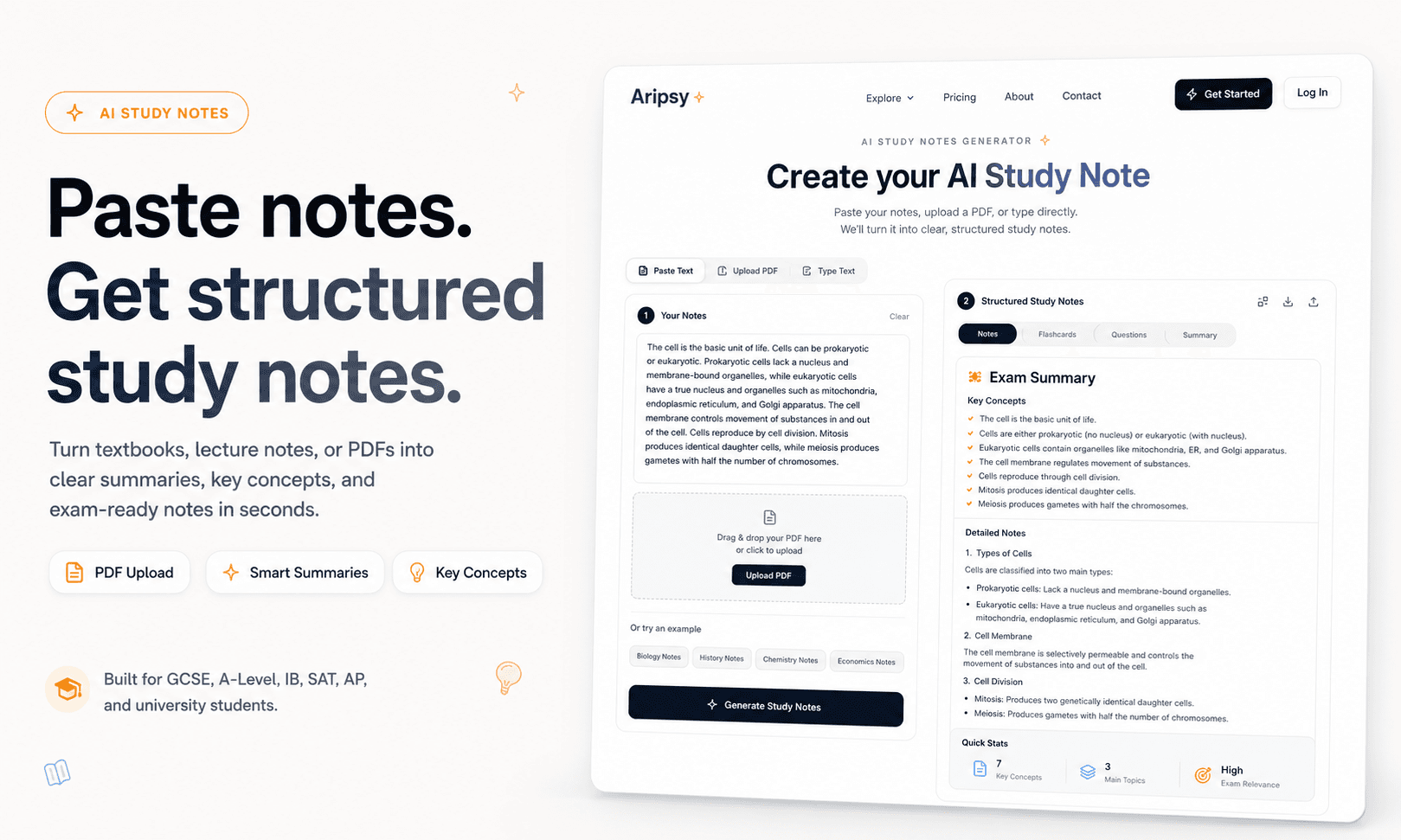
Product workflow preview
What the workflow looks like in Aripsy
A-Level Biology demands deep conceptual understanding alongside precise recall of biochemical pathways, genetic mechanisms, and experimental methodology. The screenshot shows the same Aripsy workflow students use to add material, choose study settings, generate notes, then build recall practice from the saved session.
Use the 7402 specification as your checklist
The AQA A-Level course has eight content areas. Sections 3.1–3.4 are shared with AS; sections 3.5–3.8 add A-Level content. Match each note to the current AQA subject-content page and distinguish required content from opportunities for developing skills. This page offers a revision workflow and examples, not a complete specification textbook.
Worked enzyme explanation and a practical check
Start with the note “temperature affects enzyme activity.” Improve it by explaining that rising temperature initially increases particle movement and successful collisions; sufficiently high temperatures can disrupt interactions maintaining the enzyme’s structure, changing the active site. Do not say every temperature increase denatures an enzyme. Recall prompt: why can the rate rise before falling? Practical prompt: when investigating temperature, why keep pH and concentrations controlled? Explain how changing more than one variable makes the temperature effect harder to interpret.
Check a calculation before memorising it
Illustrative microscopy task: an image measures 30 mm and the actual structure is 15 micrometres. Convert 30 mm to 30,000 micrometres, then divide image size by actual size: magnification = 2,000. Magnification has no unit. A note saying 30 ÷ 15 = 2 has skipped the unit conversion. Practise the reverse calculation with a new image and record unit mistakes separately from biology mistakes.
What is covered in AQA A-Level Biology?
AQA A-Level Biology revision includes molecular biology, cells, exchange and transport, energy transfer, genetics, ecology, control systems, gene expression, practical skills, data handling, and synoptic explanations. Aripsy helps students turn their own topic notes into shorter explanations and recall prompts.
Required practical and data-skills revision
Useful inputs include practical methods, variable tables, risk notes, graph examples, statistical test reminders, microscopy calculations, enzyme data, and ecology sampling results. Generated notes should keep method, controls, data handling, and evaluation wording clear.
Sample A-Level Biology flashcards
Example cards include: What is tertiary structure? The overall three-dimensional folding of a polypeptide caused by interactions between R groups. Why can high temperature denature enzymes? It disrupts bonds maintaining tertiary structure and changes the active site shape.
Common mistakes to check before revising
Students often write GCSE-level definitions, skip units in calculations, confuse correlation with causation, or describe practical results without linking them to evidence. Generated notes should be checked against the current specification, class notes, and mark schemes.
How to revise AQA Biology with Aripsy
Use one topic or practical at a time. Paste notes, generate a structured summary, verify key facts, then create flashcards, MCQs, or essay prompts from the corrected material.
Using AI for synoptic Biology revision
Synoptic revision needs links across topics. Use Aripsy to organize source material and generate prompt cards, but practise full explanations and essays yourself using mark schemes and course guidance.
Useful student workflows
Biochemistry & Molecular Biology
Structure notes on protein structure, enzyme kinetics, DNA replication, transcription, and translation into detailed molecular-level revision cards with diagrams and process steps.
Genetics & Evolution
Generate flashcards covering inheritance patterns, chi-squared tests, Hardy-Weinberg equilibrium, speciation mechanisms, and gene technology applications.
Synoptic Essay Preparation
Create cross-topic revision prompts that link concepts from different specification areas for AQA Paper 3 synoptic essay practice.
Why A-Level Biology pages need more than topic names
A-Level Biology revision depends on precise vocabulary, data interpretation, practical understanding, and connections between modules. A useful page should include practical checks, realistic flashcards, common mistake warnings, and source verification rather than simply swapping "Biology" into a generic notes page.
What to paste for better AQA Biology notes
The best input is a focused textbook section, class handout, practical method, corrected past-paper answer, graph explanation, or essay plan. Include definitions, diagrams described in words, data values, and mark-scheme corrections where possible so generated notes stay specific.
Turning Biology notes into active recall
After checking generated notes, turn definitions into flashcards, practicals into variable prompts, graphs into interpretation questions, and essay plans into retrieval cards. This keeps revision active and helps reveal weak links before past-paper practice.
Mastering the AQA A-Level Biology Specification
The current AQA A-Level Biology specification (7402) has eight major topic areas. Paper 1 assesses topics 1–4, Paper 2 assesses topics 5–8, and Paper 3 can assess all eight topics alongside practical techniques, experimental-data analysis, and a 25-mark essay. A-Level Biology requires students to understand mechanisms, apply mathematical and practical skills, interpret evidence, and connect ideas across the specification. Aripsy helps break focused source material into testable recall units that build towards this integrated understanding.
Active Recall for Biochemical Pathways
Pathways such as glycolysis, the Krebs cycle, oxidative phosphorylation, the Calvin cycle, and the light-dependent reactions contain numerous intermediate molecules, enzymes, and cofactors. Rereading alone does not show whether you can reconstruct a pathway without cues. Aripsy generates pathway flashcards that test each step individually: what substrate enters, what enzyme acts, what products leave, and what energy carriers are involved. By testing yourself on individual steps before attempting to recall the entire pathway, you can identify missing steps before attempting an exam-style question.
Preparing for the Synoptic Essay
AQA Paper 3 includes an essay worth 25 marks where students must link biological concepts across the entire specification. The essay title is deliberately broad (e.g. "The importance of shapes fitting together in biology") to test whether students can connect molecular, cellular, organism, and ecosystem-level examples. Use Aripsy to create cross-topic revision prompts that practise this integration skill. For each major concept (enzymes, membranes, DNA, hormones), generate a card listing examples from at least three different specification areas. Then practise a full response and compare it with official assessment guidance.
Sources and further reading
These independent education resources inform the study habits discussed on this page. Always follow your teacher, tutor, specification, or official exam guidance first.
AQA A-Level Biology Specification (7402)
Official A-Level Biology specification with topic content, practical endorsement requirements, and assessment structure.
Royal Society of BiologyRoyal Society of Biology school educators
Professional biology education resources and curriculum support for A-Level students and teachers.
The Learning ScientistsRetrieval practice
Explains why pulling answers from memory is usually stronger than rereading notes.
Topics supported
Ready to revise with less friction?
Start with your own material and build a clearer revision workflow.
Turn one focused source into structured notes, key concepts, and recall prompts, then continue in the full study tool.
Supported Subjects
Biology, Chemistry, Physics, Mathematics, History, Geography, Economics, Business, Psychology, Computer Science and English Literature.