AQA GCSE Maths Revision Notes, Flashcards & Practice Questions
Aripsy turns your AQA GCSE Maths notes, worksheets, worked examples, or class handouts into revision notes, method flashcards, and practice questions. Paste one topic or upload a supported PDF, PowerPoint (.pptx), or Word (.docx) file on Pro, then revise number, algebra, ratio, geometry, statistics, and probability with active recall.
AQA
GCSE
Subject topics
Mathematics
Exam practice
GCSE
Mathematics
GCSE / SAT
AQA
Turn one focused source into structured notes, key concepts, and recall prompts, then continue in the full study tool.
Short answer
How can Aripsy help me revise AQA GCSE Mathematics?
Aripsy turns your AQA GCSE Maths notes, worksheets, worked examples, or class handouts into revision notes, method flashcards, and practice questions. Paste one topic or upload a supported PDF, PowerPoint (.pptx), or Word (.docx) file on Pro, then revise number, algebra, ratio, geometry, statistics, and probability with active recall.
Best input
Algebra: expand brackets by multiplying each term inside the bracket. Factorising reverses expansion by finding common factors. Solving linear equations means isolating the unknown while doing the same operation to both sides.
Responsible use
Use Aripsy alongside your AQA specification, class notes, calculator guidance, formula sheet, and past-paper mark schemes. Check every method and final answer before revision.
How Aripsy helps you study this material
Aripsy turns your AQA GCSE Maths notes, worksheets, worked examples, or class handouts into revision notes, method flashcards, and practice questions. Paste one topic or upload a supported PDF, PowerPoint (.pptx), or Word (.docx) file on Pro, then revise number, algebra, ratio, geometry, statistics, and probability with active recall.
Why use this tool?
How to create study notes from your material
Common Questions
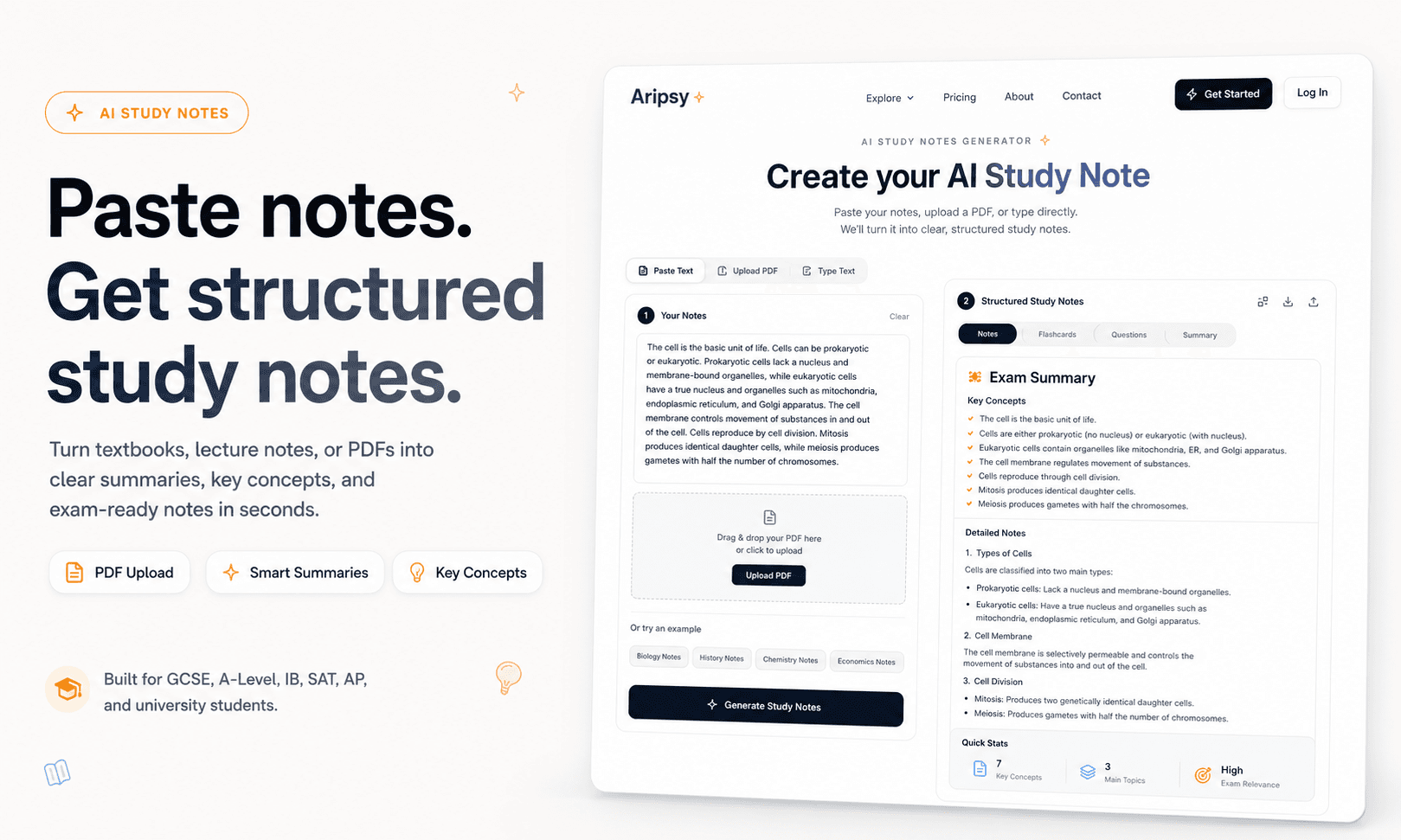
Product workflow preview
What the workflow looks like in Aripsy
GCSE Maths requires fluent recall of methods, formula application, and the ability to interpret multi-step problems under time pressure. The screenshot shows the same Aripsy workflow students use to add material, choose study settings, generate notes, then build recall practice from the saved session.
What is covered in AQA GCSE Maths?
AQA GCSE Maths is commonly revised across number, algebra, ratio and proportion, geometry and measures, probability, and statistics. Aripsy helps students turn their own notes and worked examples into shorter method explanations, formula prompts, and practice checks.
Foundation and Higher Maths revision topics
Foundation students often need secure methods for arithmetic, percentages, ratio, graphs, angles, averages, and probability. Higher students often need stronger algebra, quadratics, trigonometry, circle theorems, vectors, histograms, and proportional reasoning.
Sample AQA Maths flashcards
Example cards include: What does factorising mean? Rewriting an expression as a product of factors. What is the gradient of a straight line? The change in y divided by the change in x, often described as rise over run.
Common mistakes to check before revising
Students often lose marks by skipping method steps, rounding too early, using the wrong units, misreading scales, forgetting negative signs, or writing answers without checking whether they are reasonable. Generated notes should be checked against worked examples and mark schemes.
How to revise AQA Maths with Aripsy
Use one topic at a time. Paste class notes, corrected answers, or worked examples, generate a concise method summary, check it carefully, then create flashcards for formulae and practice questions for the same method.
Using AI for Maths without hiding the method
Maths revision should show working. Use Aripsy to organize explanations and prompts, but still practise solving questions by hand. If an AI-generated method skips a step, rewrite it before using it for revision.
Useful student workflows
Algebra & Equations Revision
Turn notes on linear equations, quadratics, simultaneous equations, and inequalities into step-by-step method cards with worked examples.
Geometry & Measures Formula Cards
Generate flashcards for area, volume, trigonometry (SOH CAH TOA), circle theorems, and Pythagoras theorem with formula recall and unit reminders.
Statistics & Probability Practice
Summarize probability rules, cumulative frequency, box plots, and histograms into recall prompts that test interpretation as well as calculation.
Why Maths pages need worked-method detail
A useful AQA GCSE Maths page should name the topic strands students actually revise and explain how to turn examples into repeatable methods. Thin pages that simply say "generate maths notes" do not help students decide what to paste, how to check the answer, or how to practise the method later.
What to paste for better AQA Maths notes
The best input is focused: one worksheet section, one set of corrected past-paper answers, one formula sheet section, or one textbook explanation. Include the question, working, and final answer where possible so the generated notes can preserve the method rather than only the result.
Turning Maths notes into active recall
After checking the generated notes, turn formulae into flashcards, method steps into sequencing prompts, and common mistakes into self-check questions. For example, quadratic revision can become factorising prompts, graph-shape checks, and questions about when to use the quadratic formula.
Covering the AQA GCSE Maths Specification Efficiently
The AQA GCSE Mathematics specification (8300) is divided into six content domains: Number, Algebra, Ratio Proportion and Rates of Change, Geometry and Measures, Probability, and Statistics. The exam consists of three papers—one non-calculator and two calculator—each lasting 1 hour 30 minutes. Unlike science subjects where students can rely on conceptual understanding, maths demands procedural fluency: knowing not just what a quadratic formula is, but being able to apply it accurately under timed conditions. Aripsy helps by converting your class notes and formula lists into active recall flashcards that test individual method steps rather than presenting passive summaries.
Higher vs Foundation Tier Revision Strategy
AQA GCSE Maths is assessed at two tiers. Foundation covers grades 1 to 5, while Higher covers grades 4 to 9. Higher tier includes additional content such as surds, algebraic fractions, iteration, trigonometric graphs, and vectors. When using Aripsy, specify your tier so generated notes focus on the content relevant to your exam. For Higher tier students, generating comparison cards between similar methods (e.g. factorising vs completing the square vs the quadratic formula) helps you choose the fastest approach in the exam.
Why Note Revision Must Lead to Problem Practice
Mathematics revision notes are a starting point, not an endpoint. Flashcards build formula recall and method recognition, but exam marks come from applying these methods to unfamiliar problems. Use Aripsy to establish confident recall of key formulae, definitions, and method steps, then spend the majority of your revision time working through official AQA past papers and mark schemes. This two-phase approach ensures you have both the knowledge and the application skill examiners reward.
Sources and further reading
These independent education resources inform the study habits discussed on this page. Always follow your teacher, tutor, specification, or official exam guidance first.
AQA GCSE Mathematics Specification (8300)
Official specification with content domains, formula sheet, and assessment structure.
BBC BitesizeBBC Bitesize AQA GCSE Maths
Topic-by-topic revision guide covering AQA GCSE Maths Higher and Foundation.
The Learning ScientistsRetrieval practice
Explains why pulling answers from memory is usually stronger than rereading notes.
Topics supported
Ready to revise with less friction?
Start with your own material and build a clearer revision workflow.
Turn one focused source into structured notes, key concepts, and recall prompts, then continue in the full study tool.
Supported Subjects
Biology, Chemistry, Physics, Mathematics, History, Geography, Economics, Business, Psychology, Computer Science and English Literature.