The Science Behind Flashcards: Active Recall and Spaced Practice
Flashcards work when you try to retrieve a specific answer before revealing it and return to the card after a delay. Their benefit comes from retrieval and spaced practice—not from copying notes onto cards or repeatedly rereading the answer.
 Aripsy Study Team
In this article10
Flashcards work best when they make you retrieve information from memory. They are not magic, and they do not guarantee that you will remember everything on exam day. But when used well, they can turn passive revision into active recall.
This guide explains how to make flashcards useful for school, university, medicine, law, languages, and exam preparation.
Quick answer: why do flashcards work?
Flashcards work when the front provides a clear cue, you attempt the answer before revealing it, and later reviews are spaced over time. Retrieval shows what you can produce independently; spacing makes you retrieve after some forgetting. Merely reading both sides or copying paragraphs onto cards removes much of that benefit.
Key takeaways
- A good flashcard tests one idea.
- The question should be clear enough that you know whether you got it right.
- Short answers are usually better than paragraph-length answers.
- Review difficult cards sooner and easier cards later.
- Flashcards should be paired with practice questions, essays, calculations, or past papers.
Why flashcards help memory
The main benefit is retrieval practice. When you look at the front of a flashcard and try to answer before checking, you practise pulling information out of memory. That is different from recognising a highlighted sentence in your notes.
For example:
Weak card:
Photosynthesis.
Better card:
What are the reactants in photosynthesis?
Better card:
Why does light intensity affect the rate of photosynthesis?
The better cards ask for a specific answer. That makes review more honest.
Spaced practice: when to review cards
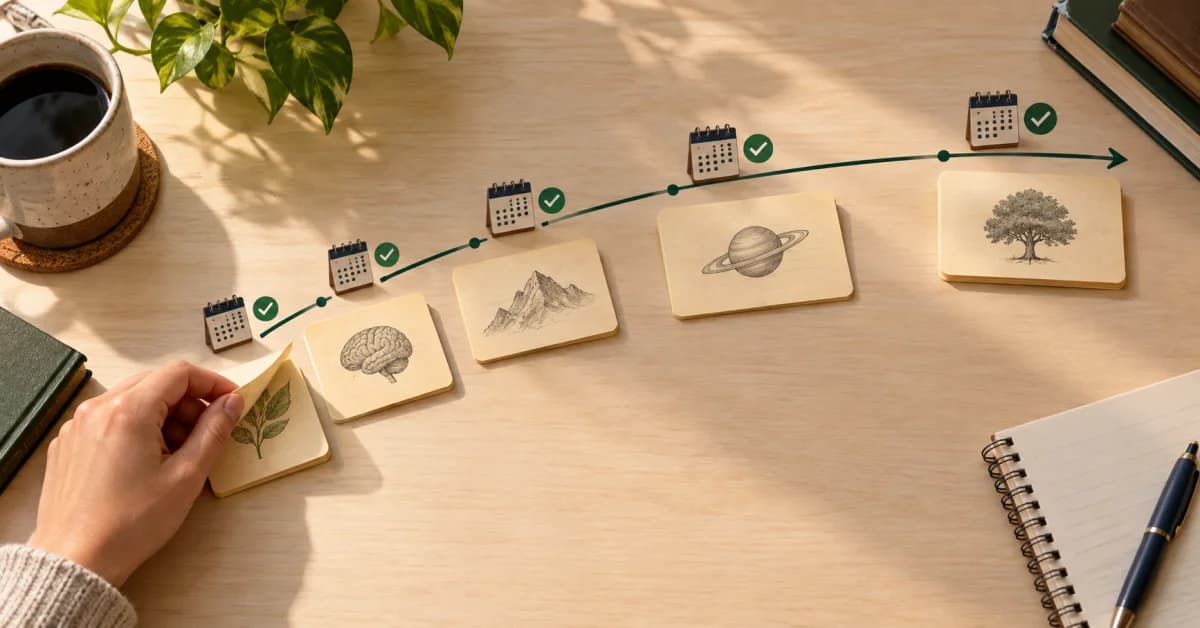
Flashcards are more useful when review is spread out. You can use a simple schedule:
| Review | Timing |
|---|---|
| First review | Same day |
| Second review | Next day |
| Third review | Three days later |
| Fourth review | One week later |
| Later reviews | Before tests and exams |
If you get a card wrong, bring it back sooner. If a card feels easy several times, space it out. This is the basic idea behind spaced repetition systems, but you do not need a complex setup to start.
How to write better flashcards
Use these rules:
- One idea per card.
- One clear answer.
- Avoid vague prompts like “Explain this topic.”
- Split long processes into steps.
- Use examples for application-heavy subjects.
- Add diagrams only when they make the idea easier to recall.
For Biology, a card might test a definition, process step, required practical, or graph trend. For Law, it might test a case principle. For Medicine, it might test a structure, function, symptom pattern, or pathway.
What flashcards are bad at
Flashcards are not enough for every task. They are weaker for:
- Long essay planning.
- Full worked solutions.
- Timed exam writing.
- Evaluating arguments.
- Applying knowledge to unfamiliar scenarios.
That does not mean you should avoid flashcards. It means you should combine them with other practice. After reviewing a deck, answer one or two exam-style questions on the same topic.
PDF to flashcards: a safer workflow
If you turn a PDF or textbook chapter into flashcards, do not generate a giant deck and trust it immediately.
Use this workflow:
- Choose one chapter, lesson, lecture, or topic.
- Generate draft flashcards.
- Remove duplicates and vague cards.
- Check definitions, formulas, dates, and mark-scheme wording.
- Add missing cards from your mistake log.
With Aripsy, Free users can paste text and generate notes or limited flashcards. Pro users can upload PDF, PowerPoint (.pptx), and Word (.docx) files up to 15MB and generate additional practice formats such as MCQs and fill-in-the-blanks.
Example: improving weak cards
Weak:
Enzymes.
Better:
What is the active site of an enzyme?
Weak:
Explain osmosis.
Better:
What is osmosis?
Better:
What happens to a plant cell in a concentrated sugar solution?
Weak:
The causes of World War One.
Better:
How did alliances contribute to tension before World War One?
The goal is to make recall precise, not to make the deck look large.
Sources and further reading
-
Nature Reviews Psychology: the science of effective learning with spacing and retrieval practice
-
American Psychological Association: Effective Learning Techniques
FAQ
Are flashcards good for exam revision?
Flashcards are useful for definitions, formulas, key facts, processes, cases, vocabulary, and common mistakes. They should be combined with practice questions and past papers for exam technique.
Should I make flashcards for every sentence?
No. Focus on high-value information: definitions, formulas, steps, causes, consequences, comparisons, and mistakes you keep making.
Are AI-generated flashcards always accurate?
No. AI-generated flashcards can be a useful first draft, but important cards should be reviewed against your notes, textbook, syllabus, or mark scheme.
Keep exploring
Science Revision
Start with Biology, Chemistry, and Physics guides built around specifications, practicals, equations, and recall.
Explore Science Revision guides
Written by
Aripsy Study Team
The Aripsy Study Team creates practical revision guides designed to support learning, source checking, and active practice.