Edexcel A-Level Economics A Revision Notes, Flashcards & Essay Plans
Aripsy turns your Edexcel A-Level Economics A (9EC0) notes, diagrams and essay plans into revision notes, flashcards and practice prompts. Paste one theme topic at a time, check definitions and diagrams against your course materials, then revise from it.
Edexcel
A-Level
Specification topics
Economics
Exam questions
A-Level
Economics
hard
Edexcel
Turn one focused source into structured notes, key concepts, and recall prompts, then continue in the full study tool.
Short answer
How can Aripsy help me revise Edexcel A-Level Economics?
Aripsy turns your Edexcel A-Level Economics A (9EC0) notes, diagrams and essay plans into revision notes, flashcards and practice prompts. Paste one theme topic at a time, check definitions and diagrams against your course materials, then revise from it.
Best input
Theme 1, market failure: a negative externality in production means the marginal social cost exceeds the marginal private cost, so the free market over-produces relative to the social optimum. Policies include indirect taxes, regulation and tradable permits.
Responsible use
Use Aripsy alongside the Edexcel A-Level Economics A (9EC0) specification, class notes, textbooks, current data and past-paper mark schemes. Check definitions, diagrams and evaluation wording before revising from generated notes.
How Aripsy helps you study this material
Aripsy turns your Edexcel A-Level Economics A (9EC0) notes, diagrams and essay plans into revision notes, flashcards and practice prompts. Paste one theme topic at a time, check definitions and diagrams against your course materials, then revise from it.
Why use this tool?
How to create study notes from your material
Common Questions
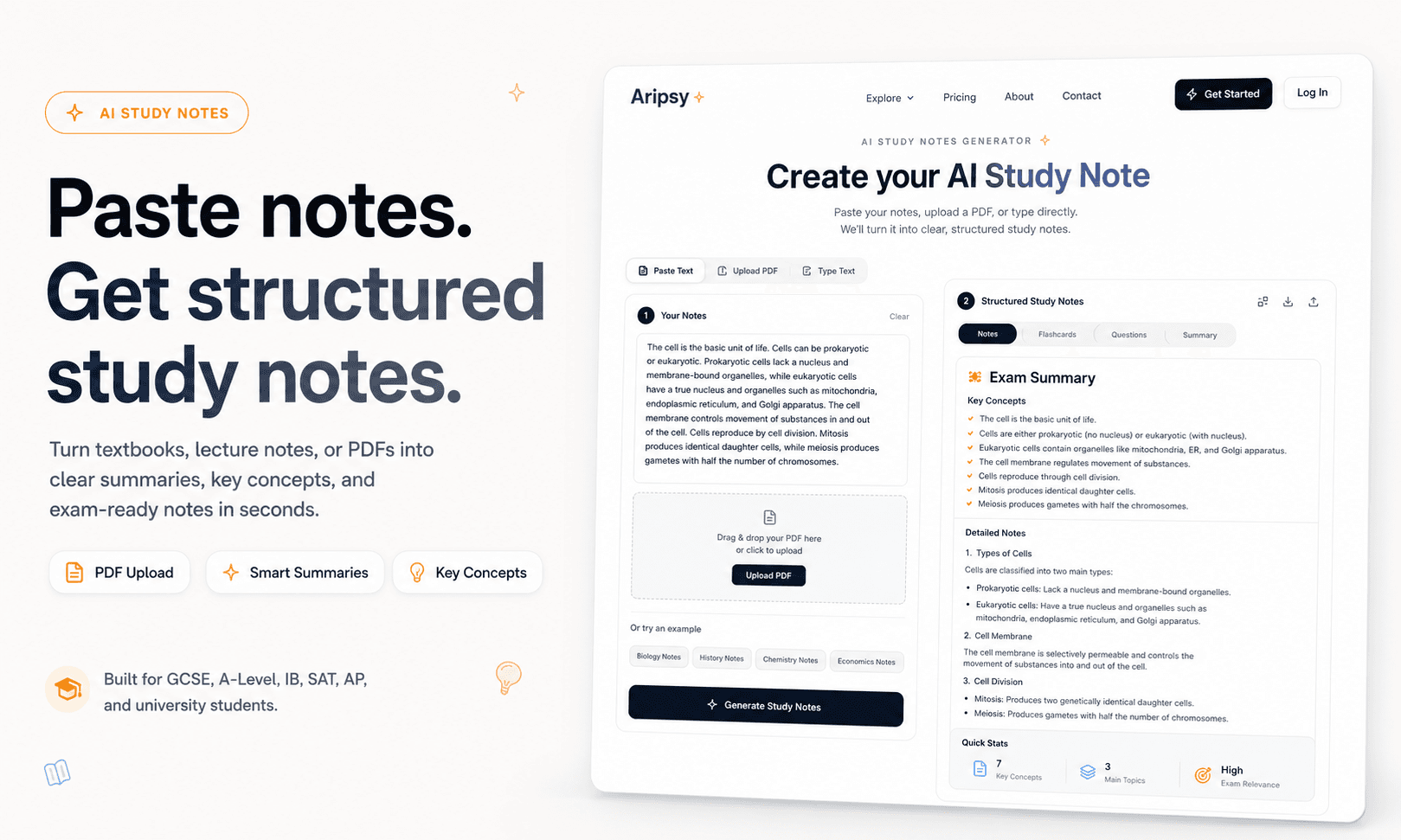
Product workflow preview
What the workflow looks like in Aripsy
Students can paste one Edexcel Economics A theme topic, choose Economics and Edexcel settings, generate notes, then turn checked definitions and diagrams into flashcards or essay prompts.
Edexcel A-Level Economics A (9EC0): papers and themes
Paper 1 Markets and business behaviour (2 hours, 100 marks, 35%): themes 1 and 3.
Paper 2 The national and global economy (2 hours, 100 marks, 35%): themes 2 and 4.
Paper 3 Microeconomics and macroeconomics (2 hours, 100 marks, 30%): all four themes, built around two data-response contexts.
Themes: 1 Introduction to markets and market failure; 2 The UK economy, performance and policies; 3 Business behaviour and the labour market; 4 A global perspective.
Papers 1 and 2 each include short questions, data response and an essay choice; the 25-mark essays are marked with levels for knowledge, application and analysis together, and for evaluation. Confirm the current paper structure with your teacher.
A 25-mark essay plan with evaluation: the minimum wage
Question: Evaluate the likely effects of a rise in the national minimum wage on the UK labour market. (25 marks)
Knowledge, application and analysis: define the minimum wage as a price floor above the equilibrium wage; draw the labour market with the floor, showing higher wages for those in work and an excess supply of labour; apply to a UK low-pay sector such as hospitality; analyse the chain from higher labour costs to reduced hiring, substitution towards automation, or higher prices.
Evaluation: the effect depends on the elasticity of demand for labour, on monopsony power where a floor can raise employment, on the size of the rise relative to the equilibrium wage, and on the time frame. Judgement: modest rises in a monopsonistic sector are unlikely to cut employment much, while large rises in competitive sectors are more likely to.
A top-level answer carries a developed chain for each point and ends with a judgement that answers the question. Aripsy marks a draft against this structure and shows where a chain stops short.
What to paste for better Economics notes
One theme topic at a time: class notes with the diagram described in words, a textbook section, a data response with its figures, or an essay plan. Include the definitions your course uses, so flashcards match the wording examiners expect.
Diagrams and chains of analysis
Paste a topic and ask for prompts that name the diagram, the shift, the new equilibrium and the effect on the variable the question is about. Marks in Economics come from the chain of reasoning, and a diagram without the explanation of what moves earns little.
Common mistakes to check before revising
Quoting a definition without the diagram, stopping the chain of analysis one step early, evaluation that lists factors without weighing them, and no final judgement. Generate notes one theme topic at a time and check them against the specification.
How to revise Edexcel Economics A with Aripsy
Make a pack per theme topic, turn definitions and diagrams into flashcards, then use the practice prompts to write chains of analysis and short evaluations. Two weeks before an exam, switch to past-paper essays and data responses and mark them against the levels.
Useful student workflows
Theme notes by paper
Turn notes on themes 1 to 4 into concise summaries mapped to Paper 1, Paper 2 and the synoptic Paper 3.
Diagram and definition cards
Convert definitions and diagram descriptions into flashcards that ask for the diagram, the shift and its effect.
Essay planning
Use checked notes to build 25-mark plans with knowledge, application, analysis and evaluation, and a judgement at the end.
Why the theme map matters
Themes 1 and 3 are micro, themes 2 and 4 are macro, and Paper 3 mixes them. Revising by paper keeps each theme at the weight the exam gives it.
Evaluation is weighed, not listed
Edexcel levels reward evaluation that depends on something: elasticity, time frame, market structure, the size of the change. Each evaluation point should say what it depends on.
Data response is a skill
Papers 1, 2 and 3 all use data. Practise reading a figure, quoting it, and using it in the chain of analysis, which Aripsy can prompt from a pasted extract.
Sources and further reading
These independent education resources inform the study habits discussed on this page. Always follow your teacher, tutor, specification, or official exam guidance first.
Topics supported
Ready to revise with less friction?
Start with your own material and build a clearer revision workflow.
Turn one focused source into structured notes, key concepts, and recall prompts, then continue in the full study tool.
Supported Subjects
Biology, Chemistry, Physics, Mathematics, History, Geography, Economics, Business, Psychology, Computer Science and English Literature.