A-Level Revision Notes Generator
Turn dense A-Level notes into structured revision material. Aripsy helps separate definitions, examples, analysis, and practice prompts so you can revise with less friction.
Exam
A-Level
Specification topics
A-Level
Exam questions
A-Level
Auto-detect
A-Level / AP / IB
General
Turn one focused source into structured notes, key concepts, and recall prompts, then continue in the full study tool.
Short answer
How can Aripsy help me revise A-Level?
Turn dense A-Level notes into structured revision material. Aripsy helps separate definitions, examples, analysis, and practice prompts so you can revise with less friction.
Best input
Paste a chapter section, lecture notes, article extract, or copied PDF text that you want to turn into study notes.
Responsible use
Use Aripsy as revision support alongside your source material, specification, or mark scheme.
How Aripsy helps you study this material
Turn dense A-Level notes into structured revision material. Aripsy helps separate definitions, examples, analysis, and practice prompts so you can revise with less friction.
Why use this tool?
How to create study notes from your material
Common Questions
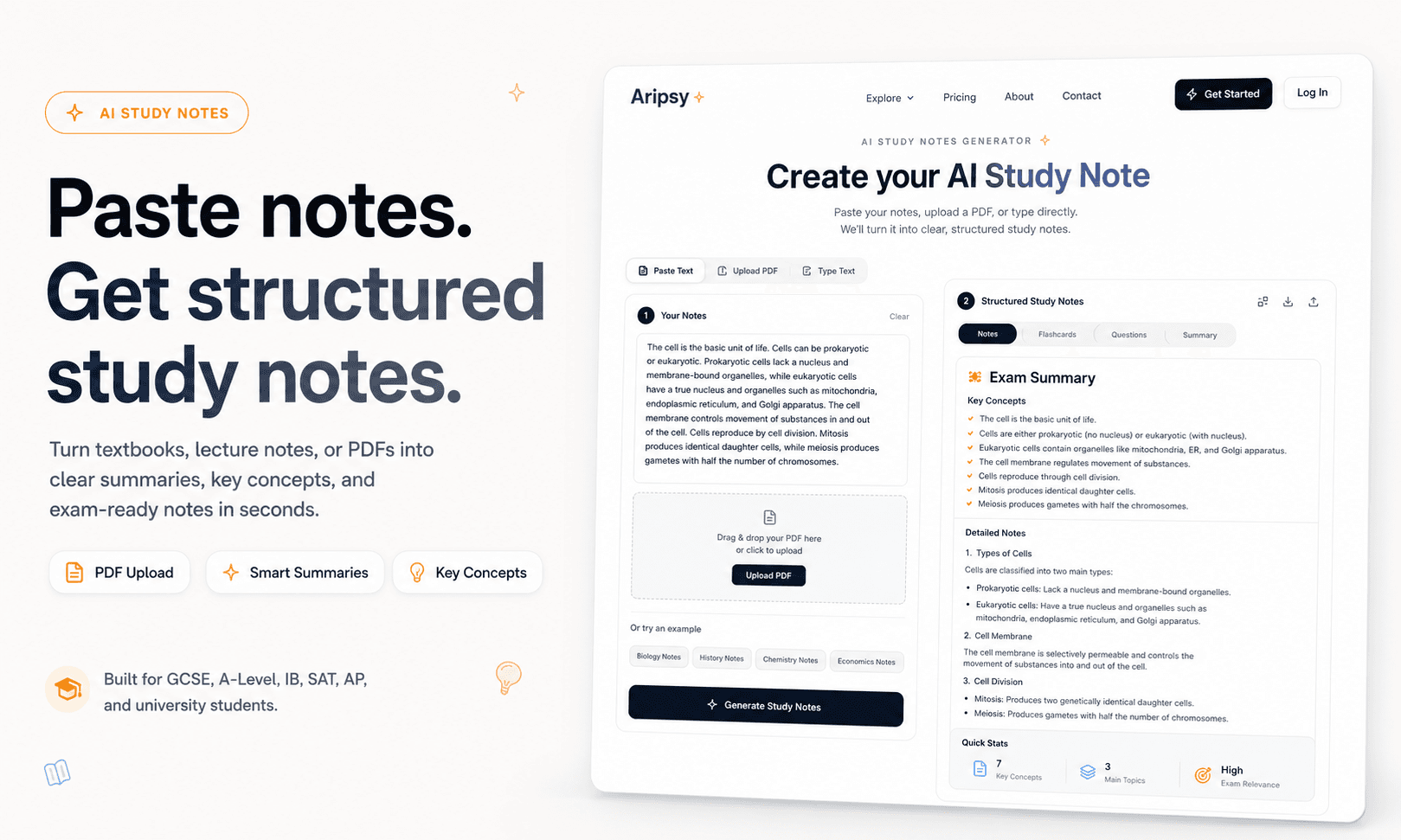
Product workflow preview
What the workflow looks like in Aripsy
A-Level students often need deeper explanations, links across topics, and precise exam language. The screenshot shows the same Aripsy workflow students use to add material, choose study settings, generate notes, then build recall practice from the saved session.
Related topics
A-Level notes from class material
Paste your class notes, textbook section, or essay-plan material. Aripsy can reorganize it into revision notes with headings, definitions, examples, and prompts. Biology students following AQA can use the AQA A-Level Biology revision notes workflow for specification topics, practical skills, data analysis, and synoptic revision.
Built for deeper course content
A-Level revision usually requires more explanation and evaluation than GCSE. Choose the advanced level setting so generated notes better match that depth.
Use active recall for heavy topics
Turn key terms, formulas, theorists, case studies, and processes into flashcards. For Pro users, MCQs and fill-in-the-blanks can add another checking layer.
Check specification expectations
Different A-Level boards use different command words and mark-scheme expectations. Verify final notes against your specification and past-paper feedback.
Useful student workflows
Synoptic revision
Connect ideas across units, such as economics diagrams, biology processes, or psychology approaches.
Essay planning notes
Convert source material into arguments, evaluation points, examples, and possible counterpoints.
Technical definitions
Clarify precise terminology in sciences, maths, law, economics, or computer science.
A-Level notes need depth and control
A-Level revision usually requires more than short facts. Students need accurate definitions, linked explanations, evidence, evaluation, and examples. Aripsy can structure long material into clearer notes, but the student still needs to check the output against specifications, textbooks, mark schemes, and tutor feedback.
How Aripsy supports advanced revision
Aripsy is useful when a topic feels too dense to start. Paste a focused section, generate a clearer version, ask AI tutor for a simpler explanation if needed, then turn the verified result into flashcards, MCQs, or fill-in-the-blank practice. Pro users can upload PDF, PowerPoint, and Word files and use longer inputs, which helps with larger A-Level handouts and slide decks.
Avoiding weak AI revision notes
Do not ask for a whole A-Level course in one generation. Split by topic, include your assessment context, and add any tutor feedback or mark-scheme wording you are allowed to use. Better input gives Aripsy a stronger source to organize, and source checking keeps the final notes honest.
Sources and further reading
These independent education resources inform the study habits discussed on this page. Always follow your teacher, tutor, specification, or official exam guidance first.
Metacognition and self-regulated learning
Evidence-informed guidance on planning, monitoring, and evaluating study.
Cornell Learning Strategies CenterThe Cornell Note Taking System
Shows a practical structure for separating notes, cues, and summaries.
The Learning ScientistsRetrieval practice
Explains why pulling answers from memory is usually stronger than rereading notes.
Ready to revise with less friction?
Start with your own material and build a clearer revision workflow.
Turn one focused source into structured notes, key concepts, and recall prompts, then continue in the full study tool.
Supported Subjects
Biology, Chemistry, Physics, Mathematics, History, Geography, Economics, Business, Psychology, Computer Science and English Literature.