AP Psychology Revision Tool for Notes & Flashcards
Turn your AP Psychology class notes and reading assignments into structured guides for the five current College Board units, focused flashcards, and AAQ or EBQ practice prompts.
College Board
AP
Course units
Psychology
Exam practice
AP
Psychology
A-Level / AP / IB
AP
Free includes 15 AI study packs per month, up to 5 per day, 5,000 words per input, notes, up to 10 flashcards per set, practice questions, a 3-question multiple-choice sample, 3 AI answer checks and 5 tutor questions per day, audio file uploads, and 1 successful document upload per month.
Short answer
How can Aripsy help me revise AP Psychology?
Turn your AP Psychology class notes and reading assignments into structured guides for the five current College Board units, focused flashcards, and AAQ or EBQ practice prompts.
Best input
Classical conditioning: Pavlov experiment with dogs. Unconditioned stimulus (food) produces unconditioned response (salivation). Conditioned stimulus (bell) produces conditioned response.
Responsible use
Use Aripsy as revision support. Review definitions, theorists, and experiment details against your College Board materials.
How Aripsy helps you study this material
Turn your AP Psychology class notes and reading assignments into structured guides for the five current College Board units, focused flashcards, and AAQ or EBQ practice prompts.
Why use this tool?
How to build a study guide
Common Questions
Product workflow preview
What the workflow looks like in Aripsy
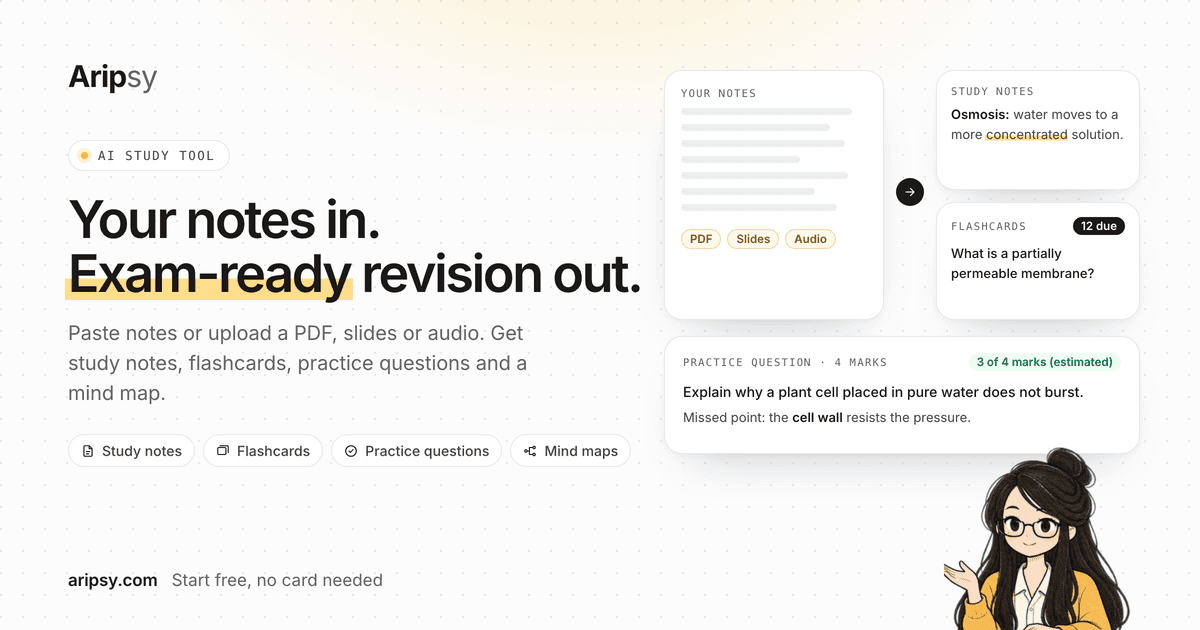
AP Psychology revision combines precise terminology, research interpretation, concept application, and free-response practice. The screenshot shows the same Aripsy workflow students use to add material, choose study settings, generate notes, then build recall practice from the saved session.
Review the five current AP Psychology units
The current College Board framework groups AP Psychology into Biological Bases of Behavior, Cognition, Development and Learning, Social Psychology and Personality, and Mental and Physical Health. Aripsy helps organize your own notes inside that structure so you can review one focused unit or topic at a time.
Differentiate concepts, theories, and research
Multiple-choice questions can require you to distinguish related psychological concepts and interpret research evidence. Use focused flashcards and comparison prompts to test definitions, applications, study designs, and data interpretation rather than only memorizing names.
Prepare for AAQ and EBQ free-response questions
The current free-response section includes an Article Analysis Question and an Evidence-Based Question. Use Aripsy to create recall and application prompts from checked class material, then practise with official College Board questions and scoring guidance.
Useful student workflows
Five-Unit College Board Review
Convert your notes from any current AP Psychology unit into a focused revision guide.
Concept & Research Flashcards
Create focused cards for psychological concepts, theories, study designs, and research findings.
AAQ & EBQ Preparation
Build prompts that practise article analysis, evidence use, data interpretation, and psychological argumentation.
Organizing the current AP Psychology framework
The current AP Psychology framework has five commonly taught units: Biological Bases of Behavior, Cognition, Development and Learning, Social Psychology and Personality, and Mental and Physical Health. Aripsy helps students turn their own class slides and reading notes into focused guides for one unit or topic at a time.
Studying concepts alongside research skills
Current AP Psychology assessment includes concept application, research methods and design, data interpretation, and argumentation. Build flashcards for terminology, then add prompts that ask you to evaluate a study design, interpret evidence, or apply a concept to a scenario.
Using active recall for AAQ and EBQ practice
The free-response section uses an Article Analysis Question and an Evidence-Based Question. Use Aripsy to create practice prompts from material you have checked, then compare your work with official College Board questions and scoring guidance so AI-generated practice does not become a substitute for the real exam format.
Sources and further reading
These independent education resources inform the study habits discussed on this page. Always follow your teacher, tutor, specification, or official exam guidance first.
Topics supported
Ready to revise with less friction?
Start with your own material and build a clearer revision workflow.
Free includes 15 AI study packs per month, up to 5 per day, 5,000 words per input, notes, up to 10 flashcards per set, practice questions, a 3-question multiple-choice sample, 3 AI answer checks and 5 tutor questions per day, audio file uploads, and 1 successful document upload per month.
Supported Subjects
Biology, Chemistry, Physics, Mathematics, History, Geography, Economics, Business, Psychology, Computer Science and English Literature.