AP Chemistry Multiple-Choice Practice: Questions, Answers and Study Tips
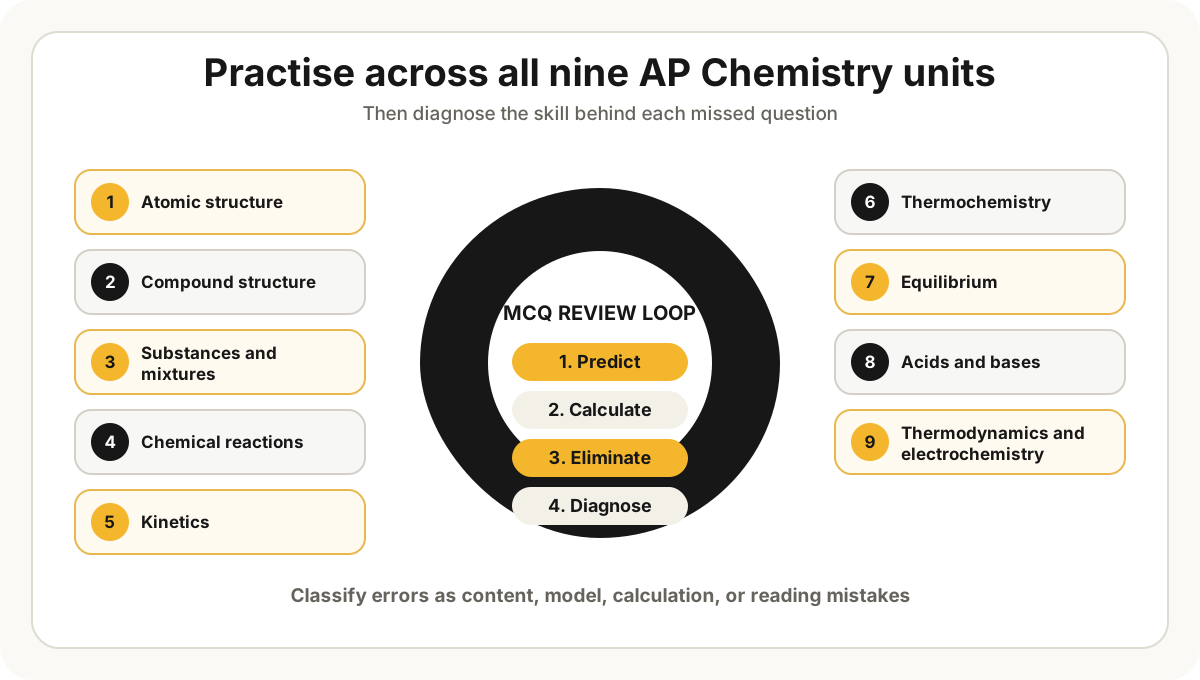
Use these 20 original AP Chemistry MCQs as a timed 30-minute set, then review the worked answers and classify each error as a content, model, calculation, or reading mistake. The set samples all nine current course units but is not an official College Board exam.
 Aripsy Study Team
In this article9
AP Chemistry multiple-choice questions rarely test a formula in isolation. They combine chemical models, data, proportional reasoning, experimental choices, and explanations of why one option works while three plausible distractors do not.
This original 20-question set samples all nine units in the current AP Chemistry course framework. Attempt it without notes, then use the worked answers to diagnose the reason for every error.
Important: these are independent practice questions written for this guide. They are not official College Board questions and are not endorsed by College Board. Use the current AP Chemistry Course and Exam Description, your teacher, AP Classroom, and Bluebook previews for authoritative exam preparation.
Quick answer: how should you use this AP Chemistry MCQ set?
Set a 30-minute timer for the 20 questions, use a permitted scientific or graphing calculator, and answer every item. That matches the current Section I pace of about 90 seconds per question. Then review each explanation and label the error:
- Content: a definition, trend, reaction, or relationship was missing.
- Model: you misread a particle diagram, graph, molecular shape, or symbolic representation.
- Calculation: the setup, units, sign, magnitude, or arithmetic failed.
- Reading: you solved a different question from the one asked.
The official AP Chemistry exam page currently describes Section I as 60 questions in 1 hour 30 minutes, worth 50% of the exam score. It includes both standalone questions and sets tied to a diagram or data presentation. Calculators are permitted and recommended.
What the current AP Chemistry MCQ section tests
The College Board course framework organizes AP Chemistry into nine units. It gives the largest multiple-choice weighting to Unit 3: Properties of Substances and Mixtures (18%–22%) and Unit 8: Acids and Bases (11%–15%). The other seven units are each listed at 7%–9%.
The section is also strongly quantitative: the current framework assigns 35%–42% of multiple-choice weighting to mathematical routines and 23%–30% to model analysis. Memorising vocabulary without interpreting representations and setting up calculations is therefore not enough.
AP Chemistry multiple-choice questions
Record one answer for every question before opening the explanations.
1. Atomic structure: isotope abundance
An element has two naturally occurring isotopes. One has a mass of 35.0 u and an abundance of 75.0%; the other has a mass of 37.0 u and an abundance of 25.0%. What is the average atomic mass?
A. 35.0 u
B. 35.5 u
C. 36.0 u
D. 36.5 u
2. Atomic structure: photoelectron spectroscopy
In a photoelectron spectrum, which electrons generally appear at the greatest binding energy?
A. Valence electrons in the highest occupied shell
B. Electrons in a half-filled subshell
C. Core 1s electrons
D. Electrons experiencing the greatest shielding
3. Periodic trends
Why is the first ionisation energy of Al lower than that of Mg?
A. Al has fewer occupied energy levels.
B. The electron removed from Al is in a higher-energy 3p subshell.
C. Mg has a larger nuclear charge.
D. The electron removed from Mg experiences more shielding.
4. Intermolecular forces
Which pure substance is expected to have the strongest intermolecular attractions?
A. CH₄
B. CO₂
C. NH₃
D. HCl
5. Molecular structure
Which description of SO₂ is correct?
A. Linear and nonpolar
B. Linear and polar
C. Bent and nonpolar
D. Bent and polar
6. Stoichiometry and limiting reactants
Al reacts with Cl₂ according to 2 Al + 3 Cl₂ → 2 AlCl₃. If 5.40 g Al reacts with 10.65 g Cl₂, which statement is correct? Use molar masses Al = 27.0 g mol⁻¹ and Cl₂ = 71.0 g mol⁻¹.
A. Al is limiting and 0.200 mol AlCl₃ forms.
B. Al is limiting and 0.100 mol AlCl₃ forms.
C. Cl₂ is limiting and 0.100 mol AlCl₃ forms.
D. Cl₂ is limiting and 0.150 mol AlCl₃ forms.
7. Solutions
What is the concentration after 50.0 mL of 2.00 M NaCl is diluted to a total volume of 250.0 mL?
A. 0.100 M
B. 0.400 M
C. 2.00 M
D. 10.0 M
8. Net ionic equations
Equal volumes of aqueous AgNO₃ and NaCl are mixed, and a precipitate forms. Which is the net ionic equation?
A. AgNO₃(aq) + NaCl(aq) → AgCl(s) + NaNO₃(aq)
B. Ag⁺(aq) + Cl⁻(aq) → AgCl(s)
C. Na⁺(aq) + NO₃⁻(aq) → NaNO₃(s)
D. Ag⁺(aq) + NO₃⁻(aq) → AgNO₃(s)
9. Gases
A sealed gas sample is kept at constant temperature. Its volume is reduced from 2.0 L to 1.0 L. What happens to its pressure?
A. It halves.
B. It remains constant.
C. It doubles.
D. It quadruples.
10. Calorimetry
A reaction warms 100.0 g of water by 5.00°C. Assume the water absorbs all the heat and use c = 4.184 J g⁻¹ °C⁻¹. What is the heat of the reaction for the amount reacted?
A. −2.09 kJ
B. −0.478 kJ
C. +0.478 kJ
D. +2.09 kJ
11. Kinetics: rate law
Doubling [A] while holding [B] constant makes the initial rate four times larger. Doubling [B] while holding [A] constant does not change the rate. Which rate law fits the evidence?
A. rate = k[A]
B. rate = k[A]²
C. rate = k[A][B]
D. rate = k[A]²[B]
12. Kinetics: catalysts
Which statement about a catalyst is correct?
A. It increases the equilibrium constant.
B. It makes the forward reaction exothermic.
C. It lowers the activation energy for both forward and reverse reactions.
D. It changes the equilibrium composition toward products.
13. Equilibrium expressions
For N₂O₄(g) ⇌ 2 NO₂(g), which expression is correct?
A. Kc = [N₂O₄]/[NO₂]²
B. Kc = 2[NO₂]/[N₂O₄]
C. Kc = [NO₂]²/[N₂O₄]
D. Kc = [NO₂]/[N₂O₄]
14. Equilibrium shifts
At constant temperature, additional N₂O₄ is injected into a system at equilibrium for N₂O₄(g) ⇌ 2 NO₂(g). What is the immediate direction of net change?
A. Toward NO₂ until a new equilibrium is established
B. Toward N₂O₄ until all NO₂ is consumed
C. No shift because Kc is unchanged
D. No shift because N₂O₄ is a reactant
15. Weak acids
A 0.100 M monoprotic weak acid has Ka = 1.0 × 10⁻⁵. Which is the best estimate of its pH?
A. 1.00
B. 3.00
C. 5.00
D. 9.00
16. Buffers
A buffer contains equal concentrations of a weak acid HA and its conjugate base A⁻. Which relationship is true?
A. pH = ½pKa
B. pH = pKa
C. pOH = pKa
D. pH = 14 − Ka
17. Titrations
At 25°C, what is the approximate pH at the equivalence point when a strong monoprotic acid is titrated with a strong base?
A. Less than 7 because acid was present initially
B. 7 because the remaining ions do not appreciably hydrolyse
C. Greater than 7 because base was added
D. It cannot be predicted from the acid and base types.
18. Solubility equilibrium
For AgCl(s), Ksp = 1.8 × 10⁻¹⁰. What is its molar solubility in pure water?
A. 1.8 × 10⁻¹⁰ M
B. 1.3 × 10⁻⁵ M
C. 9.0 × 10⁻⁶ M
D. 1.8 × 10⁻⁵ M
19. Electrochemistry
Given E°(Cu²⁺/Cu) = +0.34 V and E°(Zn²⁺/Zn) = −0.76 V, what is E°cell for a galvanic cell in which Zn is oxidised and Cu²⁺ is reduced?
A. −1.10 V
B. −0.42 V
C. +0.42 V
D. +1.10 V
20. Thermodynamics and electrochemistry
For a galvanic cell operating under standard conditions with a positive E°cell, which statement must be true?
A. ΔG° is positive and the reaction is nonspontaneous.
B. ΔG° is negative and the reaction is thermodynamically favourable.
C. K must be less than 1.
D. The cathode is the site of oxidation.
Answer key
| Question | Answer | Unit |
|---|---|---|
| 1 | B | 1 |
| 2 | C | 1 |
| 3 | B | 1 |
| 4 | C | 3 |
| 5 | D | 2 |
| 6 | C | 4 |
| 7 | B | 3 |
| 8 | B | 4 |
| 9 | C | 3 |
| 10 | A | 6 |
| 11 | B | 5 |
| 12 | C | 5 |
| 13 | C | 7 |
| 14 | A | 7 |
| 15 | B | 8 |
| 16 | B | 8 |
| 17 | B | 8 |
| 18 | B | 7 |
| 19 | D | 9 |
| 20 | B | 9 |
Worked answers and distractor analysis
1. B — 35.5 u
Use the weighted mean: (35.0 × 0.750) + (37.0 × 0.250) = 35.5 u. Option C treats both isotopes as equally abundant.
2. C — Core 1s electrons
Core electrons are closest to the nucleus and experience the strongest attraction, so more energy is required to remove them. High binding energy should not be confused with the high principal energy level of a valence electron.
3. B — The Al electron is removed from a 3p subshell
Mg ends in 3s², whereas Al’s first removed electron is in the higher-energy 3p subshell. That subshell effect outweighs the increase in nuclear charge for this comparison.
4. C — NH₃
NH₃ forms hydrogen bonds because H is bonded to electronegative N and nitrogen has a lone pair. The other choices have dipole–dipole or London dispersion forces but not the same hydrogen-bonding network.
5. D — Bent and polar
SO₂ has three electron domains around sulfur and a lone pair that gives a bent molecular geometry. Its bond dipoles do not cancel.
6. C — Cl₂ is limiting; 0.100 mol AlCl₃ forms
There are 5.40/27.0 = 0.200 mol Al and 10.65/71.0 = 0.150 mol Cl₂. The reaction needs 3 mol Cl₂ for every 2 mol Al, so Cl₂ is limiting. Product is (2/3)(0.150) = 0.100 mol AlCl₃.
7. B — 0.400 M
Use M₁V₁ = M₂V₂: M₂ = (2.00)(50.0)/250.0 = 0.400 M. The total volume—not the added-water volume—belongs in the denominator.
8. B — Ag⁺ + Cl⁻ → AgCl(s)
Na⁺ and NO₃⁻ remain aqueous spectator ions. A complete molecular equation is not a net ionic equation.
9. C — Pressure doubles
At constant temperature and amount, Boyle’s law gives P₁V₁ = P₂V₂. Halving volume doubles collision frequency per unit area and therefore doubles pressure.
10. A — −2.09 kJ
Water absorbs q = mcΔT = (100.0)(4.184)(5.00) = 2092 J. The reaction released that energy, so qreaction = −2.09 kJ.
11. B — rate = k[A]²
A fourfold rate change when [A] doubles means second order in A because 2² = 4. No rate change when [B] doubles means zero order in B, so B does not appear in the simplified rate law.
12. C — It lowers activation energy in both directions
A catalyst provides an alternative pathway but does not change ΔG°, K, or the equilibrium composition. It helps the system reach equilibrium faster.
13. C — Kc = [NO₂]²/[N₂O₄]
Concentrations are raised to their stoichiometric coefficients. The coefficient 2 becomes an exponent, not a multiplier.
14. A — Net change is toward NO₂
Adding N₂O₄ makes Q < K, so the forward reaction is favoured until equilibrium is restored. K stays constant at constant temperature, but the composition can still change.
15. B — pH ≈ 3.00
For a weak acid, [H⁺] ≈ √(KaC) = √(1.0 × 10⁻⁶) = 1.0 × 10⁻³ M, so pH is about 3.00. The approximation is reasonable because ionisation is only about 1%.
16. B — pH = pKa
The Henderson–Hasselbalch relationship is pH = pKa + log([A⁻]/[HA]). Equal concentrations give log(1) = 0.
17. B — pH is approximately 7
At the equivalence point, equal moles of strong acid and strong base have reacted. At 25°C, the spectator ions do not appreciably alter pH, so the solution is approximately neutral.
18. B — 1.3 × 10⁻⁵ M
For AgCl(s) ⇌ Ag⁺ + Cl⁻, let each ion concentration be s. Then Ksp = s², so s = √(1.8 × 10⁻¹⁰) ≈ 1.34 × 10⁻⁵ M.
19. D — +1.10 V
Use E°cell = E°cathode − E°anode = 0.34 − (−0.76) = +1.10 V. Do not multiply electrode potentials by stoichiometric coefficients.
20. B — ΔG° is negative
ΔG° = −nFE°cell. With positive E°cell, ΔG° is negative, the standard-state cell reaction is thermodynamically favourable, and K > 1. Reduction occurs at the cathode.
Score and diagnose your result
- 18–20 correct: strong coverage; focus on explaining each choice and maintaining timing.
- 15–17 correct: solid base with a few unit-specific gaps; retest those gaps after a delay.
- 11–14 correct: mixed mastery; rebuild the weakest two units before another timed set.
- 0–10 correct: return to core models and proportional reasoning, then practice in short untimed groups.
The score matters less than the pattern. Three mistakes caused by signs and units require a different intervention from three mistakes caused by equilibrium models.
Five study tips for AP Chemistry multiple choice
1. Predict before reading every option
Write the expected sign, trend, species, or approximate magnitude first. Distractors are more persuasive when you start by comparing their wording instead of solving the chemistry.
2. Use units as an error detector
Carry units through dilution, gases, calorimetry, kinetics, and electrochemistry. If the units do not match the requested quantity, the setup is incomplete even when the calculator returns a plausible number.
3. Translate between representations
Practice moving among words, equations, graphs, particle diagrams, Lewis structures, and laboratory observations. The current framework gives substantial MCQ weight to model analysis.
4. Estimate before calculating
An order-of-magnitude estimate can eliminate impossible options and reveal a mistyped exponent. Use the calculator to complete reasoning, not to choose the equation.
5. Build an error log with a retest date
For each missed question, record the unit, error type, correct principle, and one new question. Retest after several days without rereading the explanation first.
You can paste a verified error log into Aripsy to create additional practice. Check every generated question against the current Course and Exam Description, your class material, and the supplied reference information. AI practice is a supplement, not an official AP resource. To compare question-building workflows, see the multiple-choice quiz maker guide.
FAQ
How many multiple-choice questions are on the AP Chemistry exam?
The current College Board exam page lists 60 multiple-choice questions in 1 hour 30 minutes, worth 50% of the total score. Confirm the official page for your exam year in case the format changes.
Can I use a calculator on AP Chemistry multiple choice?
Yes. The current official AP Chemistry exam page says calculators are permitted and recommends a scientific or graphing calculator for Section I. Check the current AP calculator policy for approved models.
Are these official AP Chemistry questions?
No. They are original independent practice questions aligned broadly to the public course framework. Official preparation resources include AP Classroom, Bluebook test previews, the Course and Exam Description, and released free-response materials.
What should I memorise for AP Chemistry MCQs?
Memorize core relationships and chemical principles, but also practice choosing equations, interpreting models, estimating results, and explaining claims with evidence. The official reference information supplies some equations and tables, so know how to use them rather than memorizing blindly.
How can I improve AP Chemistry MCQ timing?
Practice small sets at the official average pace of about 90 seconds per question. Mark a difficult item, eliminate any impossible choices, make the best supported selection, and return if time remains. There is no penalty for an incorrect answer under the general AP multiple-choice scoring policy.
Official sources
Continue studying

Written by
Aripsy Study Team
The Aripsy Study Team creates practical revision guides designed to support learning, source checking, and active practice.


