Glycolysis Pathway Quiz: Practice Questions and Answers
Use this 20-question glycolysis quiz without notes first, then check the explained answers. It covers pathway order, enzymes, ATP investment and payoff, NADH, regulation, and the fate of pyruvate.
 Aripsy Study Team
In this article13
Glycolysis questions often look simple until the details are mixed together. You may remember that glucose becomes pyruvate but still confuse where ATP is used, why the payoff reactions happen twice, or which enzyme controls the committed step.
This glycolysis pathway quiz separates those targets. It begins with the overall purpose and location, moves through the 10 reactions, and finishes with energy accounting and application. Answer each section without notes before opening the explanations.
Quick answer: what should you know for a glycolysis quiz?
At minimum, know that glycolysis is a 10-reaction pathway in the cytosol that converts one six-carbon glucose into two three-carbon pyruvate molecules. It uses 2 ATP, produces 4 ATP and 2 NADH, and therefore gives a net gain of 2 ATP per glucose.
For a more detailed biochemistry assessment, you may also need:
- The intermediate and enzyme at every step.
- The investment and payoff phases.
- The three physiologically irreversible steps.
- The reactions that consume or form ATP.
- The point at which NADH is produced.
- The role of NAD⁺ regeneration.
- Regulation and the possible fates of pyruvate.
Check your syllabus or lecturer guidance because the expected depth varies between school biology, undergraduate biochemistry, medicine, and other health-science courses.
Glycolysis pathway overview
Use this map only to prepare. Hide it before attempting the quiz.
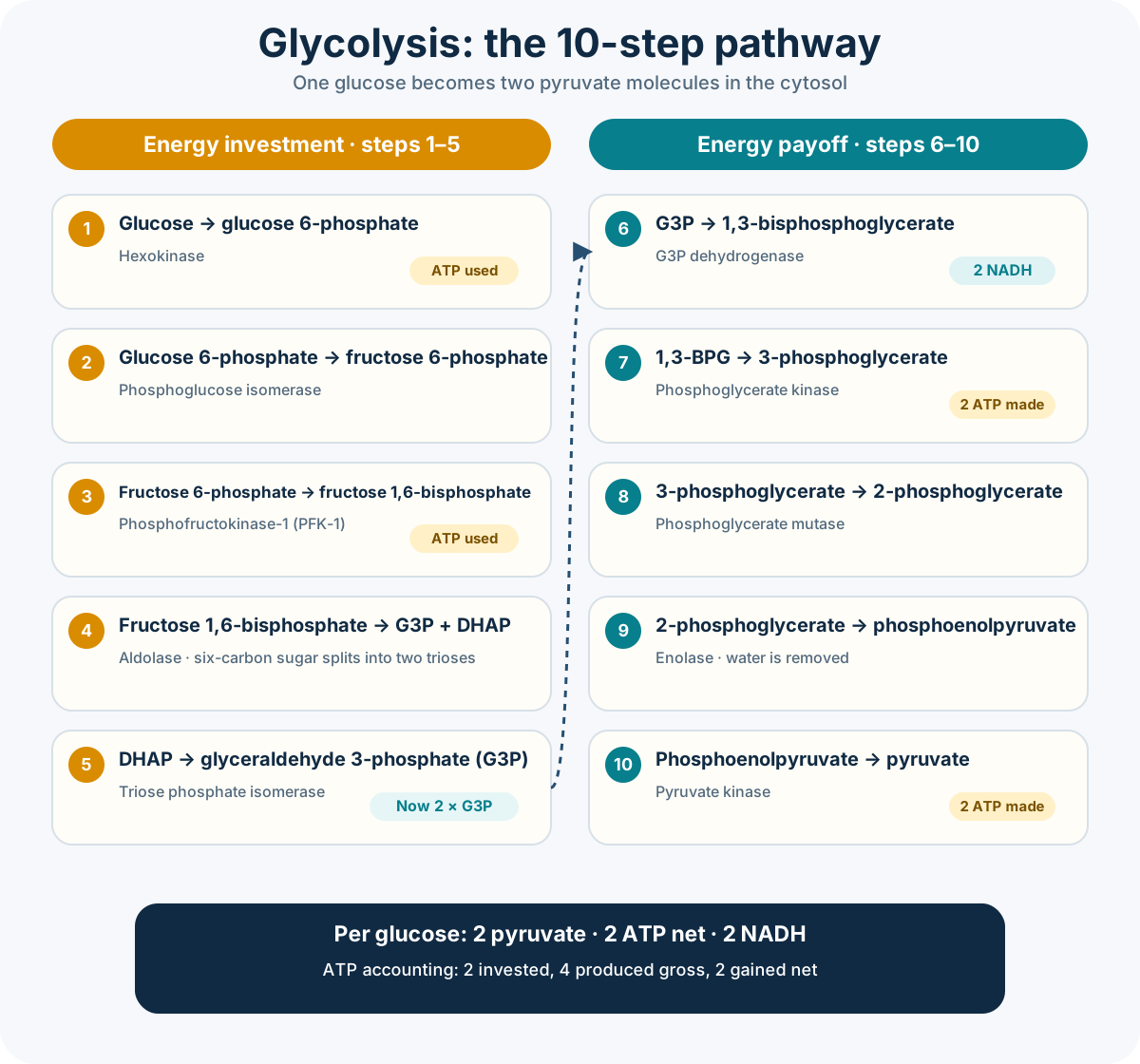
The pathway has an important turning point. Aldolase splits the six-carbon fructose 1,6-bisphosphate into two three-carbon triose phosphates. Triose phosphate isomerase converts dihydroxyacetone phosphate (DHAP) into glyceraldehyde 3-phosphate (G3P), so two G3P molecules continue through steps 6–10 for every glucose. That doubling explains the payoff totals.
How to take this quiz
- Cover the answer section.
- Write an answer rather than choosing one mentally.
- Add a confidence score: certain, unsure, or guessed.
- Check the explanation, not only the bold answer.
- Turn each error into one specific retest.
Give one point for the correct answer and a second point when your explanation is also correct. That produces a maximum score of 40 and prevents a lucky guess from looking like secure understanding.
Part 1: glycolysis foundations
Question 1: Where does glycolysis occur in a eukaryotic cell?
Question 2: What is the starting molecule and what are the main carbon-containing end products?
Question 3: How many enzyme-catalysed reactions are in the canonical glycolytic pathway?
Question 4: What are the two broad phases of glycolysis?
Question 5: Is carbon released as CO₂ during glycolysis?
Part 2: pathway order and enzymes
Question 6: Which enzyme normally catalyses the conversion of glucose to glucose 6-phosphate?
Question 7: Which enzyme catalyses the committed, major regulatory step from fructose 6-phosphate to fructose 1,6-bisphosphate?
Question 8: Which two three-carbon products are formed when aldolase cleaves fructose 1,6-bisphosphate?
Question 9: Why do two molecules of G3P enter the payoff phase for each glucose?
Question 10: Which enzymes catalyse the two ATP-producing reactions of glycolysis?
Part 3: ATP, NADH, and products
Question 11: How many ATP molecules are consumed, produced gross, and gained net per glucose?
Question 12: At which reaction is NADH formed, and how many NADH molecules are produced per glucose?
Question 13: Why does each ATP-forming payoff reaction produce two ATP per original glucose?
Question 14: What type of phosphorylation makes ATP directly during glycolysis?
Question 15: What are the usual net products of glycolysis per glucose?
Part 4: regulation and application
Question 16: Does glycolysis require molecular oxygen directly?
Question 17: Why must NADH be reoxidised to NAD⁺ for glycolysis to continue?
Question 18: Which three glycolytic reactions are generally treated as physiologically irreversible?
Question 19: What can happen to pyruvate under aerobic and oxygen-limited conditions in human cells?
Question 20: A student says glycolysis produces only 2 ATP. Another says it produces 4 ATP. Who is correct?
Glycolysis quiz answers and explanations
Answer 1: The cytosol
Glycolysis occurs in the cytosol, not inside the mitochondrion. In eukaryotic aerobic respiration, pyruvate can subsequently enter mitochondria for further metabolism, but that later location should not be assigned to glycolysis itself.
Answer 2: One glucose becomes two pyruvate
The pathway begins with one six-carbon glucose and ends with two three-carbon pyruvate molecules. The carbon total remains six; glycolysis itself does not release CO₂.
Answer 3: Ten reactions
Canonical glycolysis is described as 10 enzyme-catalysed reactions. Learning only the intermediate list is insufficient when a course also tests the enzymes, reaction types, or regulatory points.
Answer 4: Energy investment and energy payoff
Steps 1–5 form the energy-investment phase, in which ATP prepares and splits the sugar. Steps 6–10 form the energy-payoff phase, in which oxidation produces NADH and substrate-level phosphorylation produces ATP.
Answer 5: No
There is no net carbon loss as CO₂ during glycolysis. Carbon dioxide is released in later stages of complete aerobic glucose oxidation, including pyruvate oxidation and the citric acid cycle.
Answer 6: Hexokinase
The expected general answer is hexokinase, which uses ATP to phosphorylate glucose and form glucose 6-phosphate. Some tissues express a specialised isoenzyme called glucokinase, so use the level of detail required by your course.
Answer 7: Phosphofructokinase-1
Phosphofructokinase-1 (PFK-1) uses ATP to convert fructose 6-phosphate into fructose 1,6-bisphosphate. It is commonly described as the committed and rate-limiting regulatory step of glycolysis.
Answer 8: G3P and DHAP
Aldolase forms glyceraldehyde 3-phosphate (G3P) and dihydroxyacetone phosphate (DHAP). These are triose phosphates: each contains three carbons.
Answer 9: DHAP is converted to G3P
One G3P is produced directly by aldolase. Triose phosphate isomerase converts DHAP into a second G3P, so two G3P molecules continue through the payoff reactions.
Answer 10: Phosphoglycerate kinase and pyruvate kinase
Phosphoglycerate kinase transfers phosphate from 1,3-bisphosphoglycerate to ADP, while pyruvate kinase transfers phosphate from phosphoenolpyruvate to ADP. Both reactions form ATP by substrate-level phosphorylation.
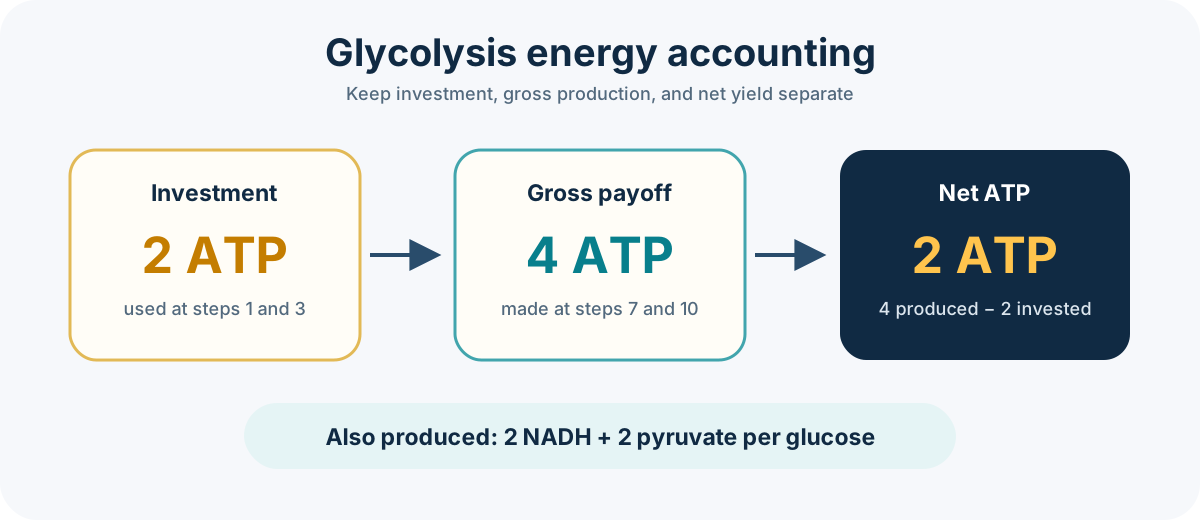
Answer 11: 2 consumed, 4 produced, 2 net
Glycolysis consumes 2 ATP in the investment phase and produces 4 ATP gross in the payoff phase. Subtracting the investment leaves a net gain of 2 ATP per glucose.
Answer 12: The G3P dehydrogenase reaction produces 2 NADH
NADH forms when glyceraldehyde 3-phosphate dehydrogenase oxidises G3P while reducing NAD⁺. Because there are two G3P molecules per glucose, the pathway produces 2 NADH per glucose.
Answer 13: The pathway has doubled after cleavage
After the six-carbon intermediate is split and DHAP is converted, two G3P molecules pass through every payoff reaction. Each ATP-forming reaction therefore occurs twice per glucose.
Answer 14: Substrate-level phosphorylation
The direct transfer of a phosphate group from a high-energy metabolic intermediate to ADP is called substrate-level phosphorylation. It is different from oxidative phosphorylation through the electron-transport system.
Answer 15: Two pyruvate, two ATP net, and two NADH
The usual summary is 2 pyruvate, 2 ATP net, and 2 NADH per glucose. Water and proton accounting may also appear in a full balanced equation, but notation can vary with biochemical conventions; follow the equation used by your course.
Answer 16: No—not as a direct reactant
Glycolysis can generate ATP without directly consuming molecular oxygen. Continued flux still requires NAD⁺. Under aerobic conditions, electron-transfer pathways help reoxidise cytosolic NADH; under oxygen-limited conditions, fermentation can regenerate NAD⁺.
Answer 17: NAD⁺ is required at step 6
Glyceraldehyde 3-phosphate dehydrogenase requires NAD⁺ as an electron acceptor. If NAD⁺ is not regenerated, this reaction stops and the pathway cannot continue through the payoff phase.
Answer 18: Steps catalysed by hexokinase, PFK-1, and pyruvate kinase
The three reactions generally treated as physiologically irreversible are step 1 (hexokinase), step 3 (PFK-1), and step 10 (pyruvate kinase). PFK-1 is the principal committed regulatory step; “irreversible” here describes cellular conditions rather than an absolute impossibility of a reverse chemical reaction.
Answer 19: Oxidation or lactate formation, depending on context
In aerobic human cells with mitochondria, pyruvate can enter the mitochondrion and be converted to acetyl-CoA before the citric acid cycle. When oxygen delivery or oxidative capacity is limited, lactate dehydrogenase can reduce pyruvate to lactate while oxidising NADH to NAD⁺. Cells without mitochondria, such as mature red blood cells, rely on glycolysis and lactate formation regardless of oxygen availability.
Answer 20: Both can be correct if the accounting term is stated
Glycolysis produces 4 ATP gross, but 2 ATP were consumed earlier. The net gain is 2 ATP. An exam answer should always distinguish gross production from net yield.
Score your glycolysis quiz
Use the result diagnostically rather than treating it as a grade boundary.
| Score | What it suggests | Next action |
|---|---|---|
| 34–40 | Secure core recall with minor gaps | Add unfamiliar application questions and delayed retesting |
| 26–33 | Pathway mostly understood | Target the missed enzyme, accounting, or regulation layer |
| 16–25 | Partial recall depends on prompts | Rebuild the pathway in phases, then retake one section |
| 0–15 | Foundations need attention | Learn the overall story and carbon flow before drilling enzymes |
A confident wrong answer is especially useful: it reveals a misconception rather than a temporary lapse. Correct the underlying rule and retest it with different wording.
Turn each mistake into active recall
| Mistake pattern | Focused revision task |
|---|---|
| Mixed up the order | Arrange intermediate cards from glucose to pyruvate |
| Forgot an enzyme | Practise substrate → enzyme → product triples |
| Confused gross and net ATP | Draw separate investment, payoff, and net boxes |
| Forgot why outputs double | Start at fructose 1,6-bisphosphate and trace both trioses |
| Said glycolysis uses oxygen | Explain the difference between direct oxygen use and NAD⁺ regeneration |
| Knew facts but missed application | Write a cause-and-effect answer before checking the pathway |
For a digital version, place a focused, verified section of your notes into Aripsy. Generate a small question set, answer it without looking, and compare every enzyme, product, and accounting convention with your textbook or lecturer materials.
AI-generated questions should be treated as drafts. Remove ambiguous prompts, correct off-course detail, and keep gross versus net values explicit.
A 20-minute glycolysis revision session
- Three minutes: explain the pathway’s overall purpose and location.
- Five minutes: draw the 10-step sequence from memory.
- Seven minutes: answer one quiz section without notes.
- Three minutes: check explanations and classify each error.
- Two minutes: schedule a short delayed retest of the weakest layer.
Once glycolysis is secure, continue the route of aerobic respiration with the Krebs cycle game and memorisation guide. For broader question-writing advice, use the fill-in-the-blank practice guide.
Sources
- NCBI Bookshelf: How cells obtain energy from food
- PubChem Pathway: Glycolysis
- NCBI Bookshelf: Biochemistry, Glycolysis
- OpenStax Biology 2e: Glycolysis
- Roediger and Karpicke: Test-enhanced learning
FAQ
What are the net products of glycolysis?
Per glucose, the usual summary is two pyruvate, two ATP net, and two NADH. Glycolysis makes four ATP gross but consumes two ATP during its investment phase.
How many steps are in glycolysis?
The canonical glycolytic pathway contains 10 enzyme-catalysed reactions. Steps 1–5 are the investment phase and steps 6–10 are the payoff phase.
Which steps of glycolysis use ATP?
ATP is consumed when hexokinase phosphorylates glucose and when phosphofructokinase-1 phosphorylates fructose 6-phosphate. That is two ATP invested per glucose.
Which steps of glycolysis produce ATP?
ATP is formed at the phosphoglycerate kinase and pyruvate kinase reactions. Each reaction occurs twice per glucose after the pathway splits, producing four ATP gross.
Which step of glycolysis produces NADH?
Glyceraldehyde 3-phosphate dehydrogenase produces NADH while converting G3P to 1,3-bisphosphoglycerate. The reaction occurs twice per glucose, forming two NADH.
Does glycolysis require oxygen?
Glycolysis does not consume oxygen directly. It does require NAD⁺, which can be regenerated through aerobic electron-transfer pathways or through fermentation, depending on the cell and conditions.
What is the rate-limiting enzyme of glycolysis?
Phosphofructokinase-1 is commonly taught as the major rate-limiting and committed-step enzyme of glycolysis. Regulation can be more detailed in advanced courses.
Where does glycolysis occur?
Glycolysis occurs in the cytosol. Pyruvate may later enter mitochondria in aerobic eukaryotic cells, but those later reactions are not part of glycolysis.
Keep exploring
Science Revision
Start with Biology, Chemistry, and Physics guides built around specifications, practicals, equations, and recall.
Explore Science Revision guides
Written by
Aripsy Study Team
The Aripsy Study Team creates practical revision guides designed to support learning, source checking, and active practice.