7 Amino Acid Memorization Games for Active Recall
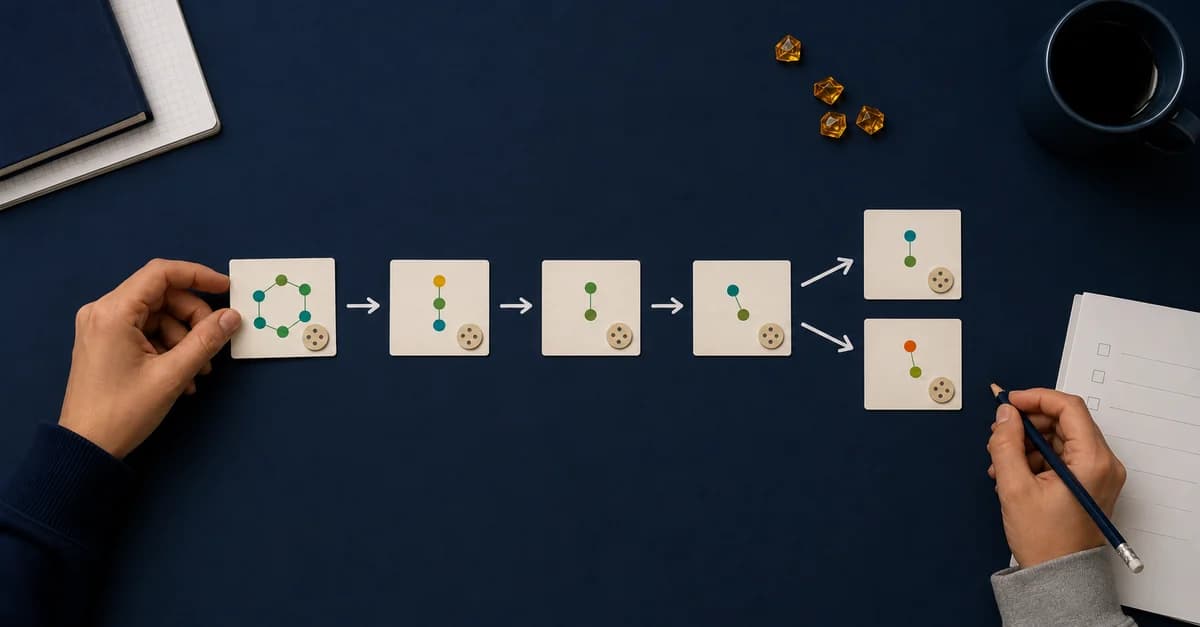
Use card matching for names and codes, Hangman for structure recall, mnemonic relays for grouped facts, sorting for properties, Concentration for fluency, Bingo for group review, and prediction challenges for application.
 Aripsy Study Team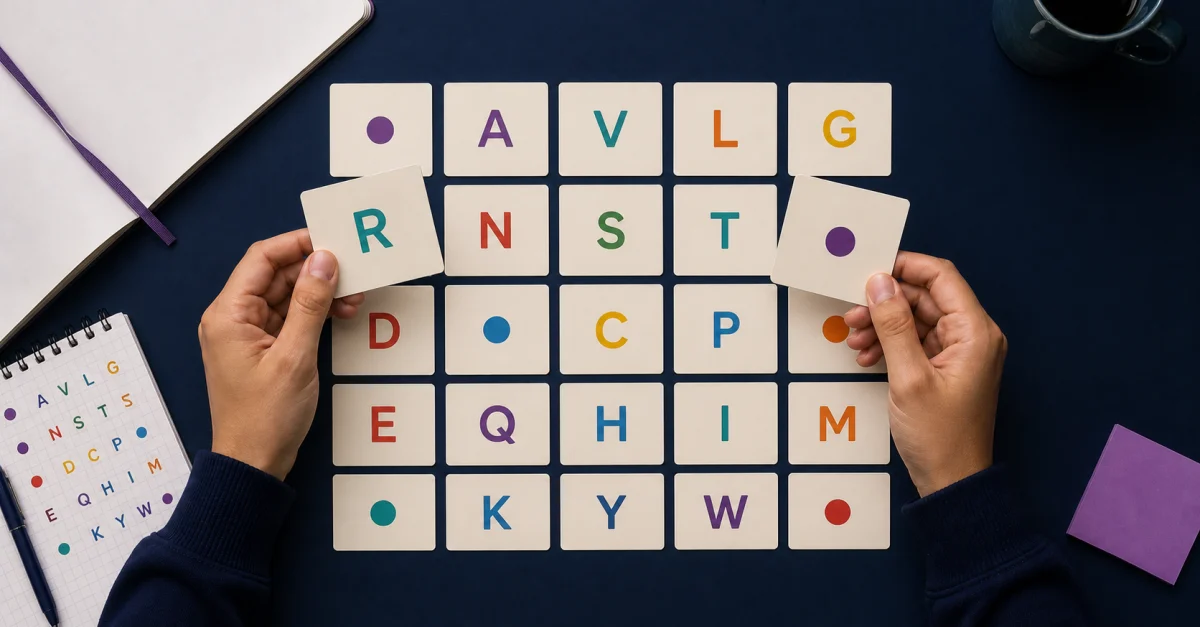
In this article15
Rereading an amino acid table can make the page feel familiar without showing whether you can recall the information. A useful amino acid memorization game makes you retrieve a name, code, structure, or property before you see the answer.
That distinction matters because retrieval practice is different from simply looking again. In two experiments using prose passages, Roediger and Karpicke found that repeated testing supported stronger delayed retention than repeated study. That study was not about amino acids specifically, but it explains why the games below require an answer before checking it.
Quick answer: what is the best amino acid memorization game?
Start with bidirectional card matching if you are learning names, one-letter codes, and three-letter codes. Add sorting when you need to classify side chains, and use prediction challenges only after you understand the relevant chemistry.
The best game depends on what your course actually requires. Some courses expect names and abbreviations; others also assess structures, side-chain properties, charge at a stated pH, or biochemical application. Check your syllabus, specification, lecturer guidance, or learning objectives before building the game.
Play a two-minute code recall round now
You can try this small practice set on paper immediately. Cover the answer column, say or write both codes, and only then check. These follow the IUPAC amino-acid code symbols; the set is a starting round, not all 20 amino acids.
| Name prompt | Answer: three-letter / one-letter code |
|---|---|
| Alanine | Ala / A |
| Glycine | Gly / G |
| Serine | Ser / S |
| Valine | Val / V |
| Leucine | Leu / L |
Reverse the round: cover the names and retrieve them from the codes. Give yourself one point only when both codes are correct, then retest misses in a different order. Add structures or properties only after checking the classification required by your course.
These are instructions for a paper or flashcard activity, not an embedded online game. To practise digitally, open the flashcard workflow and paste your own checked code list. No study content is included in that link.
What should you memorise first?
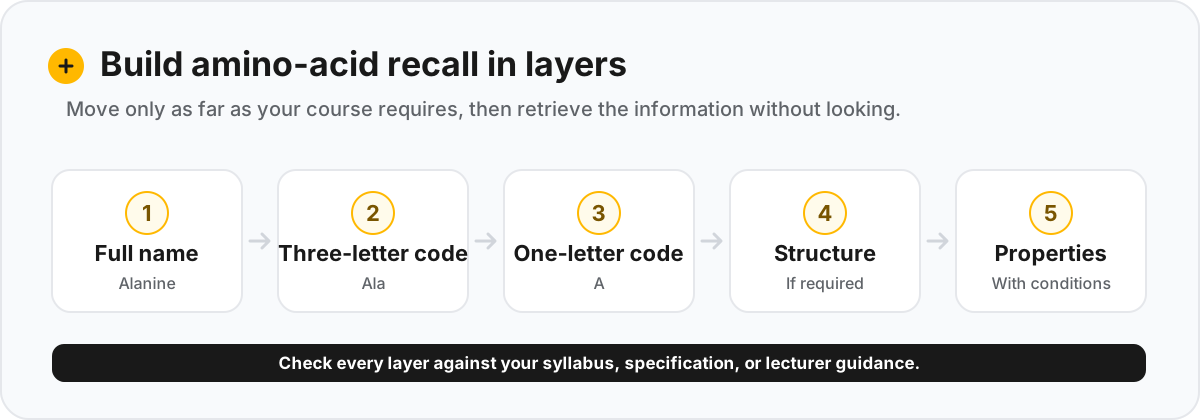
Do not try to learn every possible property at once. Build the set in layers:
- Full name.
- Three-letter code.
- One-letter code.
- Side-chain structure, if required.
- The classification system used by your course.
- Charge or other behaviour under clearly stated conditions.
Classification can vary with context. A course may group residues by polarity, charge, aromaticity, sulfur content, or another useful feature. Use the exact scheme in your trusted course material, especially for residues that do not fit a simplistic label neatly.
1. Bidirectional amino acid card matching
Create separate cards for the information you need to connect. One card might show alanine, while its partner shows Ala and A. If structures are assessed, put the verified structure on a third card.
Before claiming a pair, say the missing information aloud. Then reverse the direction:
- Name to codes.
- Code to name.
- Structure to name.
- Name to structure.
- Property clue to example.
This prevents a common problem: recognising an answer in one direction but being unable to produce it in another.
Make every miss useful: record the exact gap. “Forgot the one-letter code” needs a different follow-up card from “confused two side chains.” Keep one retrieval target per card, then mix the order so position does not become the cue.
If you want a digital version, use the Aripsy AI flashcard generator with a focused, verified section of your course notes. Check every generated card against the source before reviewing it.
2. Amino acid Hangman
A published classroom activity adapted Hangman so that amino acid structures represented letters. Students drew a structure from memory when guessing its one-letter abbreviation, and clues were written as “amino acid sentences.” The authors reported substantial pre- to post-activity improvement in recognising and drawing structures from memory.
You can make a simpler version:
- Choose a short answer word that uses valid amino acid one-letter codes.
- Give each player a checked reference sheet during setup.
- To guess a letter, the player must first name the amino acid or draw its structure, depending on the learning goal.
- After the round, retest missed codes or structures without the game board.
The published activity supports this particular classroom design; it does not prove that every game format will improve every student’s results. Use a short before-and-after check to see whether your own recall changed.
3. Mnemonic relay
Mnemonics can help organise a list, but the phrase must match the list exactly. Give one player a verified mnemonic, ask the next player to reconstruct the amino acids, and have a third player check every item against the course source.
Keep separate mnemonics for separate learning targets. A phrase for essential amino acids should not be reused as though it described hydrophobic amino acids. That kind of category error is memorable for the wrong reason.
After reconstructing the list, require one explanation:
- What rule defines this group?
- Which side-chain feature supports the classification?
- Does the rule depend on pH or another condition?
- Is there a residue your course treats as a special case?
A mnemonic is a cue, not proof of understanding. Follow it with a sorting or explanation round.
4. Amino acid sorting challenge
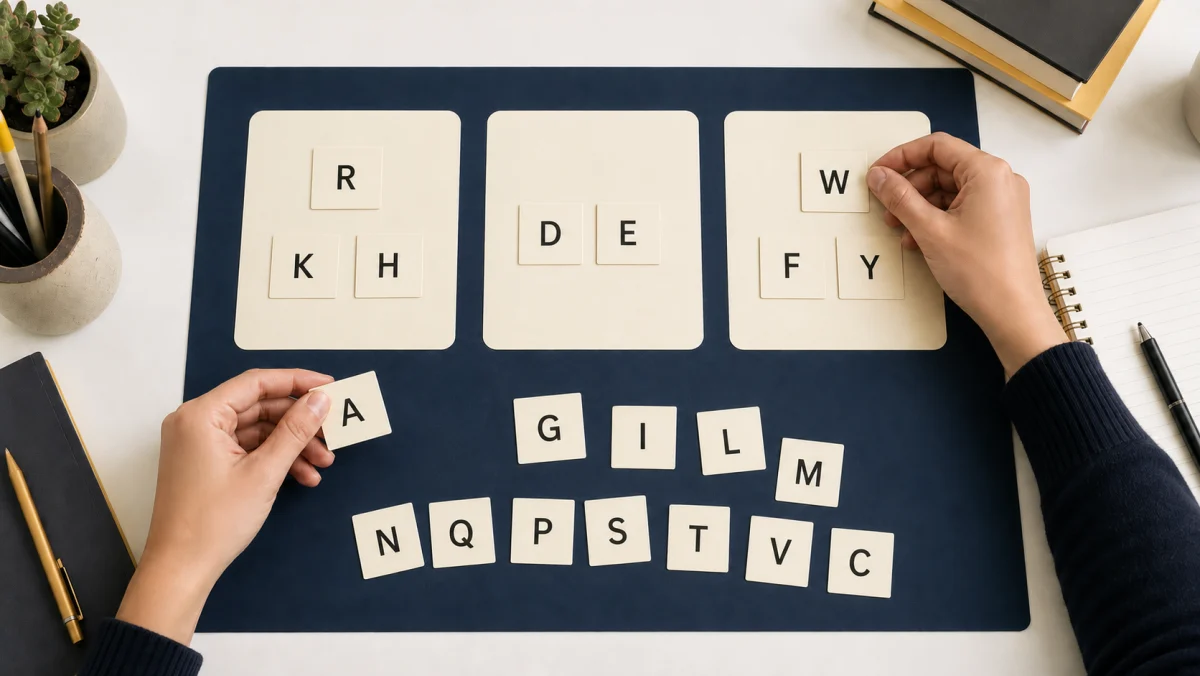
Sorting changes a memorised list into a classification task. Write one amino acid on each card, choose the categories used in your course, and place every card while explaining the decision.
Possible rounds include:
- Charged versus uncharged under a stated condition.
- Polar versus nonpolar using the course’s chosen scheme.
- Aromatic versus non-aromatic.
- Sulfur-containing versus not sulfur-containing.
- Side chains with a particular functional group.
Do not score speed until the classification rules are understood. When a card is misplaced, write down both the chosen category and the reason. The explanation reveals whether the problem is a forgotten label, a misread structure, or a weak chemistry rule.
Finish with the reference sheet hidden. If several classifications still depend on guessing, reduce the set and practise the rule before repeating the full challenge.
5. Concentration for names, codes, and structures
Lay the cards face down and turn over two at a time. A valid pair could connect a full name with its code, a code with a checked structure, or a property clue with an example.
The important moment happens before the second card is revealed: commit to what you think the first card represents. Otherwise, the game can become visual matching without meaningful recall.
Increase the difficulty gradually:
| Round | Pair type | Main skill |
|---|---|---|
| 1 | Full name and three-letter code | Basic identification |
| 2 | Full name and one-letter code | Faster code recall |
| 3 | Name and verified structure | Visual discrimination |
| 4 | Property clue and amino acid | Classification and application |
Track hesitation as well as incorrect matches. A correct answer that takes a long time may still need more varied practice.
6. Amino acid property Bingo
Bingo works well for a class or study group because one clue can test everyone at once. Put amino acid names or codes in the squares. The caller reads a clue from trusted course material, and players mark the matching square.
Use different rounds for different depths:
- Code round: call a one- or three-letter code.
- Feature round: describe a side-chain feature.
- Classification round: give a category from the course scheme.
- Application round: describe a relevant biochemical role or context that the class has studied.
Before accepting a completed line, ask the player to justify two or three marked answers. Guessed squares stay unconfirmed until explained.
Build a “missed clue” list during the round. Those clues can become targeted fill-in-the-blank practice or flashcards later.
7. Property prediction challenge
Prediction moves beyond naming. Give a verified structure or a clearly written scenario, state the conditions, and ask the player to predict a property before checking a reference.
Depending on the course, prompts might ask students to:
- Identify whether an ionisable group is likely to be protonated at a stated pH.
- Compare two side chains using a named hydrophobicity scale.
- Predict how a substitution changes a local chemical property.
- Explain which structural feature supports a classification.
Write the prediction and reasoning before checking. If the answer is wrong, correct the rule rather than memorising only the isolated result.
Avoid vague questions such as “Which amino acid is most hydrophobic?” unless the scale and context are specified. Hydrophobicity scales are not interchangeable, and charge depends on the relevant groups and conditions.
What does the classroom research show?
Two published activities are useful examples, but their findings should be interpreted narrowly.
- The 2014 amino acid Hangman paper describes students drawing structures and translating one-letter-code clues. Its abstract reports strong improvement between pre- and post-assessments.
- A 2024 Journal of Chemical Education paper evaluated an “Amino-structure” card game with 201 university students. The abstract reports high acceptance and says 82.1% passed a two-question knowledge test after the activity.
These results support trying structured, retrieval-based classroom activities. They do not establish that games replace instruction, worked chemistry problems, or later assessment. The 82.1% figure is a post-activity pass rate, not a guaranteed improvement rate for other learners.
Turn game mistakes into a revision plan
The score matters less than the error pattern. After each round, convert mistakes into the next task:
| Mistake | Next revision task |
|---|---|
| Forgot a name or code | Make one bidirectional flashcard |
| Confused two structures | Draw both from memory and mark the differing group |
| Used the wrong category | Rewrite the classification rule, then sort again |
| Guessed a property | Answer a short explanation question with conditions stated |
| Recalled slowly | Mix the item into a smaller timed set after accurate practice |
For a connected workflow, paste a focused section of verified amino acid notes into Aripsy. Signed-in Free users can create notes and limited flashcards from pasted text. Signed-in Free users also have a document-upload trial. Pro adds ongoing PDF, PowerPoint (.pptx), and Word (.docx) uploads, MCQs, and fill-in-the-blank practice within current plan limits. Check extracted document text and generated answers before review. AP students can place amino acids in the wider unit with the AP Biology Chemistry of Life study guide.
Use AI output as a draft. Check names, codes, structures, classifications, pH conditions, and course-specific wording against your original material before studying from it.
A practical 20-minute session
- Five minutes: review one verified group or code set.
- Seven minutes: play one retrieval game without looking first.
- Five minutes: correct errors and create targeted cards.
- Three minutes: retest the missed items in a new order.
Return to the weak items after a delay. The goal is not to win one round; it is to retrieve the right information when the original layout and clues are gone.
If you are applying the same card-game approach to cellular respiration, continue with seven ways to memorise the Krebs cycle.
Sources
- Pennington, Sears and Clegg: Interactive Hangman teaches amino acid structures and abbreviations
- Gómez Buitrago, Tobar-Muñoz and Arteaga: Amino-structure card game
- Roediger and Karpicke: Test-enhanced learning
FAQ
What is the easiest way to memorise the 20 amino acids?
Learn them in layers rather than all at once: names, then codes, then structures or properties if your course requires them. Use bidirectional recall and check every category against trusted course material.
Are amino acid games better than flashcards?
They practise different things. Flashcards are efficient for individual retrieval, while sorting, Bingo, and prediction games can add classification, explanation, or group interaction. Use the format that matches the learning target.
Which amino acid properties should I memorise?
Follow your course requirements. Common targets include names, one- and three-letter codes, structures, polarity, charge under stated conditions, and selected side-chain features. Do not assume every course uses the same categories.
Can I use a mnemonic to learn amino acids?
Yes, but verify that the mnemonic maps to the intended list. Then practise explaining the grouping rule so the phrase supports understanding instead of preserving a category mistake.
Can AI create amino acid revision games?
AI can draft cards, clues, MCQs, and fill-in-the-blank prompts from your notes. Check all chemical structures, codes, classifications, and conditions against a trusted source before using them.
Keep exploring
Science Revision
Start with Biology, Chemistry, and Physics guides built around specifications, practicals, equations, and recall.
Explore Science Revision guides
Written by
Aripsy Study Team
The Aripsy Study Team creates practical revision guides designed to support learning, source checking, and active practice.