Krebs Cycle Game: 7 Ways to Memorise the Krebs Cycle
Start by arranging the eight Krebs cycle intermediates in order, then add carbon counts, enzymes, and output tokens in separate rounds. Finish by rebuilding and explaining the pathway from memory.
 Aripsy Study Team

In this article15
The Krebs cycle can look like one crowded diagram: eight reactions, similar compound names, changing carbon counts, several enzymes, and energy carriers leaving at different steps. Trying to memorise the whole page at once makes those layers compete for attention.
A better Krebs cycle game separates the pathway into small retrieval tasks. Learn the order first. Then add carbon counts, enzymes, outputs, and regulation only if your course requires them. Each game below makes you produce an answer before checking the diagram.
The Krebs cycle is also called the citric acid cycle or tricarboxylic acid (TCA) cycle. This guide uses all three names because textbooks and exam questions may use any of them.
Quick answer: what is the best Krebs cycle game?
Start with an eight-card cycle sort. Put citrate, isocitrate, α-ketoglutarate, succinyl-CoA, succinate, fumarate, malate, and oxaloacetate in order. When that sequence is reliable, add separate cards for enzymes, carbon numbers, NADH, FADH₂, GTP or ATP, and CO₂.
The strongest version is cumulative:
- Arrange the intermediates.
- Say each transition aloud.
- Add one new information layer.
- Hide the reference and rebuild the cycle.
- Record exactly where your reconstruction failed.
Do not memorise more detail than your assessment expects. A school biology course may focus on location and overall products, while a university biochemistry or medical course may require enzymes, regulation, structures, and links to other pathways.
What should you memorise first?
Build Krebs cycle recall in layers rather than treating the pathway as one long list.
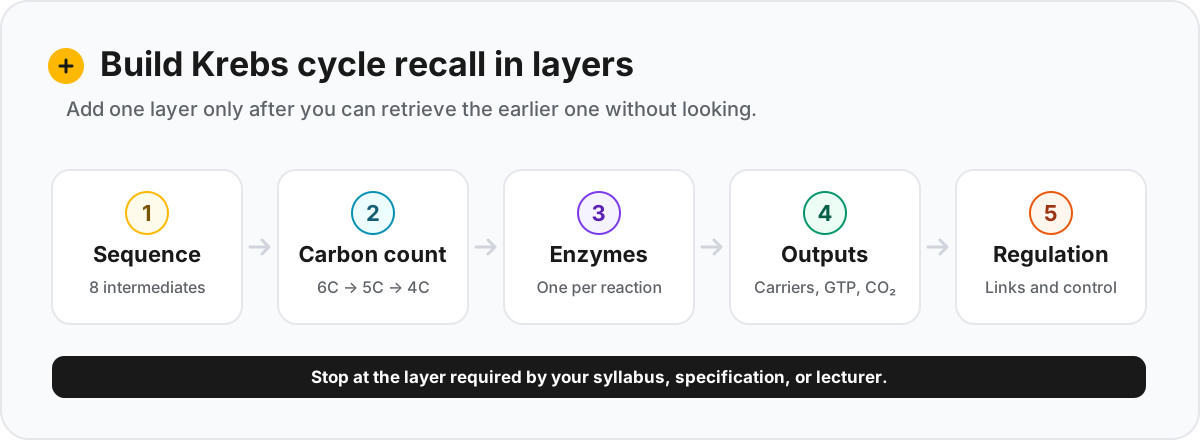
| Layer | What to retrieve | Why it matters |
|---|---|---|
| 1. Sequence | The intermediates in order | Gives the pathway a stable map |
| 2. Carbon count | 6C, 6C, 5C, then the 4C compounds | Shows where two carbons leave as CO₂ |
| 3. Enzymes | The enzyme for each transition | Connects names with reaction types |
| 4. Outputs | Where NADH, FADH₂, GTP or ATP, and CO₂ appear | Supports energy accounting |
| 5. Regulation and links | Control points and pathway connections required by your course | Turns recall into biochemical reasoning |
Understand the overall story before drilling names. A two-carbon acetyl group enters through acetyl-CoA and combines with four-carbon oxaloacetate to form six-carbon citrate. The pathway releases two CO₂, captures energy in reduced carriers and a high-energy phosphate, and regenerates oxaloacetate.
The Krebs cycle sequence to use in the games
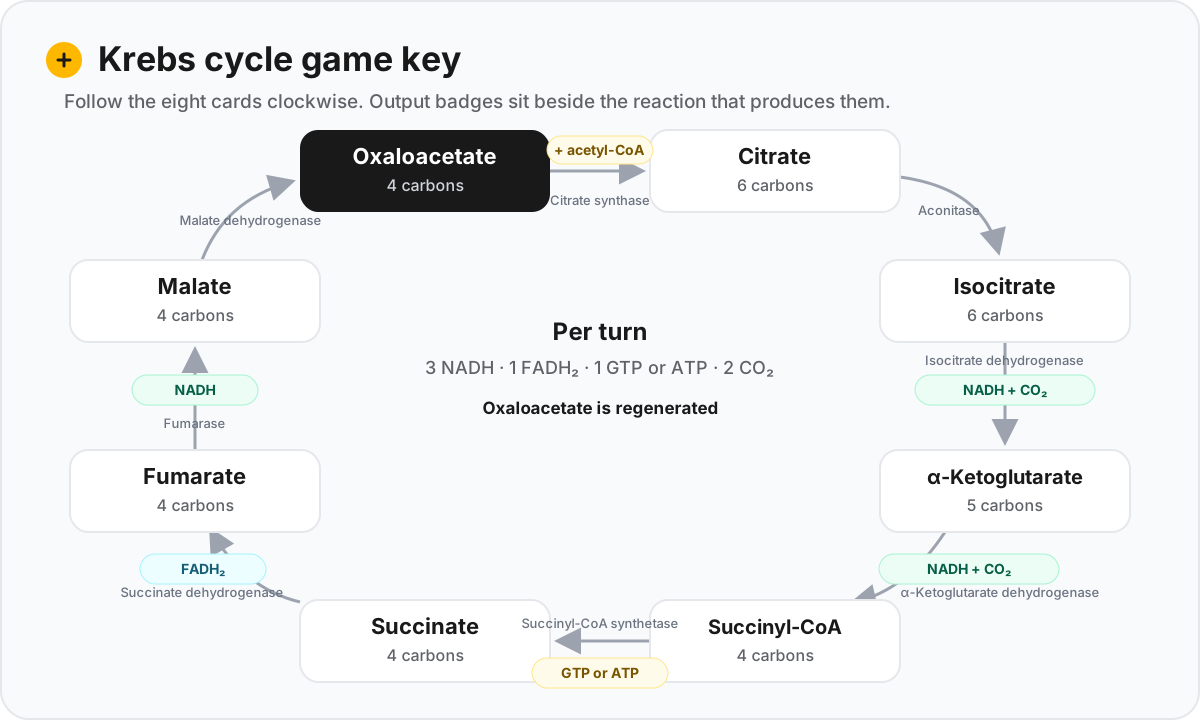
Use a checked course diagram as your answer key. The canonical sequence is:
Oxaloacetate + acetyl-CoA → citrate → isocitrate → α-ketoglutarate → succinyl-CoA → succinate → fumarate → malate → oxaloacetate
One turn per acetyl-CoA yields 3 NADH, 1 FADH₂, 1 GTP or ATP, and 2 CO₂ in the usual accounting. Because one glucose can produce two acetyl-CoA molecules, figures stated per glucose are normally double the per-turn values. Keep those two accounting units separate.
The two carbons released as CO₂ during the first turn are not simply the same two acetyl carbons that have just entered. Detailed carbon tracing is more subtle, so use your course’s isotope or carbon-tracking explanation if that distinction is assessed.
1. Eight-card cycle sort
Write one intermediate on each of eight cards:
- Citrate.
- Isocitrate.
- α-Ketoglutarate.
- Succinyl-CoA.
- Succinate.
- Fumarate.
- Malate.
- Oxaloacetate.
Shuffle the cards and arrange them clockwise. Before checking, point to the place where acetyl-CoA enters and explain why oxaloacetate appears at both the end and the beginning.
Run the game in three rounds:
- Open-key round: use the diagram while learning the route.
- Timed sort: hide the key and arrange all eight cards.
- Random start: begin from a named intermediate such as fumarate rather than always starting with citrate.
The random-start round matters. If you only remember a sentence mnemonic from its first word, one forgotten item can block the whole chain. Starting anywhere tests whether you understand the circular relationships.
2. Imagery mnemonic journey
Turn each intermediate into a vivid image and connect the images in one circular scene. Your images can be personal, but each must map unambiguously to one compound. For example, citrate might become a citrus fruit and fumarate could become smoke, provided your chosen cue does not make you confuse the scientific name.
Make the game active:
- Draw or select one picture for each intermediate.
- Shuffle the pictures and rebuild the sequence.
- Say the biochemical name before turning over its label.
- Travel backwards around the cycle as a second round.
A small randomized study of 27 undergraduates found that an imagery mnemonic group performed better immediately after instruction than a rote-learning group. Four weeks later, both groups had declined and no longer differed significantly. That result supports imagery as an initial cue, not as a substitute for spaced retrieval and understanding.
Avoid relying on a mnemonic sentence alone. Pair every cue with the actual name, then remove the cue once recall becomes reliable.
3. Enzyme-intermediate dominoes
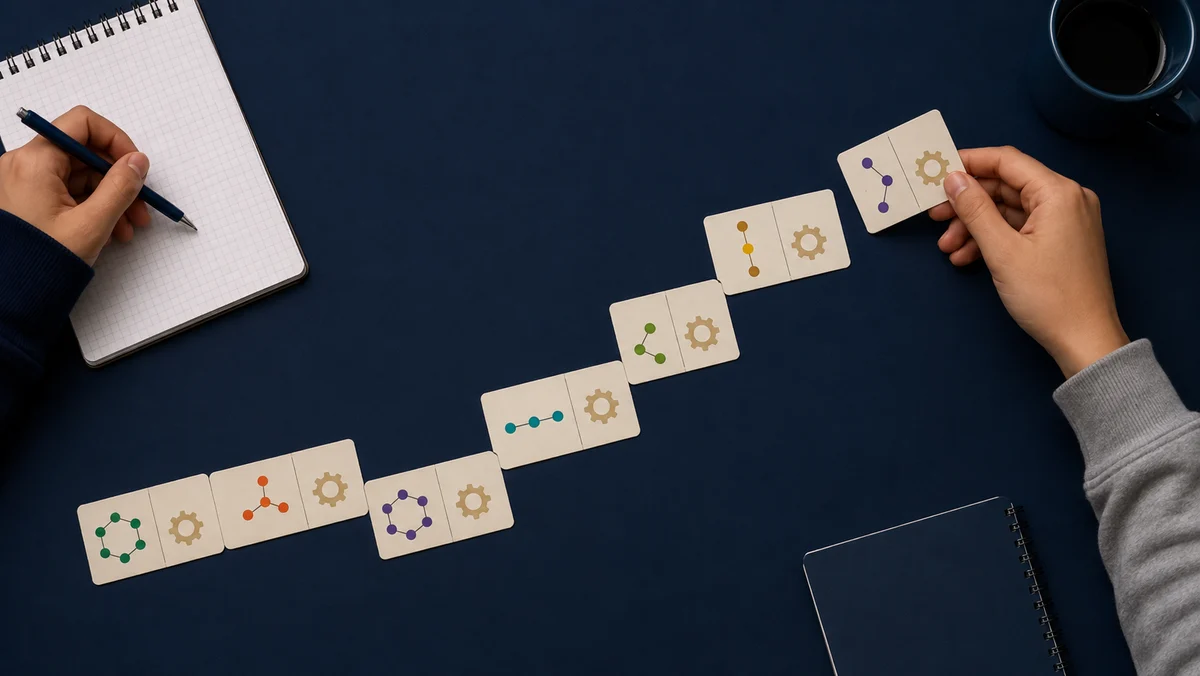
Create domino-style cards with an intermediate on the left and an enzyme on the right. A legal chain connects each substrate to the enzyme that acts on it and then to the correct product.
Use this answer sequence:
| Transition | Enzyme |
|---|---|
| Oxaloacetate + acetyl-CoA → citrate | Citrate synthase |
| Citrate → isocitrate | Aconitase |
| Isocitrate → α-ketoglutarate | Isocitrate dehydrogenase |
| α-Ketoglutarate → succinyl-CoA | α-Ketoglutarate dehydrogenase complex |
| Succinyl-CoA → succinate | Succinyl-CoA synthetase |
| Succinate → fumarate | Succinate dehydrogenase |
| Fumarate → malate | Fumarase |
| Malate → oxaloacetate | Malate dehydrogenase |
For an easier round, keep enzyme cards face up. For a harder round, draw an enzyme card and name both its substrate and product before placing it.
Look for naming clues, but do not let them replace chemistry. Dehydrogenases are associated with oxidation-reduction steps, while fumarase hydrates fumarate. Succinate dehydrogenase is also Complex II of the electron transport chain and, in eukaryotes, is associated with the inner mitochondrial membrane rather than freely dissolved in the matrix.
4. Carbon-count token trail
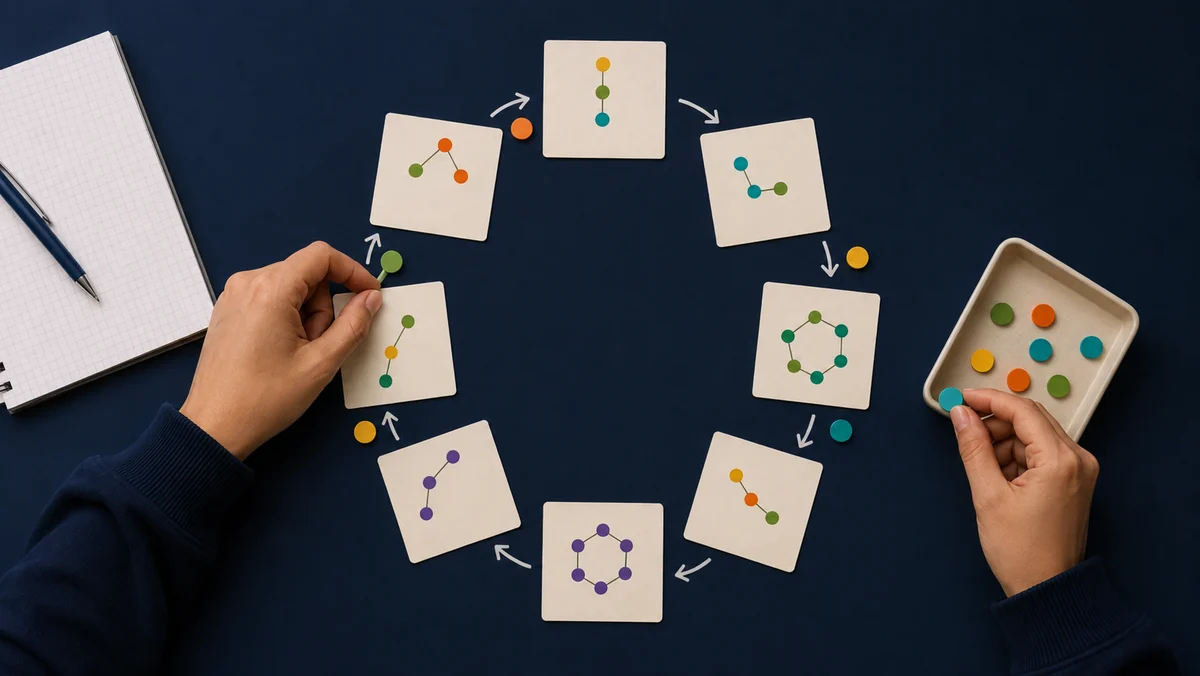
Give every carbon atom a small token. Begin with a four-token oxaloacetate card and add a two-token acetyl group to make six-carbon citrate.
Move through the pathway while changing the count:
- Citrate: 6 carbons.
- Isocitrate: 6 carbons.
- α-Ketoglutarate: 5 carbons, after one CO₂-producing step.
- Succinyl-CoA: 4 carbons, after a second CO₂-producing step.
- Succinate, fumarate, malate, and oxaloacetate: 4 carbons each.
The player must remove a carbon token only at a decarboxylation step. Award the point only if they can name both the new intermediate and the associated reduced carrier produced in that transition.
This game prevents two common errors: releasing CO₂ at the wrong place and assuming the cycle continually becomes smaller instead of regenerating a four-carbon acceptor.
5. Output-token placement game
Make seven output tokens: three marked NADH, one FADH₂, one GTP or ATP, and two CO₂. Build the intermediate sequence, then place each token beside the reaction that produces it.
Use these checkpoints:
- Isocitrate → α-ketoglutarate: NADH and CO₂.
- α-Ketoglutarate → succinyl-CoA: NADH and CO₂.
- Succinyl-CoA → succinate: GTP or ATP, depending on the convention or tissue context taught.
- Succinate → fumarate: FADH₂.
- Malate → oxaloacetate: NADH.
After placing the tokens, answer two questions without looking:
- What is produced per turn of the cycle?
- What is produced for the two turns associated with one glucose molecule?
Do not say that the Krebs cycle directly makes large amounts of ATP. Most of the captured energy leaves as NADH and FADH₂, whose electrons can feed oxidative phosphorylation.
6. Missing-step detective
Lay out a complete pathway, then ask a partner to remove one card or swap two cards while you look away. Identify the error and justify the repair.
Use different mystery types:
- A missing intermediate.
- Two intermediates reversed.
- An enzyme attached to the wrong arrow.
- A misplaced NADH, FADH₂, GTP, or CO₂ token.
- An incorrect carbon count.
- Acetyl-CoA shown as though it were regenerated by the cycle.
The explanation earns the point, not simply spotting that something looks wrong. Say what the substrate should become, which enzyme is involved, and what output or carbon-count change occurs if relevant.
This is especially useful for diagrams in which you must interpret a disrupted pathway rather than reproduce a memorised list.
7. Closed-book pathway race
Use a blank sheet and set a short timer. Draw the cycle from memory with the amount of detail your course expects.
Score one point for each correct layer:
- Intermediates in the correct order.
- Acetyl-CoA entry and oxaloacetate regeneration.
- Carbon counts.
- Enzymes.
- Output locations.
- Cellular location.
- Required regulation or pathway links.
Accuracy comes before speed. After the timer, compare your drawing with a trusted diagram and mark errors in a different colour. Wait, then redraw only the weak section before attempting the complete cycle again.
The final round is a one-minute teach-back: explain what the cycle accomplishes without reciting names only. A good answer connects acetyl-CoA oxidation, CO₂ release, reduced electron carriers, substrate-level phosphorylation, and oxaloacetate regeneration.
What does the learning research show?
The most directly relevant mnemonic study was small and narrow: 27 undergraduates, one teaching setting, and better immediate performance for imagery that did not persist as a group difference at four weeks. It does not prove that one Krebs cycle game is universally best.
Broader retrieval-practice research explains the design of these activities. Testing yourself requires information to be produced from memory, while looking repeatedly at a finished diagram mainly supports familiarity. The practical lesson is to hide the answer key, attempt the cycle, check the result, and revisit missed steps after a delay.
Games should support biochemical understanding rather than turn the pathway into disconnected vocabulary. Once the order is secure, ask why carbon is lost, where oxidation occurs, how reduced carriers connect to electron transport, and why the regeneration of oxaloacetate makes the pathway cyclic.
Turn game mistakes into a revision plan
The error tells you which layer needs practice.
| Mistake | Next revision task |
|---|---|
| Lost the intermediate order | Rebuild the eight-card sequence from three different starting points |
| Confused citrate and isocitrate | Pair both with aconitase and explain what changes |
| Put CO₂ on the wrong steps | Repeat the carbon-token trail from 6C to 5C to 4C |
| Mixed up NADH and FADH₂ | Place output tokens, then explain the succinate dehydrogenase exception |
| Remembered names but not enzymes | Play enzyme dominoes with substrate and product prompts |
| Could draw but not explain the pathway | Complete a one-minute teach-back and answer application questions |
For a digital workflow, paste a focused, verified section of your biochemistry notes into Aripsy. Turn each layer into a small flashcard set, then create practice questions for the relationships you missed. You can also follow the broader active recall guide.
Use generated cards as drafts. Check every intermediate, enzyme, carbon count, product, cellular location, and course-specific convention against your textbook, syllabus, or lecturer materials before studying from them.
A practical 25-minute Krebs cycle session
- Five minutes: review one checked overview and identify the required layers.
- Six minutes: complete the eight-card sort from two different starting points.
- Six minutes: add enzyme, carbon, or output tokens.
- Five minutes: draw the pathway from memory and correct it.
- Three minutes: explain one error and schedule a later retest.
On the next session, begin with the layer you previously missed. The goal is not to make one perfect diagram while looking at it; it is to reconstruct and use the pathway when the diagram is absent.
For the stage immediately before acetyl-CoA enters this cycle, test yourself with the glycolysis pathway quiz. For another biochemistry topic built around the same layered-recall approach, try these amino acid memorization games.
Sources
- NCBI Bookshelf: How cells obtain energy from food
- PubChem Pathway: Citric acid cycle
- Morisaki, Bon and Levitt: The use of an imagery mnemonic to teach the Krebs cycle
- HHMI BioInteractive: Citric acid cycle animation
- Roediger and Karpicke: Test-enhanced learning
FAQ
What is the easiest way to memorise the Krebs cycle?
Learn it in layers. First arrange the eight intermediates in order. Then add carbon counts, enzymes, and outputs in separate rounds. Rebuild the cycle without looking and practise starting from different intermediates.
What mnemonic helps remember the Krebs cycle intermediates?
Any appropriate mnemonic can work if each cue maps clearly to citrate, isocitrate, α-ketoglutarate, succinyl-CoA, succinate, fumarate, malate, and oxaloacetate. Pair the mnemonic with retrieval practice so you can eventually recall the scientific names without it.
How many steps are in the Krebs cycle?
The canonical cycle is usually described as eight enzyme-catalysed reactions. Acetyl-CoA entry through citrate synthase begins the turn, and the final reaction regenerates oxaloacetate.
What does one turn of the Krebs cycle produce?
In the usual accounting, one turn per acetyl-CoA produces 3 NADH, 1 FADH₂, 1 GTP or ATP, and 2 CO₂ while regenerating oxaloacetate. Check the notation and level of detail expected by your course.
Does the Krebs cycle use oxygen directly?
No molecular oxygen is consumed in the cycle’s reaction equation. In aerobic cells, however, continued cycle activity depends indirectly on the electron transport system regenerating NAD⁺ and FAD, with oxygen serving as the final electron acceptor.
Where does the Krebs cycle happen?
In eukaryotic cells, most Krebs cycle reactions occur in the mitochondrial matrix; succinate dehydrogenase is associated with the inner mitochondrial membrane. In bacteria, the pathway occurs in the cytosol, with succinate dehydrogenase in the cell membrane.
Are Krebs cycle games enough for a biochemistry exam?
No. Games can support recall of the pathway, but many assessments also require reaction logic, regulation, energetics, pathway integration, experimental interpretation, or clinical application. Match your practice to the learning objectives and past questions.
Keep exploring
Science Revision
Start with Biology, Chemistry, and Physics guides built around specifications, practicals, equations, and recall.
Explore Science Revision guides
Written by
Aripsy Study Team
The Aripsy Study Team creates practical revision guides designed to support learning, source checking, and active practice.