Make GCSE Flashcards from Your Own Notes
Turn one checked GCSE topic into short active-recall cards. Paste class notes, select your subject and exam context, then compare each generated card with your source and exact specification before studying.
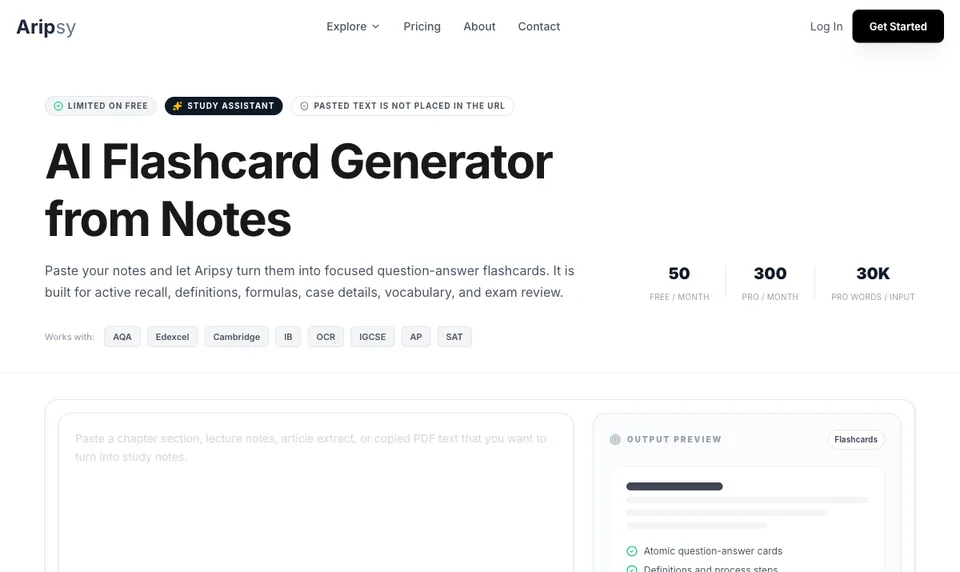
50
Free / month
300
Pro / month
30K
Pro words / input
Auto-detect
GCSE / SAT
General
Free includes limited flashcards; Pro has no separate flashcard cap within the 300 monthly AI-generation allowance.
Short answer
How can I make checked GCSE flashcards from my notes?
Turn one checked GCSE topic into short active-recall cards. Paste class notes, select your subject and exam context, then compare each generated card with your source and exact specification before studying.
Best input
AQA GCSE Biology 8461, Bioenergetics. Photosynthesis is an endothermic reaction in which light transfers energy to the chloroplasts. The rate of photosynthesis can be affected by light intensity, temperature, carbon dioxide concentration and the amount of chlorophyll. A required practical investigates how light intensity affects the rate using an aquatic organism such as pondweed. Students also measure and calculate rates, interpret graphs and explain limiting factors.
Responsible use
Exam-context settings guide the draft. Verify definitions, equations, practicals and required wording against your exact GCSE specification and source.
How Aripsy helps you study this material
Turn one checked GCSE topic into short active-recall cards. Paste class notes, select your subject and exam context, then compare each generated card with your source and exact specification before studying.
Why use this tool?
How to create flashcards from notes
Common Questions
Product workflow preview
What the workflow looks like in Aripsy
The Aripsy study workflow starts with your material and settings, then lets you create and review cards from a saved session.
Related topics
Start with one specification topic
Choose one lesson or specification point, such as the factors affecting photosynthesis in AQA GCSE Biology. Paste a short, checked explanation rather than a whole revision guide. The topic boundary helps you see what the generated deck includes and misses. You can use text from your class notes, teacher handout or permitted textbook extract; keep the original open for comparison.
Set the course context before making cards
Select the subject, level and available curriculum or board context in the study tool. This guides the wording of the draft, but it is not an automatic check against the current AQA, Edexcel, OCR or other specification. If your course has Foundation and Higher requirements, check the tier before you keep a card.
Make a card answerable without the notes
A vague prompt such as “Explain photosynthesis” is difficult to mark. A more useful card asks for one factor affecting the rate of photosynthesis, or asks why light intensity can become limiting. Keep definitions, equations, graph interpretation and practical details as separate retrieval targets. After generating cards, remove duplicates and split questions with several unrelated answers.
Check GCSE content before memorising
Compare names, dates, formulas, units, quotations, practical methods and required terms with your original material and the official specification. For example, AQA GCSE Biology 8461 lists light intensity, temperature, carbon dioxide concentration and chlorophyll amount as rate factors. If a card omits one or invents a value, correct or discard it. A board setting cannot guarantee mark-scheme wording.
Review weak cards and then practise application
Attempt each answer before flipping the card, mark what you missed, and return to difficult cards after a delay. Flashcards can help you remember an equation or definition, but they do not replace full GCSE calculations, source analysis, essays or timed past-paper questions. Use cards to identify gaps, then test whether you can apply the knowledge.
Use pasted text or a supported document
Pasted text is the simplest starting point. Signed-in Free users can try 1 successful PDF, PowerPoint, or Word upload before ongoing document uploads up to 15MB require Pro. Aripsy extracts document text; complex visuals and formatting should be checked. Because Aripsy extracts document text, check diagrams, scanned pages, equations and tables against the original. For a dense PDF, confirm the extracted notes before generating a deck.
Useful student workflows
GCSE Biology definitions and processes
Paste one checked topic such as AQA Biology bioenergetics. Split rate factors, equations and required practical points into separate cards, then compare the cards with the specification.
GCSE History dates and causation
Use a teacher-approved timeline or source summary. Keep date recall separate from why an event happened, and check names and chronology before review.
GCSE English Literature quotations
Start with notes containing quotations you have already checked in the set text. Use cards for speaker, context and interpretation, then verify every quotation word for word.
A practical GCSE deck check
Take a five-card sample from one topic. For each card, ask: Is the question clear without surrounding notes? Is there one answer I can judge? Does the answer match the source and current specification? Is this fact worth recalling for my course? Could the topic be better tested with a past-paper question? Edit the sample before generating or keeping a larger set.
When to choose another flashcard workflow
If your main need is importing existing Quizlet sets, scheduled review over several years, or discussing many cited documents, compare tools by those jobs. The linked GCSE app comparison explains the choices. This page focuses on the task Aripsy supports directly: converting your own checked GCSE source into recall cards and related practice.
Sources and further reading
These independent education resources inform the study habits discussed on this page. Always follow your teacher, tutor, specification, or official exam guidance first.
Ready to revise with less friction?
Start with your own material and build a clearer revision workflow.
Free includes limited flashcards; Pro has no separate flashcard cap within the 300 monthly AI-generation allowance.
Supported Subjects
Biology, Chemistry, Physics, Mathematics, History, Geography, Economics, Business, Psychology, Computer Science and English Literature.