AI Flashcard Generator from Notes
Paste your notes and let Aripsy turn them into focused question-answer flashcards. It is built for active recall, definitions, formulas, case details, vocabulary, and exam review.
50
Free / month
300
Pro / month
30K
Pro words / input
Auto-detect
Auto
General
Free includes limited flashcards; Pro has no separate flashcard cap within the 300 monthly AI-generation allowance.
Short answer
How does Aripsy turn notes into flashcards?
Paste your notes and let Aripsy turn them into focused question-answer flashcards. It is built for active recall, definitions, formulas, case details, vocabulary, and exam review.
Best input
Paste a chapter section, lecture notes, article extract, or copied PDF text that you want to turn into study notes.
Responsible use
Use Aripsy as revision support alongside your source material, specification, or mark scheme.
How Aripsy helps you study this material
Paste your notes and let Aripsy turn them into focused question-answer flashcards. It is built for active recall, definitions, formulas, case details, vocabulary, and exam review.
Why use this tool?
How to create flashcards from notes
Common Questions
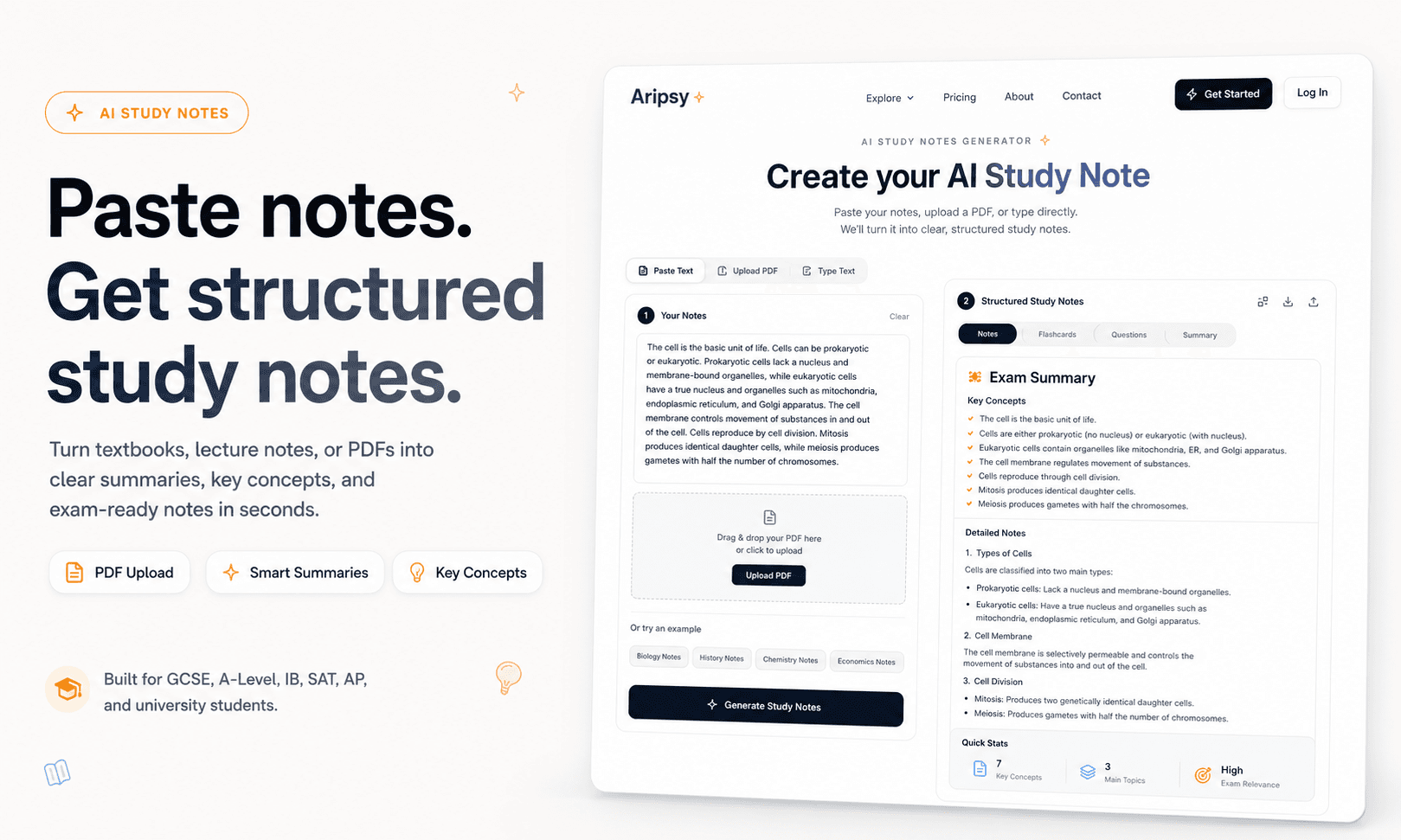
Product workflow preview
What the workflow looks like in Aripsy
This workflow focuses on turning verified notes into recall cards students can test from memory. The screenshot shows the same Aripsy workflow students use to add material, choose study settings, generate notes, then build recall practice from the saved session.
Related topics
Turn notes into active recall cards
Flashcards work because they force you to retrieve information from memory. Aripsy reads your notes and creates question-answer pairs so you can start testing yourself without manually writing every card.
Best for definitions, processes, formulas, and examples
The strongest flashcards ask one clear question and expect one clear answer. Aripsy is useful for biology definitions, chemistry processes, physics formulas, history dates, language vocabulary, and law or medicine concepts.
Use your own source material
Generic flashcard decks can miss what your teacher or exam board expects. Aripsy creates flashcards from the notes you provide, helping your practice stay closer to your syllabus, lecture, or textbook chapter.
From flashcards to stronger revision
After generating cards, review them regularly and mark weak areas for another pass. Pro users can create larger flashcard sets and export study materials depending on plan features.
Useful student workflows
Key term revision
Create front/back cards for definitions, formulas, dates, theorists, symptoms, cases, or command words.
Process memorization
Break biology pathways, legal tests, historical causes, or maths methods into small recall prompts.
Before a timed quiz
Generate a compact flashcard set from the notes you just revised, then remove weak or duplicated cards.
Good AI flashcards are small and testable
A flashcard should ask for one retrievable idea at a time. If a card asks for a whole paragraph, it becomes another reading task. Aripsy helps students turn source notes into focused prompts, then lets Pro users export an Anki-importable tab-separated .txt file when that fits their workflow. The best results come from verified notes with clear definitions, examples, and boundaries.
Aripsy compared with Anki and Quizlet
Anki is powerful for spaced repetition and Quizlet is familiar for manual sets. Aripsy focuses on the creation step: students can generate notes from their own material, then create flashcards without manually rewriting every term. That is useful when a lecture, textbook section, or PDF contains many facts but still needs checking before long-term memorization.
How to review AI-generated cards responsibly
After generation, delete cards that are too broad, split cards that test two ideas, and correct any wording that does not match your course. Use the original source for facts and dates. Flashcards work best when students answer from memory first, then check the back of the card, rather than flipping through them like mini notes.
Sources and further reading
These independent education resources inform the study habits discussed on this page. Always follow your teacher, tutor, specification, or official exam guidance first.
Retrieval practice
Explains why pulling answers from memory is usually stronger than rereading notes.
The Learning ScientistsSpaced practice
Useful background for turning notes into flashcards and revisiting them over time.
University of MinnesotaUse retrieval practice
A university study resource explaining how self-testing supports learning.
Ready to revise with less friction?
Start with your own material and build a clearer revision workflow.
Free includes limited flashcards; Pro has no separate flashcard cap within the 300 monthly AI-generation allowance.
Supported Subjects
Biology, Chemistry, Physics, Mathematics, History, Geography, Economics, Business, Psychology, Computer Science and English Literature.