How to Make A-Level Revision Notes for Content-Heavy Subjects
Make effective A-Level revision notes by mapping the current specification, compressing each topic into a one-page core, separating evidence and examples from explanations, and converting the finished notes into retrieval and exam-question prompts.
Turn your material into structured notes
Content-heavy A-Levels create a specific revision problem: the amount of material makes complete notes feel safe, but copying everything leaves too much to retrieve. A 40-page topic pack is not useful simply because it is shorter than the textbook.
Effective revision notes perform three jobs. They show what the current specification requires, explain the core knowledge clearly, and expose prompts that can be practised without looking. Anything else should earn its place by helping with an assessed skill.
Quick answer: how should you make A-Level revision notes?
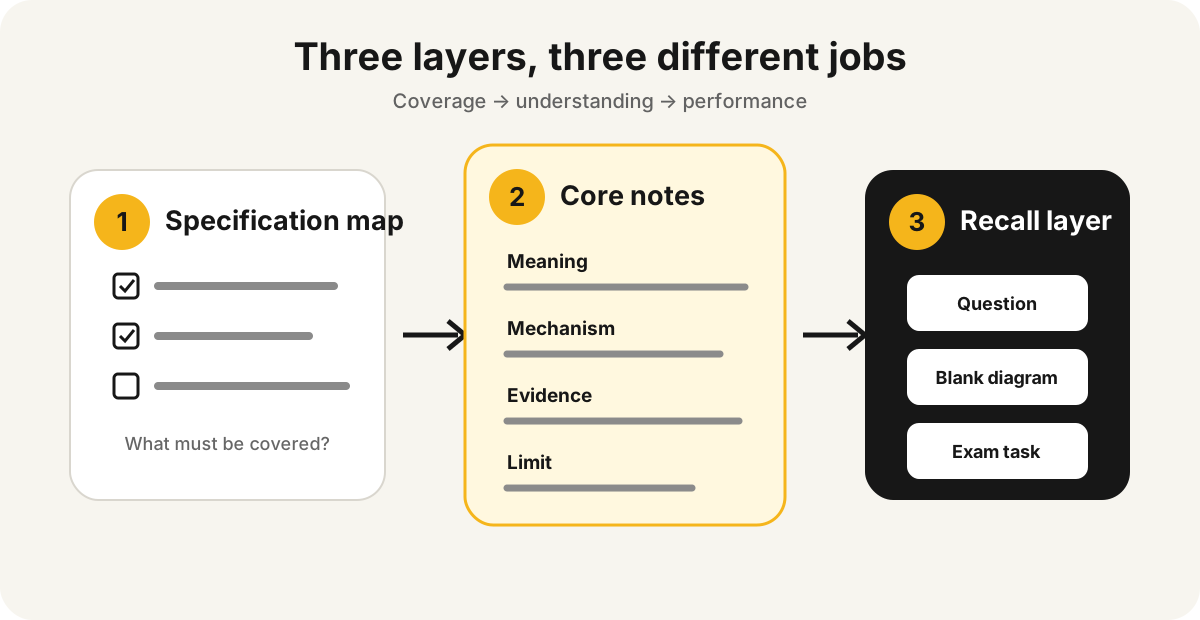
Use a three-layer system:
- Specification map: turn each required topic or assessment objective into a checklist.
- Core notes: compress one subtopic into definitions, relationships, processes, evidence, and exceptions.
- Recall layer: convert the core notes into questions, blank diagrams, essay plans, calculations, or data tasks.
Start with the current specification and course guidance for your exact subject and exam board. Use textbooks and lessons to understand each point, then reduce the material into your own checked structure. Revisit weak topics through retrieval and exam questions rather than repeatedly rewriting the same pages.
Why ordinary note-taking breaks down at A-Level
Content-heavy subjects do not contain only “more facts.” They also require students to connect different kinds of knowledge.
- Biology combines terminology, mechanisms, diagrams, calculations, practical methods, and data interpretation.
- History combines chronology, causation, change, evidence, interpretations, and argument.
- Psychology combines theories, studies, research methods, evaluation, and application.
- Law combines rules, cases, exceptions, statutory language, and scenario analysis.
- Geography combines processes, case studies, data, concepts, and place-specific evidence.
A single paragraph-based note style handles these demands badly. Definitions become buried, evidence loses its purpose, and the learner cannot see whether the notes support recall, explanation, or evaluation.
The solution is to organise notes by the job each piece of information performs.
Build the specification map first
The specification is the boundary of the course, but it is not always a complete teaching explanation. Use it to create a coverage map, then use lessons, endorsed texts, and teacher materials to understand the content.
For every specification point, record:
| Field | Question to answer |
|---|---|
| Topic | What exact area does this point cover? |
| Command | Must you state, explain, calculate, analyse, compare, or evaluate? |
| Core knowledge | Which facts, relationships, or processes are essential? |
| Evidence | Which study, case, quotation, statistic, example, or practical supports it? |
| Skill | Which question type should you practise? |
| Status | Can you retrieve and apply it without notes? |
Pearson describes a specification as the document that outlines what is taught, how students are assessed, and how marks are awarded. AQA’s subject pages similarly connect content with assessment objectives and component weightings. That is why the current document for your exact qualification—not a generic online checklist—should anchor the map.
Exam-board documents can change. Confirm the qualification code, teaching period, and assessment materials with your school or college before reorganising a full course.
Use three layers instead of one enormous notebook
Layer 1: specification map
This is the coverage view. It should be short enough to scan and precise enough to reveal a missing topic. It is not the place for full explanations.
Layer 2: core notes
This is the understanding view. Each subtopic should normally contain:
- A one-sentence overview.
- Essential terminology.
- The main process, chain of reasoning, or argument.
- Evidence or examples attached to the point they support.
- Important limitations, exceptions, or conditions.
- One or two links to related topics.
Layer 3: recall and exam prompts
This is the practice view. It contains questions rather than more explanation: blank diagrams, flashcards, essay-plan titles, calculations, source questions, case scenarios, and “explain why” prompts.
The layers prevent a common mistake: using attractive notes as proof that learning has happened. Layer 2 supports understanding; Layer 3 tests whether that understanding can be retrieved and used.
Compress by meaning, not by deleting random words
Good compression keeps the relationship while removing repeated prose.
A copied history paragraph might describe several economic, political, and social pressures before a reform. A useful note does not merely shorten each sentence. It reorganises the content into:
- Claim: the factor’s contribution.
- Mechanism: how it created pressure for change.
- Evidence: a date, event, quotation, or historian where required.
- Limit: why the factor does not fully explain the outcome.
- Link: how it interacted with another factor.
In biology, the same structure may become:
- Process: what happens.
- Location: where it happens.
- Cause: what drives the change.
- Outcome: what is produced or affected.
- Condition: when the statement is true.
- Evidence: a practical result, graph, or calculation.
If compression removes the mechanism, the note becomes a disconnected fact. If it removes the qualifier, the note may become false.
Make one-page topic cores
A one-page core is not a rigid rule and should not force tiny writing. It is a design constraint: one glance should reveal the topic’s structure.
A useful page might contain:
- The exact topic or specification point.
- Five to eight core ideas.
- One process, timeline, argument chain, or comparison.
- Required evidence and examples.
- Common confusions or exceptions.
- Three retrieval prompts.
- One exam-style application.
Move extended examples, source extracts, full case summaries, and worked solutions into linked supporting pages. The core page should tell you what matters and where deeper evidence belongs.
Choose the right note structure for each subject
A-Level Biology and other sciences
Use process diagrams, cause-and-effect chains, comparison tables, required-practical summaries, and calculation prompts. Keep units and conditions beside formulas. Test diagrams without labels instead of repeatedly viewing completed versions.
A-Level History
Organise material by enquiry rather than chapter order. Use timelines for sequence, factor tables for causation, and evidence banks tied to potential arguments. A date without significance is trivia; an argument without evidence is unsupported.
A-Level Psychology
Separate description from evaluation. For each theory or study, record the claim, method, finding, implication, strength, limitation, and the exact issue each evaluation point addresses. Avoid memorising generic evaluation sentences that could apply to anything.
A-Level Law
Use rule-case-application structures. Record the legal rule, authority, material facts, principle, exception, and a short scenario that requires application. A case name alone is not a usable revision note.
A-Level English Literature
Avoid a quotation bank with no argument. Group concise quotations by theme, character, method, context, or debate, and record what each quotation can support. Check the assessment objectives for the specific qualification because their weight and combination shape the response.
Keep evidence attached to its purpose
Large note sets often separate “facts” from “evaluation,” which makes it hard to build an answer. Store evidence beside the claim it supports.
Use a compact evidence record:
| Element | Example prompt |
|---|---|
| Claim | What point does this evidence support? |
| Evidence | What exact study, case, statistic, quotation, or event is needed? |
| Explanation | Why does it support the claim? |
| Limitation | When is the evidence weaker or less relevant? |
| Use | Which question types could use it? |
This is particularly helpful for essays. It turns memorised material into a resource for selecting and defending an argument.
Convert notes into active recall
Notes become revision material when they generate a task you can attempt without looking.
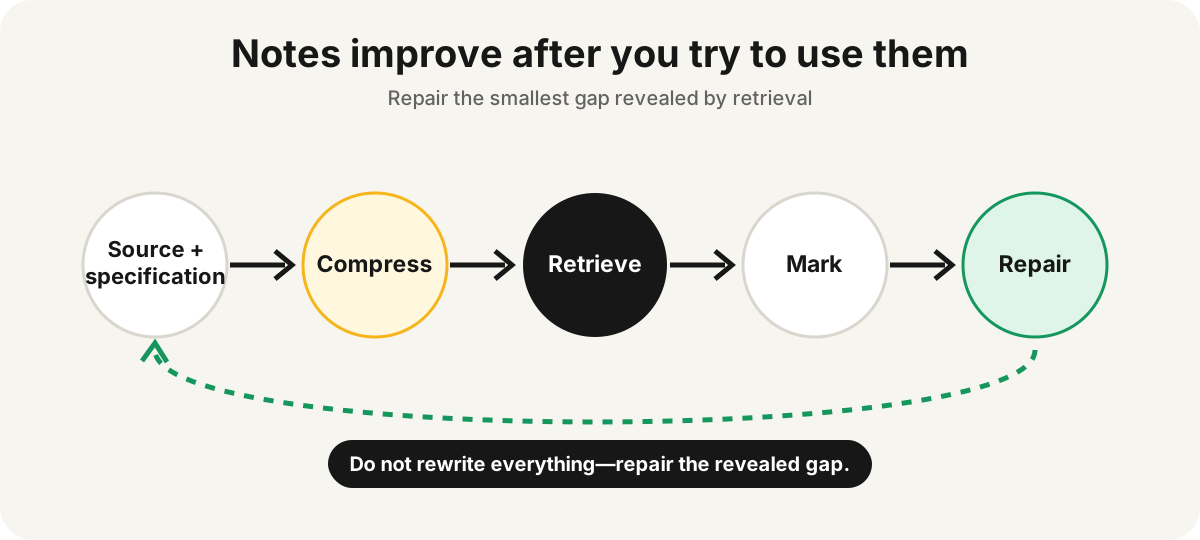
After finishing a topic core:
- Close the notes.
- Reproduce the structure from a blank page or explain it aloud.
- Answer the recall prompts.
- Complete one exam-style question or outline.
- Mark the attempt using current teacher or exam-board materials where available.
- Repair the smallest missing part of the notes.
Do not rewrite the whole topic after one weak answer. Add the missing distinction, example, link, or trigger that would have helped.
The active-recall guide explains why attempting retrieval is different from rereading. The past-paper guide covers the later stage of applying knowledge under assessment conditions.
A weekly workflow for content-heavy subjects
Use a cycle that keeps current material moving into long-term review.
After each lesson
- File the source under the correct specification point.
- Correct incomplete or unclear class notes.
- Add only new information to the core notes.
- Write three to five retrieval prompts.
At the end of the week
- Attempt the topic prompts without notes.
- Mark confident, partial, and failed answers.
- Update the coverage map.
- Complete one mixed question using more than one subtopic.
Every few weeks
- Use cumulative retrieval across older topics.
- Compare your coverage with the current specification.
- Practise timed planning or calculation.
- Remove duplicate notes and repair recurring gaps.
This prevents revision from becoming a second round of note production just before the exam.
How Aripsy can help make A-Level revision notes
Aripsy can turn focused pasted text and supported documents into structured notes, flashcards, and practice material. It accepts PDF, PowerPoint .pptx, and Word .docx document inputs. Signed-in Free users can try one successful document upload; ongoing uploads up to 15MB require Pro.
Use it as a drafting and practice layer:
- Select one specification point or coherent lesson section.
- Open the study tool.
- Paste the relevant text or upload a supported document.
- Choose the subject, level, and available curriculum context.
- Generate a structured draft.
- Compare every important claim with the source and current course materials.
- Edit the notes into your three-layer system.
- Generate flashcards or questions from the checked version.
Selecting an exam board provides context; it does not guarantee exact specification coverage or mark-scheme wording. AI output can omit qualifiers, misread tables, or add plausible material that was not in the source. Keep the current specification, course guidance, and original material beside you while checking.
What not to put in your final revision notes
Remove or relocate:
- Repeated textbook explanations you already understand.
- Decorative formatting that does not reveal structure.
- Examples that do not support a required point.
- Unsupported AI-generated additions.
- Full mark schemes copied without analysing what they reward.
- Large quotation or case lists with no possible use attached.
- Duplicate notes made from several resources.
Keep a source archive if you may need the detail later. Compression does not mean deleting the original material; it means separating the revision layer from the reference layer.
Common mistakes
Making notes before checking the specification
This can produce beautiful coverage of the wrong depth or topic. Map the course first.
Using one format for every subject
A timeline, mechanism diagram, essay grid, and case table solve different problems. Match the format to the knowledge and assessment.
Adding evidence without an argument
Record what each example proves and its limitations.
Highlighting instead of retrieving
Colour can show structure, but it does not test memory. Add prompts that require an answer without the page.
Treating generated notes as final
Check them against the original source, specification, and course guidance before revising from them.
FAQ
How long should A-Level revision notes be?
There is no reliable page target. A useful topic core should be short enough to reveal the structure at a glance while preserving the definitions, mechanisms, evidence, and conditions needed for assessment. Keep extended evidence in linked supporting pages.
Should I make notes from the textbook or specification?
Use the current specification to define coverage and the textbook, lessons, and approved course materials to understand it. A specification is a map, not always a complete explanation.
Are flashcards useful for content-heavy A-Levels?
Yes, for definitions, distinctions, evidence, sequences, formulas, and short explanations. They should be combined with essay planning, calculations, data interpretation, source work, and exam questions where the subject requires those skills.
Can AI make my A-Level revision notes?
AI can draft and organise notes from focused source material, but it can omit, distort, or invent details. Verify the output against the current specification and original source before using it for revision.
How do I revise several content-heavy subjects at once?
Maintain a specification map for each subject, update topic cores after lessons, and schedule cumulative retrieval. Allocate extra practice to weak topics and high-demand question types instead of rewriting every subject equally.
Sources and further reading
- Pearson: About specifications and course materials
- AQA: A-Level English Literature assessment objectives and weightings
- Dunlosky et al.: Improving students’ learning with effective learning techniques
- Roediger and Karpicke: Test-enhanced learning
- Aripsy study tool
Next study steps in Aripsy
Start with one specification point, make a checked topic core, and turn it into a retrieval task.
Example study workflow
Use one focused source section at a time:
Paste a textbook section, lecture extract, or copied PDF text. Create structured notes, compare important details with the source, then mark the points that still need explanation or practice.
Which workflow should you use?
| Need | Best next step | Aripsy path |
|---|---|---|
| Understand a source | Create structured notes, then verify details. | PDF to notes |
| Remember key facts | Convert definitions and errors into recall cards. | Flashcards |
| Test exam readiness | Use MCQs and mistake review after notes. | Quiz and MCQ practice |
Related study paths
Editorial note
Aripsy articles are written for educational support and exam revision. We review posts for clarity, plan-limit accuracy, permission-aware upload guidance, and cautious AI-use guidance. AI-generated study materials can contain errors, so students should review important points against their source material, syllabus, or mark scheme.
Turn long notes
into revision.
Free users can paste text within Free limits to create notes and limited flashcards. Pro users can upload PDF, PowerPoint, and Word files up to 15MB and generate extra practice formats such as MCQs and fill-in-the-blanks.
Input material
Paste text or upload documents on Pro
Choose focus
Set subject, level and exam board
Revise actively
Review notes, flashcards and practice
Written by
Aripsy Study Team
The Aripsy Study Team writes and reviews practical revision guides for clarity, plan-limit accuracy, and safe exam-use guidance. Articles are designed to support learning, not replace course feedback or source checking.


