How to Build a Study Plan From Your Syllabus and Exam Date
Turn the current syllabus into small, testable tasks; record every exam date; estimate your real weekly capacity; and schedule backward from each paper. Give difficult or high-value topics more practice, include retrieval and exam questions, keep buffer time, and review the plan weekly using completed work and test results.
 Aripsy Study Team
In this article15
A revision timetable is only useful when the work fits before the exam. Colour-coded hours can look organised while hiding an impossible workload, vague tasks, or no time for practice.
A better plan starts with two fixed sources: the current syllabus, which defines what may need to be learned, and the exam date, which defines the time available. You then work backward to turn each topic into a specific task, test it, and adjust the schedule with evidence.
This guide shows you how to build that plan in seven steps. It works for one exam or several subjects, and it includes a recovery method for the week when the original timetable inevitably changes.
Quick answer: how do you make a study plan from a syllabus?
Download the current syllabus or course outline and record every examinable topic. Break broad headings into tasks small enough to complete in one session. Add each confirmed exam date to a calendar, subtract days you cannot study, and estimate how many realistic study blocks remain. Schedule backward from each exam, leaving space for first learning, closed-book recall, questions, correction, and a final review. Keep some blocks empty and revise the plan each week using what you actually completed.
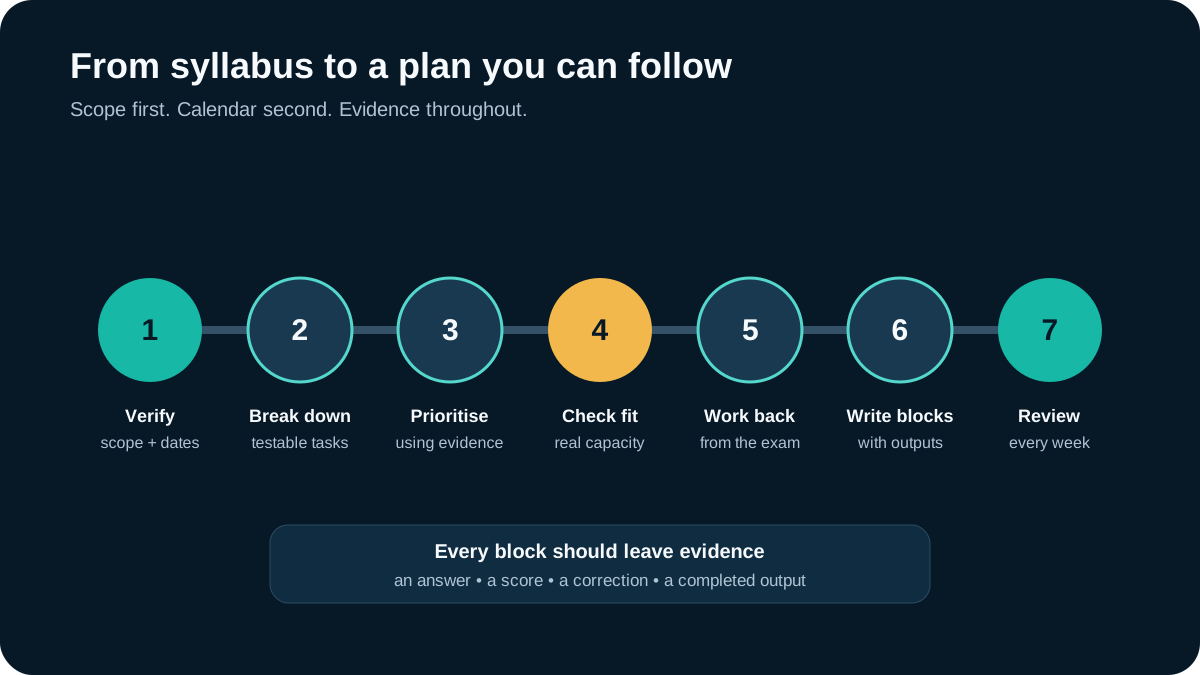
The calendar comes after the scope and workload check. Otherwise, a tidy timetable can still omit topics or demand more hours than you have.
What a useful study plan must show
Before choosing an app, spreadsheet, or paper planner, make sure the plan can answer five questions:
- What is in scope? Every task should connect to the current syllabus, course outcomes, or instructions for the course.
- When is it assessed? Record the exact date, paper, component, and start time from an official timetable or school source.
- What will you produce? “Revise biology” is not an outcome. “Answer six cell-division questions without notes” is.
- When will you return to it? One encounter is rarely enough for reliable recall.
- What changes when you fall behind? A usable plan has buffer and a rule for reprioritising.
The goal is not to account for every minute. It is to make the next useful action obvious while keeping the entire syllabus visible.
Step 1: confirm the syllabus and exam dates
Start with current, official information. For a school qualification, confirm the awarding organisation, qualification, subject, syllabus or specification code, tier, and examination series. For a university course, use the current module handbook, learning outcomes, assessment brief, lecturer announcements, and official exam timetable.
Record:
- exam name, date, start time, and location or delivery method;
- paper or component number and duration;
- topics and skills assessed;
- permitted calculators, formula sheets, texts, or other materials;
- practical, oral, coursework, or submission deadlines that compete for study time;
- the source URL or document version and the date you checked it.
Do not build a current plan from an old revision website or a past paper alone. Exam structures and content can change. AQA, for example, advises students to use the specification to check expected content and skills and provides past papers for current specifications. If two sources disagree about a date, ask your school, college, or exam office before scheduling around it.
Step 2: turn every syllabus point into a testable task
A syllabus is a coverage checklist, not a ready-made timetable. Translate each line into work you can finish and verify.
| Syllabus wording | Too vague | Schedulable task |
|---|---|---|
| Cell division | Revise cells | Explain mitosis from memory, label one diagram, then answer four questions |
| Quadratic equations | Do algebra | Solve six mixed quadratics and classify each error |
| Poetry comparison | Study poetry | Build one comparison plan using two poems and three quotations |
| Market structures | Read chapter 6 | Explain four structures, compare two, then apply them to one case |
Use verbs that leave evidence: explain, solve, label, compare, recall, plan, answer, mark, correct. “Read” and “review” can be part of a session, but they do not show whether you can retrieve or apply the material afterward.
If a syllabus heading would take several hours, split it. If a task takes less than ten minutes, combine it with a related item. A practical planning unit is usually one focused outcome that fits a normal study block.
Add one source beside every task. That may be a textbook section, lecture, teacher resource, official specification point, or permitted set of notes. This prevents the plan from becoming a list of topics with no reliable material attached.
Step 3: rank topics using evidence, not preference
Equal time for every topic sounds fair but is rarely efficient. Rank each task using:
- current performance: what happens when you answer without notes;
- assessment value: the topic’s published weighting or its role in assessed skills;
- connections: whether it supports several later topics;
- work remaining: whether you need first learning, practice, or only a short check;
- urgency: which paper comes first.
Use official weighting only when it is actually published. Do not infer that a topic is “due” because it was missing from a recent paper.
A quick traffic-light label is enough to begin:
- Red: cannot retrieve or apply the idea yet.
- Amber: partly correct, inconsistent, or too slow.
- Green: can answer an appropriate question accurately without support.
Confidence is only a prediction. Verify it with a closed-book prompt or a representative question. For a fuller diagnosis, use the seven-step method for finding weak topics.
Step 4: calculate your real study capacity
Count the days until each exam, then remove time that is already committed: classes, work, travel, sleep, meals, care responsibilities, coursework, and days when studying will not be realistic.
Next, count study blocks, not imaginary perfect hours. If you can reliably complete two 40-minute blocks on Tuesday, record two blocks. Do not write four because four would be convenient.
Use this feasibility check:
Required blocks = first-learning blocks + retrieval blocks + question-practice blocks + correction and final-review blocks
Compare the result with the blocks actually available before the relevant paper.
Leaving roughly 20–30% of available blocks unassigned can be a useful starting buffer, but it is a planning heuristic—not a universal research-backed percentage. Your buffer may need to be larger if your week changes often, and smaller if the exam is very close. The important rule is not to allocate every available minute.
If the work does not fit, do not compress every task until the timetable becomes fiction. Instead:
- protect high-value weak topics and prerequisite skills;
- reduce low-value polishing and duplicate note-making;
- combine related green-topic checks;
- ask a teacher which gaps deserve attention first;
- revise the scope whenever an exam date or assignment changes.
Step 5: work backward from each exam date
Start at the exam and place the final practice first. Then move backward through correction, retrieval, and initial learning.
For each topic, use a sequence such as:
- Learn or clarify: understand the concept and create a concise checked reference.
- Retrieve: answer a prompt with the reference closed.
- Apply: complete a fresh question or task in the required format.
- Correct: identify why marks or steps were lost and repair that point.
- Retest: attempt a different question after a delay.
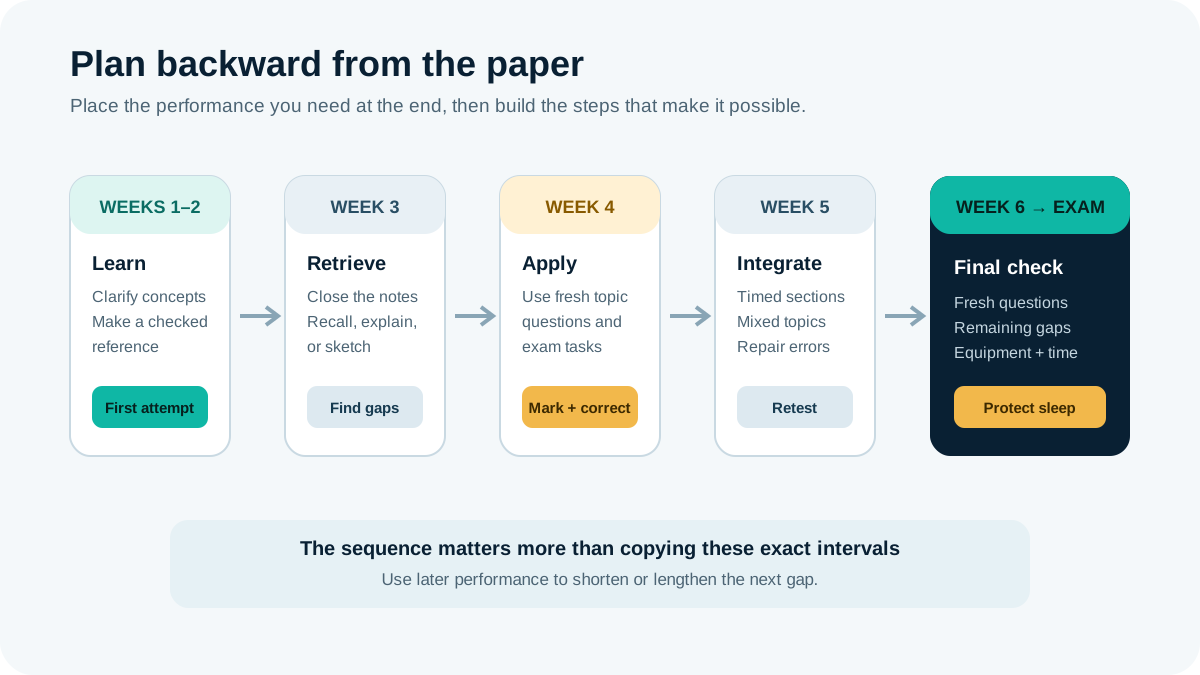
This six-week example shows the order of work, not compulsory intervals. Spacing should reflect the time available, the material, and your performance.
Research supports distributing study across time rather than massing it into one sitting, but there is no single perfect spacing schedule for every subject or exam date. A same-day recall attempt, another attempt several days later, and a later application task is a practical starting pattern. Shorten or lengthen the gaps based on whether you can still retrieve the material.
Build spaced practice into flashcard review, but remember that a scheduled review still needs effortful recall. Looking at the answer before attempting it is not retrieval practice.
When you have several exams
Work backward from every paper separately, then combine the plans on one calendar. An earlier exam usually needs earlier question practice, while a later exam may still need small maintenance sessions so it is not forgotten.
Use three checks before accepting the combined plan:
- Does any day contain more blocks than you can realistically finish?
- Does one subject consume the week because its tasks were written too broadly?
- Does every paper have time for questions and correction, not just content coverage?
If two important tasks collide, compare exam proximity, current weakness, assessment value, and dependency. Do not always choose the nearest deadline if neglecting a foundational topic will create a larger problem later.
Step 6: write each session as an observable outcome
The calendar entry should tell you exactly how to start and how to know you are finished.
Use this template:
- Topic: the precise syllabus point.
- Outcome: what you will be able to do by the end.
- Main task: explanation, worked example, or focused revision.
- Recall task: what you will produce with notes closed.
- Practice task: question, calculation, essay plan, or application.
- Check: answer, mark scheme, model, instructor comments, or source comparison.
- Next review: a provisional return date.
Example:
- Topic: trigonometric ratios in right-angled triangles.
- Outcome: select sine, cosine, or tangent from the known and unknown sides.
- Main task: annotate two worked examples.
- Recall task: write SOHCAHTOA and explain the selection rule without notes.
- Practice task: complete six mixed questions.
- Check: mark each step and label selection, substitution, calculator, or rounding errors.
- Next review: retry two fresh questions in three days.
| Day | Specific block | Evidence produced |
|---|---|---|
| Monday | Explain cell division, then draw it from memory | Labelled diagram plus correction |
| Tuesday | Solve six quadratics using mixed methods | Marked workings and error labels |
| Wednesday | Compare two poems in a timed plan | Thesis, evidence, and paragraph order |
| Thursday | Mixed closed-book recall across three topics | Short score and gaps list |
| Friday | Complete one timed paper section | Marks, timing, and correction log |
| Saturday | Repair the two highest-impact errors | Retest answers |
| Sunday | Review the plan for 15 minutes | Rescheduled tasks and next week’s priorities |
For the learning method behind the recall blocks, read how active recall improves exam revision. For question selection and correction, use the mark–review–retry past-paper workflow.
Step 7: review the plan weekly and repair it
A timetable is a forecast. Treat missed sessions as information, not as a reason to abandon the plan.
At the end of each week, ask:
- Which blocks were completed?
- Which tasks repeatedly took longer than estimated?
- Which topics improved when tested?
- Which errors remain high impact?
- What changed in the official course or exam information?
Then use the move, shrink, replace, or remove rule:
- Move an important unfinished task into a buffer block.
- Shrink a broad task into one essential outcome.
- Replace a passive session with a diagnostic question when you need evidence.
- Remove duplicate polishing or a task that is no longer relevant.
Do not double the next day’s workload to “catch up.” That often creates a second failure. Recalculate the available blocks and protect the work most likely to improve readiness.
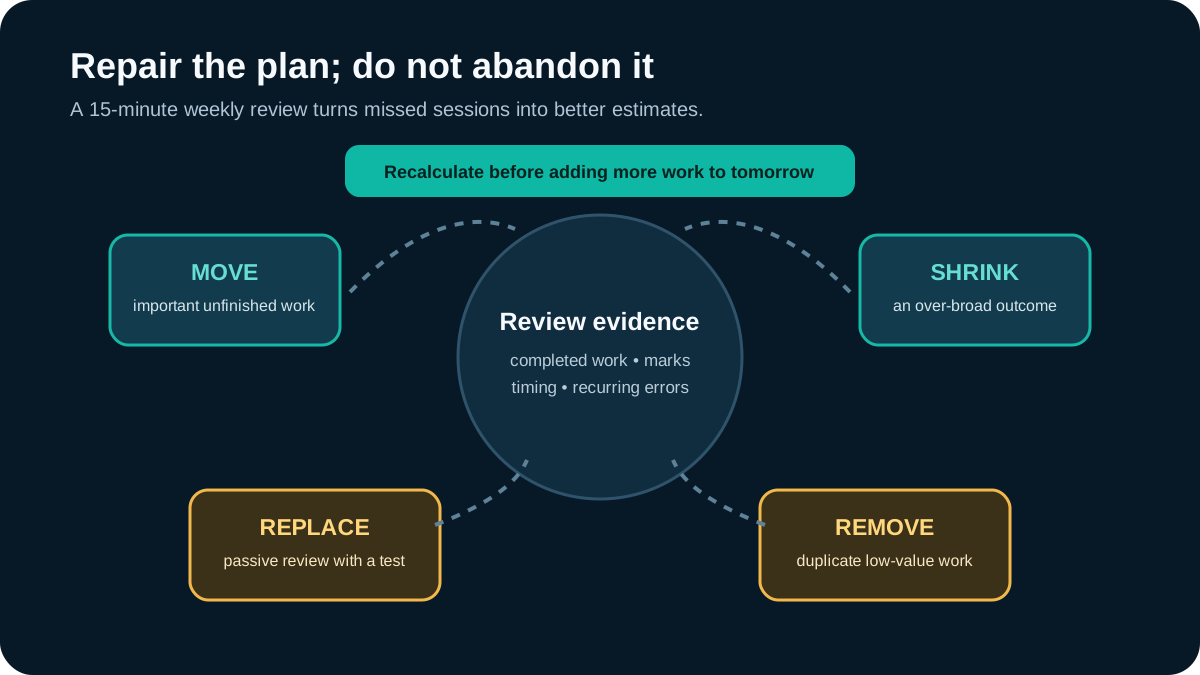
A good plan changes when the evidence changes. Completed tasks, marks, timing, and recurring errors are more useful than guilt.
A worked six-week example
Imagine a student has a biology exam in six weeks, 24 focused blocks available, and 18 syllabus tasks. A possible allocation is:
| Period | Main purpose | Example work |
|---|---|---|
| Weeks 1–2 | Diagnose and cover red foundations | Short teaching review, diagrams, first retrieval, targeted questions |
| Weeks 3–4 | Complete first coverage and revisit earlier topics | Mixed recall, calculations, data interpretation, topic questions |
| Week 5 | Integrate topics under exam conditions | Timed sections, mark-scheme review, error repair |
| Week 6 | Retest the remaining gaps and protect sleep | Fresh questions, concise recall sheets, equipment and timetable check |
The 24 blocks should not automatically be divided equally among 18 tasks. A secure topic may need one diagnostic check. A weak foundational process may need several attempts across different days.
If early questions show that the student already understands a scheduled topic, that block can move to a higher-priority gap. If a task takes twice as long as estimated, the next weekly review should update similar estimates instead of pretending the original plan was correct.
What to do when the exam is close
When there is not enough time for full coverage, switch from ideal planning to explicit triage:
- confirm the current paper format and remaining time;
- identify prerequisite and high-impact weak areas;
- test before making more notes;
- use short, checked explanations only where a knowledge gap blocks practice;
- complete representative questions and correct them;
- avoid sacrificing sleep to preserve an unrealistic schedule.
Do not use past-paper patterns to guess that an unstudied topic “will not come up.” Prioritisation manages limited time; it does not change the published scope of the exam.
Students following a compressed GCSE schedule can adapt the four-week GCSE revision plan. The syllabus-based method in this article should still determine the topics inside each week.
Use AI without outsourcing the plan
AI can help break a long topic into draft tasks or turn permitted source material into notes and recall prompts. It should not invent exam dates, decide what is outside the syllabus, or guarantee that a generated plan covers the assessment.
Before relying on an AI-assisted plan:
- compare every date with the official timetable;
- compare every topic with the current syllabus or learning outcomes;
- remove tasks based on material you are not expected to study;
- check generated facts and questions against trusted sources;
- adjust duration estimates using your own completed sessions.
Once one task is clearly defined, you can turn the source material into revision notes and practice. Treat the output as a draft, then verify it before adding it to the timetable.
Copyable study-plan checklist
- [ ] I confirmed the current syllabus, course, tier, and exam series.
- [ ] I recorded every exam and competing deadline from an official source.
- [ ] Every broad topic is split into a task that fits one study block.
- [ ] Every block has an observable output.
- [ ] Weakness ratings are supported by a recall attempt or question.
- [ ] The total required work fits the blocks actually available.
- [ ] The plan includes learning, retrieval, questions, correction, and retesting.
- [ ] Some time remains unassigned for disruption and overruns.
- [ ] Multiple subjects are combined without overloading individual days.
- [ ] I have a weekly review and a rule for missed tasks.
FAQ
How do I make a study plan from a syllabus?
Turn each current syllabus point into a task you can complete and check, such as explaining a concept from memory, making a small flashcard set, or answering questions. Record the confirmed exam date, calculate the study blocks genuinely available, and schedule the tasks backward with time for retrieval, application, correction, and buffer.
What is the best way to plan revision before exams?
Work backward from each exam date after checking that the workload fits. Prioritise weak or foundational topics with meaningful assessment value, and put active recall, spaced review, questions, and correction into the calendar. Review the plan weekly instead of treating the first version as fixed.
How much time should I leave for revision each week?
Use the hours you can repeat without sacrificing classes, responsibilities, sleep, meals, or recovery. Leaving roughly 20–30% of potential blocks unassigned is a practical starting buffer, not a universal rule. Change it based on how predictable your schedule is and how close the exam is.
What should go in a revision timetable?
Use specific outcomes rather than subject names. Write “answer six cell-division questions and correct them” instead of “biology.” Include the source, the intended output, how you will check it, and when you expect to return to the topic.
Does active recall belong in a study plan?
Yes. Put recall after initial learning and before checking the answer. Flashcards, free recall, short quizzes, explanations, and practice questions can all work when you genuinely attempt retrieval and then correct errors using a reliable source.
Why is spaced repetition useful for exam revision?
Spacing puts separate learning attempts across time rather than into one long session. Research generally finds an advantage for distributed practice, but the best gap depends on the material and the time until the exam. Use later recall performance to decide whether the next gap should be shorter or longer.
Sources and further reading
Keep exploring
Find a study workflow
Choose the source, output, or course route that fits your next study task.
Browse study workflows
Written by
Aripsy Study Team
The Aripsy Study Team creates practical revision guides designed to support learning, source checking, and active practice.