Academic Integrity: A Student Guide to Honest Work
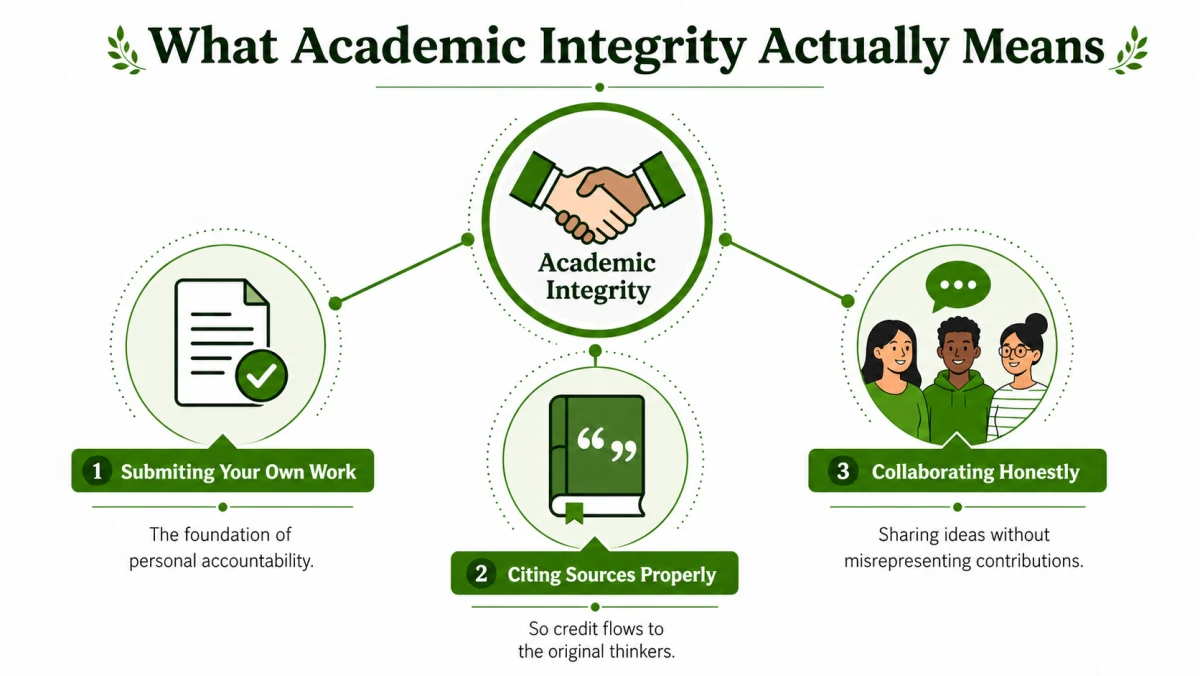
Academic integrity means submitting work that honestly represents your own contribution, crediting every source, collaborating only within the stated rules, and checking permission before reusing work or using AI and other assistance.
 Aripsy Study Team
In this article13
Academic integrity is more than avoiding deliberate cheating. It means making your contribution clear: which ideas are yours, which came from a source, who helped, and which tools you used.
The difficult cases are often not obvious. Can a classmate comment on your draft? Can you reuse a paragraph from a previous assignment? Is an AI study tool allowed to create practice questions? The answer depends on the rules for that specific course and assessment.
This guide explains four forms of academic misconduct students commonly confuse and gives you a practical way to check your work before submission. It is general guidance, not a replacement for your institution’s policy or assessment brief.
Quick answer: what does academic integrity mean?
Academic integrity means doing and presenting academic work honestly. In practice, that usually requires you to:
- Submit work that accurately represents your own contribution.
- Acknowledge words, ideas, data, images, code, and other material taken from sources.
- Collaborate only to the extent the assessment allows.
- Get permission before reusing work you have already submitted.
- Use calculators, translators, AI tools, editors, and other assistance only when permitted.
- Explain or declare assistance when the rules require it.
The International Center for Academic Integrity describes academic integrity through six values: honesty, trust, fairness, respect, responsibility, and courage. Those values provide the purpose; your institution’s policy and assessment instructions provide the local rules.
Four forms of academic misconduct students often confuse
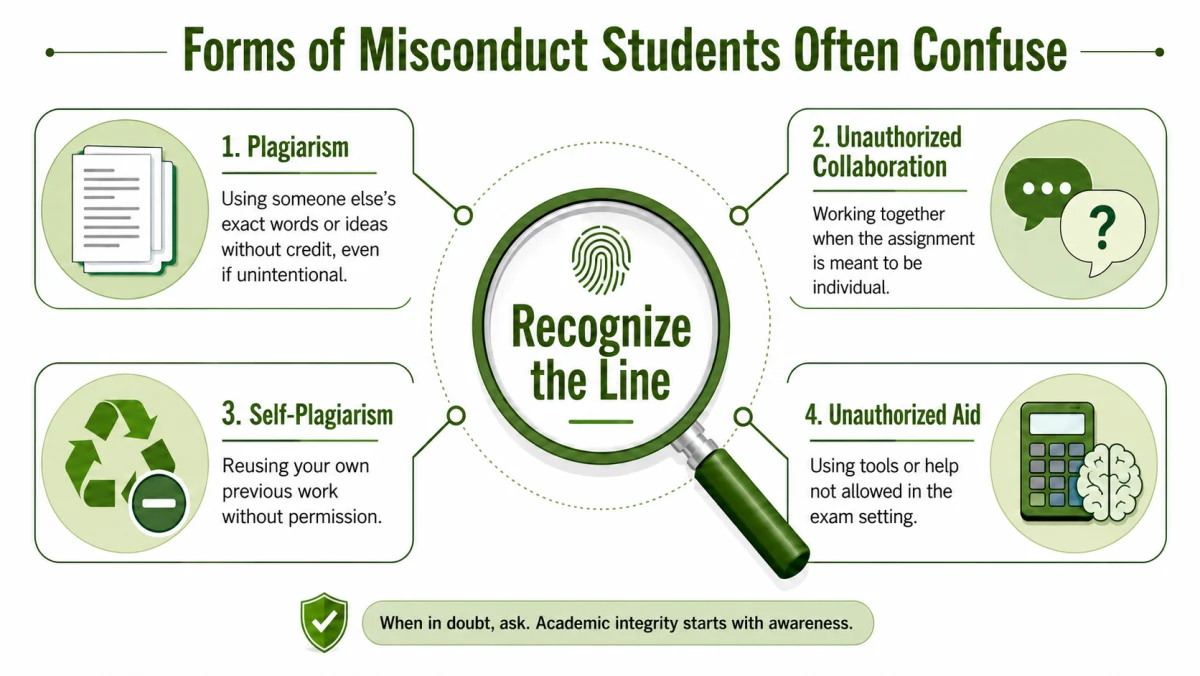
The labels and procedures differ between institutions, but the following distinctions are widely useful.
| Form | What it generally means | A common example | Safer next step |
|---|---|---|---|
| Plagiarism | Presenting another person’s words, ideas, or work without appropriate acknowledgement | Paraphrasing an article closely but giving no citation | Cite the source and rewrite from your understanding |
| Unauthorized collaboration or collusion | Working with another person beyond what the assessment permits | Two students jointly draft answers for an individual assignment | Confirm what discussion, feedback, or shared work is allowed |
| Self-plagiarism | Reusing work you previously submitted without permission or acknowledgement | Submitting part of an old essay in a new assessed task | Ask whether reuse is permitted and how it should be referenced |
| Unauthorized aid | Using a person, device, resource, or tool that the assessment does not allow | Using an AI assistant during a closed assessment that prohibits it | Check the brief before use and disclose assistance if required |
These categories can overlap. For example, submitting AI-generated prose as your own could breach rules on permitted AI use, authorship, acknowledgement, or plagiarism. The exact finding depends on the policy that applies to the task.
1. Plagiarism is about attribution, not just copying
Plagiarism is often described as copying exact words, but it can also involve ideas, structure, data, images, code, translations, or unusually close paraphrasing.
Citation has two jobs:
- It tells the reader where the material came from.
- It separates the source’s contribution from your own analysis.
A bibliography alone may not do both jobs. If a particular sentence, claim, quotation, figure, or argument comes from a source, place the relevant in-text citation or footnote where the reader can connect it to that material. Follow the citation style required by your course.
A safer paraphrasing method
- Read the source until you understand the point.
- Close or move away from it.
- Explain the idea in your own structure and wording.
- Compare your version with the original for accidental close copying.
- Add the citation even though the wording is now yours.
Changing a few words or rearranging a sentence is not a reliable paraphrase. The underlying idea still needs acknowledgement.
2. Collaboration becomes collusion when it crosses the stated boundary
Collaboration is not automatically misconduct. Group projects, peer discussion, study groups, and feedback can all be legitimate. The issue is whether the help remains within the assessment’s permitted boundary.
For an individual task, the rules might allow you to discuss the topic but require independent research, planning, drafting, calculations, code, or editing. Another course might permit peer review but prohibit line-by-line rewriting. Do not assume that rules from one module apply to another.
Before working with someone else, separate three activities:
- Discussing: exchanging general ideas or explaining a concept.
- Reviewing: commenting on work that each student created independently.
- Producing: writing, solving, coding, designing, or editing the assessed answer together.
If the brief is unclear about any of these, ask the module contact before sharing your draft or solution. A useful question is: “For this individual assessment, may we discuss the approach or review each other’s drafts, and what must remain entirely independent?”
3. Self-plagiarism is reuse without permission
You cannot steal an idea from yourself in the ordinary sense, which is why the term can feel confusing. The academic concern is that a new assessment is normally expected to contain new work and to represent the effort completed for that task.
Reusing an old paragraph, dataset, lab report, design, or code submission may therefore require permission and acknowledgement. Even when two assignments cover similar material, the safest process is:
- Check whether previously submitted work may be reused.
- Tell the relevant course contact exactly what you want to reuse.
- Follow any requirement to cite or declare the earlier submission.
- Create new work if permission is not clearly given.
Using an earlier draft of the same assignment may be treated differently from resubmitting work assessed elsewhere. This is one reason the local policy matters.
4. Unauthorized aid includes AI, but it is not limited to AI
Unauthorized aid can include prohibited notes, calculators, translation tools, answer websites, editing services, another person’s help, or generative AI. The tool is not the only question; the task, purpose, and permission matter too.
AI rules can differ across courses and even across assessments in the same course. A tool might be allowed for brainstorming or private revision but prohibited for drafting assessed prose. Some tasks require a declaration, prompt log, or explanation of how output was checked. Others prohibit generative AI entirely.
The permission-purpose-proof test
Before using any digital tool for assessed work, ask:
- Permission: Does the assessment brief or policy clearly allow this use?
- Purpose: Am I using it to learn and review, or to produce work I am expected to create myself?
- Proof: Could I explain what the tool did, show my process, and demonstrate my own understanding?
If permission is unclear, pause and ask. Do not treat silence as approval.
What responsible AI use can look like
Where the rules permit it, AI can support learning without replacing the student’s assessed contribution. Examples may include:
- Asking for a simpler explanation, then checking it against course material.
- Turning your own verified notes into private practice questions.
- Identifying topics to revisit without asking for a submission-ready answer.
- Testing yourself with flashcards before writing independently.
- Comparing your completed work with a rubric when automated feedback is allowed.
Permission still comes first. A responsible study use does not automatically make the same tool acceptable inside an assessment.
If you use Aripsy’s study tool, start with material you are entitled to use, check generated study content against the source, and follow the rules for your course. Aripsy is designed to support studying; it should not be used to misrepresent authorship or bypass an assessment’s conditions. Read more in Aripsy’s responsible AI guidance.
A five-question check before you submit
Use this short audit for essays, reports, presentations, code, lab work, take-home exams, and other assessments.
1. Is every contribution clear?
Could a reader tell which analysis, wording, data, media, and code are yours and which came from someone or somewhere else?
2. Are sources acknowledged at the point of use?
Check quotations, paraphrases, facts that require support, figures, datasets, images, code, and translated material. Make sure every in-text citation also appears in the reference list when your citation system requires it.
3. Was every collaboration permitted?
Confirm that conversations, shared notes, peer comments, proofreading, and joint problem-solving stayed within the task’s rules.
4. Was every tool permitted for this purpose?
Check calculators, translators, grammar tools, code assistants, generative AI, and any other external help. Record or declare their use when required.
5. Can you stand behind the final work?
You should be able to explain the reasoning, verify important claims, reproduce essential steps, and correct mistakes. If you cannot explain part of the submission, investigate it before handing the work in.
Common situations: allowed, risky, or not allowed?
No universal table can decide every case, but these examples show how to reason from the brief.
| Situation | What makes it risky | What to check |
|---|---|---|
| A classmate explains a difficult concept | Their explanation could turn into shared wording or a shared solution | Whether discussion is allowed and what must be produced independently |
| You cite an article after paraphrasing it | The wording may still be too close, or the citation may be misplaced | Whether the expression is genuinely yours and the source is clear |
| You reuse a paragraph from last year’s essay | The new task may require original work completed for this assessment | Whether reuse is permitted and how to declare it |
| An AI tool suggests an outline | The outline may shape assessed work more than the rules allow | Whether AI planning is allowed and whether disclosure is required |
| A friend proofreads your final draft | Their edits could change argument, content, or voice | What kind of proofreading or editing assistance is permitted |
| You create AI flashcards from your notes | Private revision may still involve copyrighted or confidential material | Whether you may upload the material and whether the tool use fits course rules |
What should you do if you are unsure or made a mistake?
Ask early and be specific. Show the instruction that confused you and describe the exact help, reuse, or tool you are considering. Written clarification is easier to follow later than a vague assumption.
If you notice a missing citation or prohibited assistance after submission, read the relevant procedure and contact the appropriate course or academic-integrity office promptly. Do not hide, delete, or fabricate evidence of your process. Honest disclosure does not predetermine the outcome, but it gives the institution accurate information to work with.
Why academic integrity matters beyond one assignment
Honest work gives feedback meaning. If an assessment reflects your actual understanding, the result can show what you know and what needs more practice. Clear attribution also respects the people whose ideas and work helped you.
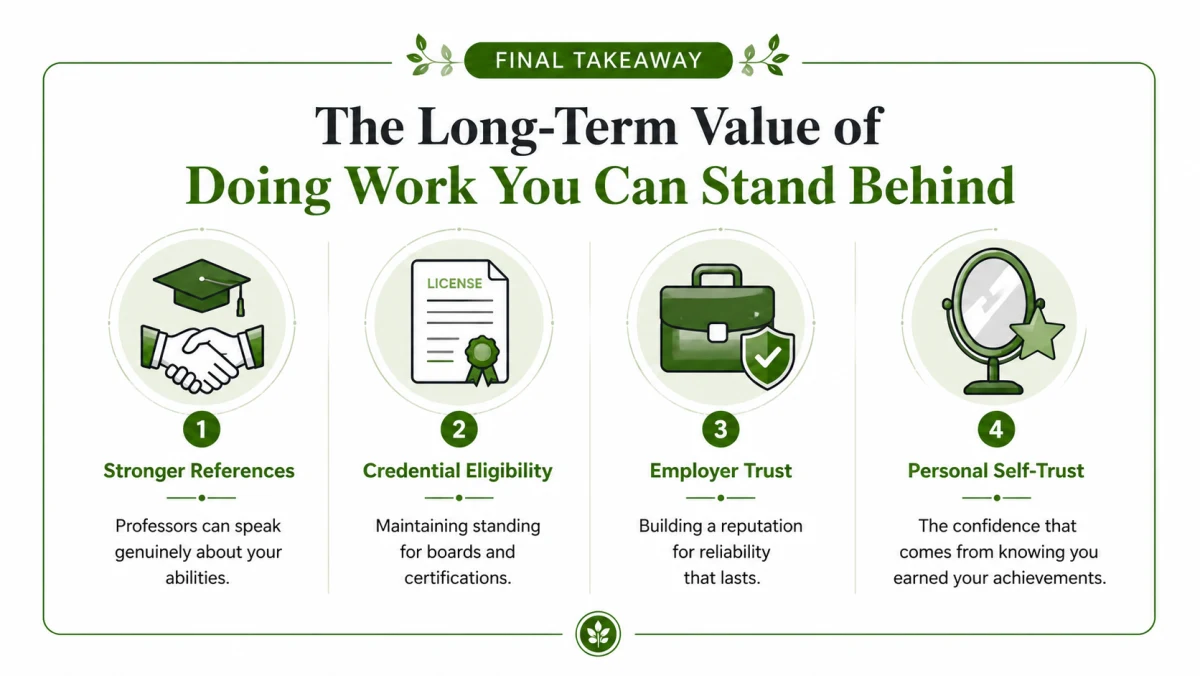
Over time, these habits support reliable references, credible qualifications, professional trust, and confidence in your own abilities. The point is not to produce flawless work. It is to produce work whose origins, assistance, and limitations you can explain.
The outcomes in the following visual are useful reasons to value honest work, not guaranteed consequences. References, professional standing, and credential decisions depend on the relevant people, institutions, and rules.
Sources and further reading
- International Center for Academic Integrity: Fundamental Values of Academic Integrity
- University of Oxford: Plagiarism, collusion, and permitted AI use
- UCL Academic Manual: Student Academic Misconduct Procedure
FAQ
Is accidental plagiarism still plagiarism?
Some institutions distinguish mistakes or poor academic practice from misconduct, while others use different categories and procedures. Lack of intent does not make missing acknowledgement harmless. Correct the work, learn the required citation method, and ask what procedure applies in your course.
Is working with a classmate always collusion?
No. Collaboration is legitimate when the task permits it. It becomes risky when students share or produce work beyond the allowed boundary, especially when an individual assessment must represent independent work.
Can I reuse my own previous assignment?
Only when the applicable rules permit it. Previously submitted work may need explicit permission and acknowledgement, or it may need to be replaced with new work. Check before reusing any part of it.
Is using AI always academic misconduct?
No. AI use is assessment-specific. It may be permitted for some learning or assessment activities, restricted to particular purposes, subject to disclosure, or prohibited. Follow the instructions for the exact task rather than assuming one general rule.
Do I need to cite AI-generated content?
That depends on the institution, citation style, and assessment rules. Some require a declaration or record of prompts rather than a conventional reference. Even when acknowledgement is required, it does not make otherwise prohibited AI use acceptable.
What is the safest rule when instructions are unclear?
Pause before using the help, tool, or previous work and ask the relevant course contact a specific question. Keep the clarification with your assessment instructions so you can follow it consistently.
Keep exploring
Responsible AI for studying
Review practical boundaries for checking and using AI-generated study material.
Open Responsible AI for studying
Written by
Aripsy Study Team
The Aripsy Study Team creates practical revision guides designed to support learning, source checking, and active practice.


