Are AI-Generated Practice Questions Accurate? A Student Evaluation Rubric
AI-generated practice questions can be useful drafts, but there is no reliable universal accuracy rate. Before revising from one, check that its answer and explanation are supported by a trusted source, it matches your syllabus and intended skill, its difficulty is appropriate, its wording permits one defensible answer, and its distractors or marking guidance are plausible. Reject any question with an unsupported answer or content outside the intended course.
 Aripsy Study Team
In this article18
AI-generated practice questions can be accurate, relevant and useful. They can also be fluent-looking drafts with the wrong key, two defensible answers, weak distractors or no relationship to the assessment you are preparing for. You cannot judge that difference from polish alone.
The research does not support one universal accuracy percentage. A recent systematic review and network meta-analysis of AI-generated multiple-choice questions in health-professions education found that results varied across models and measures. Its pooled accuracy estimate was based on a small evidence base, and the authors rated the certainty of every outcome very low. That is a reason to review generated questions—not a reason to assume that all of them are good or all of them are useless.
This guide gives students a repeatable six-part rubric. It is designed for revision questions, not for validating a formal exam or replacing an examiner’s quality-assurance process.
Quick answer: are AI-generated practice questions accurate?
Sometimes, but accuracy must be checked question by question. A revision-ready question needs more than a correct-looking answer. It should be supported by a trusted source, match the intended syllabus or learning objective, test the right level of thinking, use clear wording and provide plausible answer options or marking guidance.
Use the rubric below and score each criterion from 0 to 2. A zero for source support, answer accuracy or course alignment is a hard fail: reject the question until it is corrected and independently checked.
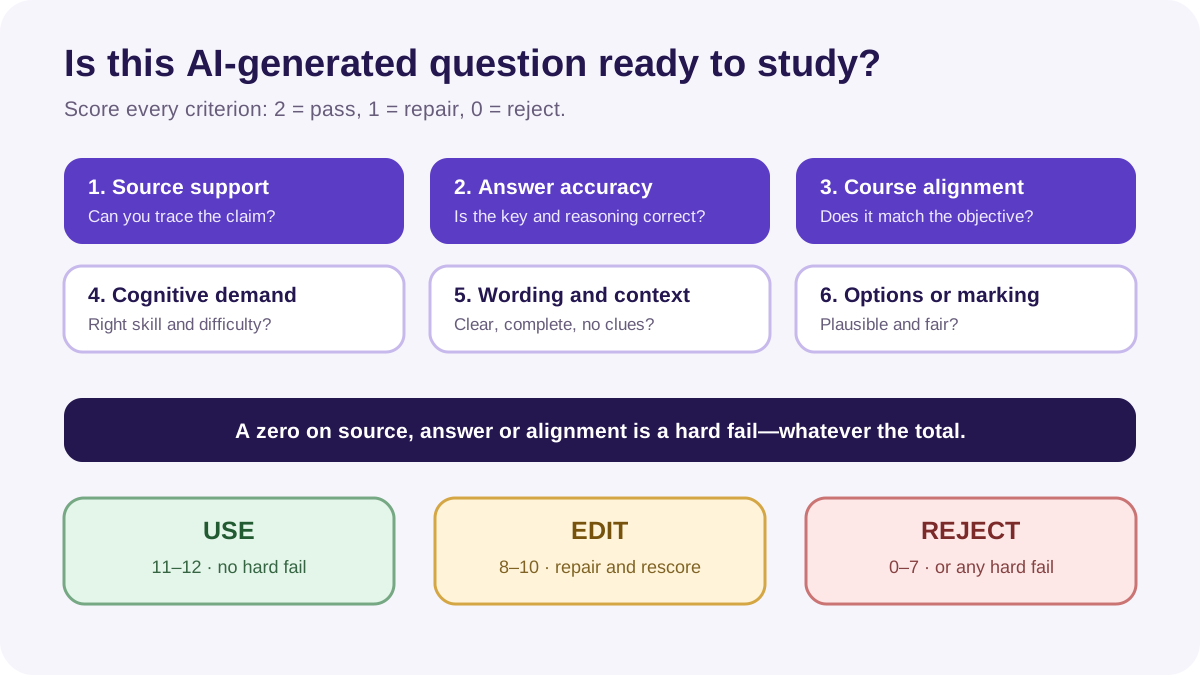
The six-point evaluation rubric
Score each row independently. Do not award points because the wording sounds professional or because the question came from a familiar product.
| Criterion | 2 — Pass | 1 — Repair | 0 — Reject |
|---|---|---|---|
| 1. Source support | The stem, answer and explanation can be traced to a trusted course source | The core idea is supported, but context, conditions or a source reference is missing | The answer depends on invented, contradicted or untraceable information |
| 2. Answer accuracy | The key and reasoning are correct; calculations, units and terminology also check out | The answer is broadly right but the explanation, precision or working needs correction | The key is wrong, two answers are defensible or the method is invalid |
| 3. Course alignment | The question maps to a current learning objective, specification point or assigned material | The topic is relevant but the scope, command word or mark demand needs adjustment | It tests material outside the intended course or misrepresents what must be learned |
| 4. Cognitive demand | The task matches the required recall, application, analysis or evaluation skill | It tests the right topic but at the wrong depth or difficulty | It is trivial, impossibly underspecified or tests a different skill entirely |
| 5. Wording and context | The task is clear, concise and answerable from the information provided | Minor ambiguity, excess wording or missing context can be edited | The wording changes the meaning, gives away the answer or cannot support one reasonable interpretation |
| 6. Options or marking quality | MCQ distractors are plausible and distinct, or open-response guidance identifies valid evidence and reasoning | One option, distractor, explanation or mark point needs repair | Options contain clues or duplicates, or the marking guidance rewards an unsupported response |
How to interpret the total
- 11–12, with no hard fail — use: the question is suitable for low-stakes revision after your source check.
- 8–10, with no hard fail — edit: repair the weak criterion, then score the whole question again.
- 0–7, or any hard fail — reject: do not learn from it in its current form.
The total is an editorial decision aid, not a validated psychometric score. A question can earn ten points and still be unusable if its answer key is wrong. That is why the first three criteria act as gates.
1. Check source support before checking style
Start with the material the question is supposed to test: a textbook section, lecture slide, specification, official guidance, worked example or checked set of notes. Locate support for the stem, keyed answer and explanation.
Ask:
- What exact page, paragraph, diagram or learning objective supports the answer?
- Has the question removed a condition, exception, time period or population?
- Does it require information that was never present in the supplied material?
- Was a table, equation, image or multi-column PDF extracted correctly?
Source-based generation makes this audit easier because you have a clear comparison point. It does not guarantee correctness. The source may be incomplete, the extraction may be damaged or the model may add an unsupported bridge between two correct facts.
If you generated questions from notes that have not yet been checked, verify the notes first with the TRACE accuracy checklist. Otherwise, one error can travel from source notes into every flashcard, MCQ and explanation built from them.
2. Solve the question and verify the key independently
Do not begin by reading the generated explanation and deciding whether it sounds reasonable. Cover the key, solve the question yourself and then compare your reasoning with a trusted source or worked method.
For factual questions, check the exact definition and any limiting language. For calculations, redo every line and confirm units, signs, rounding and assumptions. For source-based subjects, check that the evidence supports the interpretation. For short answers, ask whether the marking guidance would accept other valid wording.
A multiple-choice question fails this criterion when:
- the stated key is incorrect;
- more than one option is defensible under the stem;
- the “correct” option is only the least-wrong choice;
- the explanation reaches the right answer through invalid reasoning;
- a missing value, diagram or assumption is needed to solve it.
The NBME item-writing guide recommends clear, unambiguous one-best-answer items whose options can be judged on the same dimension. Although written for medical assessment, that principle is a useful audit test for student MCQs in many subjects.
3. Map the question to the course and assessment
A factually correct question can still be poor revision if it targets the wrong material or the wrong response format.
Write the intended objective beside the question. This might be a specification reference, lesson outcome, module topic or exact skill from a mistake log. Then compare:
- Content: Is the knowledge inside the current course boundary?
- Command: Does “state,” “explain,” “calculate,” “compare” or “evaluate” mean what the assessment expects?
- Context: Does the subject normally test this idea through recall, data, calculation, interpretation or extended writing?
- Mark demand: Is the amount of work proportionate to the marks or time you plan to give it?
AQA explains that command words tell students what task to perform and advises question writers to use them consistently. Its guidance also stresses that difficulty should come from answering the question, not decoding unnecessarily difficult language. For GCSE or A-Level revision, use the current specification, specimen materials, past papers and mark schemes for your exact subject and exam board—not a generic list of command words from another qualification.
For IB, AP, SAT, university or professional study, apply the same principle with the current official course documents and assessment examples. Generated practice is supplementary; it is not official merely because you mentioned the exam name in a prompt.
4. Check the level of thinking, not only the topic
Topic match and cognitive match are different. A question about photosynthesis may ask for a definition, interpret a graph, predict the effect of a limiting factor or evaluate an investigation. Those tasks do not provide interchangeable practice.
Ask what the learner must actually do:
| Intended skill | Evidence in a useful question |
|---|---|
| Recall | Retrieve a precise fact, term, formula or step without answer clues |
| Explain | Connect cause and effect rather than restating the stem |
| Apply | Select and use knowledge in a changed or unfamiliar situation |
| Analyse | Interpret relationships in data, evidence, text or a scenario |
| Evaluate | Judge using explicit evidence, criteria and limitations |
| Calculate | Choose a valid method, show working and use appropriate units |
Do not label a question “hard” merely because it is long or uses obscure vocabulary. Equally, do not reject recall questions altogether: they are appropriate when exact retrieval is the objective. The problem is a set made entirely of definitions when the real assessment demands application and reasoning.
5. Test the wording without looking at the options
A strong stem should identify a clear task. For an MCQ, cover the options and ask whether you can understand what kind of answer is required. If the question becomes meaningless without scanning the choices, the stem probably needs work.
Watch for:
- vague qualifiers such as “often,” “important” or “best” without a defined context;
- negative constructions such as “Which is not…” that are easy to misread;
- unnecessary story details that add reading load but no assessed reasoning;
- grammar or length patterns that reveal the keyed option;
- words copied from the stem into only the correct option;
- absolute terms such as “always” and “never” used as accidental clues;
- a command word that does not match the expected answer.
The goal is not to make every question short. Some scenarios need detail. The test is whether every detail helps define the problem or supply evidence needed to answer it.
6. Audit distractors or the marking guidance
For MCQs, the wrong options matter. The Association for Computational Linguistics’ survey of distractor generation describes useful distractors as incorrect but plausible; their purpose is to challenge understanding, not merely fill space.
A good distractor usually represents a real misconception, incomplete method or predictable calculation error. A poor distractor is absurd, unrelated, duplicated, grammatically incompatible with the stem or partially correct under a reasonable interpretation.
Use these checks:
- Are all options the same kind of thing?
- Is each distractor definitely wrong under the stated conditions?
- Could a partially prepared student choose it for an understandable reason?
- Are options similar enough in length and grammar to avoid clues?
- Does any option overlap with another?
- Is the correct answer always in the same position across the set?
For short-answer and extended-response questions, replace the distractor check with a marking check. The guidance should identify the knowledge, reasoning or evidence a strong answer needs without pretending that only one exact sentence is valid.
Worked example: repair a plausible but unsafe MCQ
Suppose the trusted source says:
Enzyme activity usually increases with temperature up to an optimum because particles have more kinetic energy and successful collisions occur more frequently. Above the optimum, activity falls as the active site changes shape.
The generated question is:
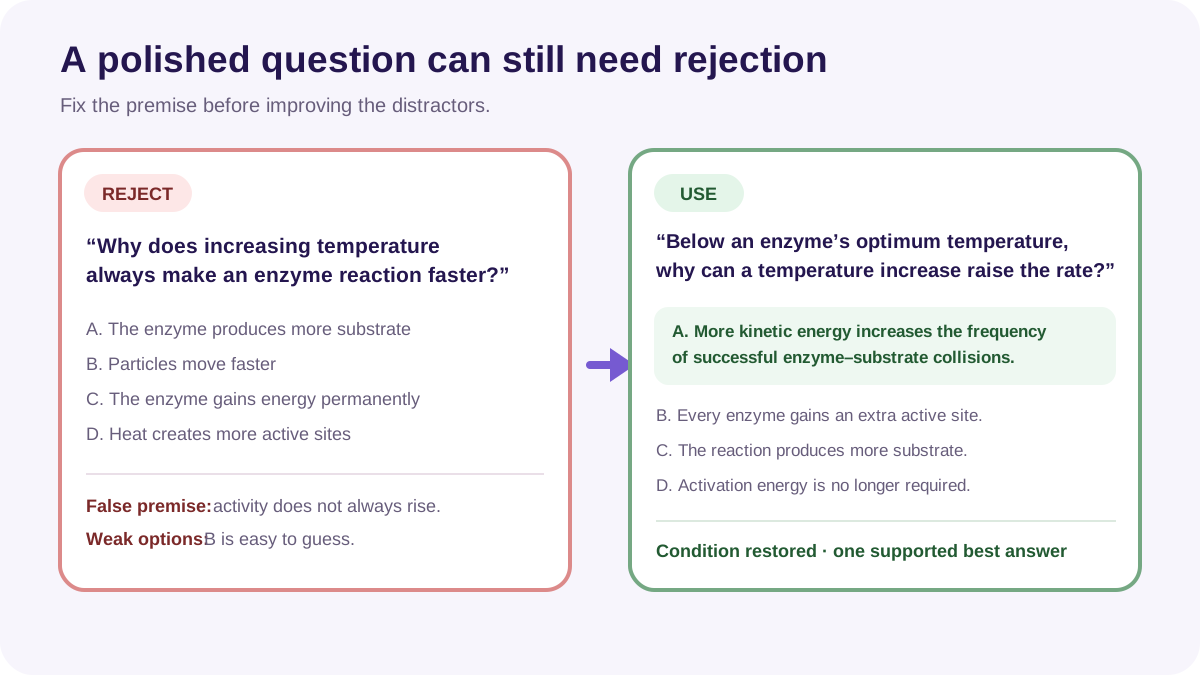
Why does increasing temperature always make an enzyme-controlled reaction faster?
A. The enzyme produces more substrate
B. Particles move faster
C. The enzyme gains energy permanently
D. Heat creates more active sites
It looks tidy, but it is not ready to use.
| Rubric check | Score | Reason |
|---|---|---|
| Source support | 0 | “Always” contradicts the source’s optimum-temperature condition |
| Answer accuracy | 1 | B points in the right direction but does not explain successful collisions |
| Course alignment | 2 | The underlying enzyme-rate relationship is relevant |
| Cognitive demand | 1 | It asks for explanation but mostly rewards phrase matching |
| Wording and context | 0 | The stem contains a false premise |
| Options or marking quality | 1 | Several distractors are implausible, making B easy to guess |
Total: 5/12, with hard fails — reject and rewrite.
A safer version is:
Below an enzyme’s optimum temperature, why can increasing temperature increase the reaction rate?
A. Enzyme and substrate particles have more kinetic energy, increasing the frequency of successful collisions
B. Each enzyme molecule permanently gains an additional active site
C. The reaction produces more substrate molecules as temperature rises
D. Increasing temperature removes the activation-energy requirement
The revision restores the condition, asks one focused question and gives one supported best answer. It still needs comparison with the exact course wording before use.
Common red flags in AI-generated MCQs
These flaws are useful screening signals, but none proves that a question was written by AI. Human-written questions can contain the same problems.
Two answers are arguably correct
This often happens when the stem omits a condition or asks for the “best” answer without defining the goal. Add the missing context or change the options so they can be judged on one dimension.
The correct answer is visibly different
It may be longer, more specific, better qualified or grammatically compatible when the others are not. Make the options parallel, then ensure correctness comes from subject knowledge rather than visual pattern recognition.
Distractors are nonsense
If three options can be rejected without knowing the topic, the item measures elimination skill more than understanding. Replace them with genuine misconceptions or common wrong methods.
The explanation repeats the key
“B is correct because B describes the process” is not feedback. A useful explanation connects the answer to the source and briefly shows why the most tempting alternative fails.
Every question tests a definition
A whole set of polished recall questions can create false confidence when the real assessment requires interpretation, calculation or evaluation. Map the set—not only individual questions—to the required balance of skills.
The question invents exam-board authority
Terms such as “AQA-style,” “IB-level” or “SAT-style” do not make a generated item official or calibrated. Compare it with current official specifications, examples and scoring guidance.
How accurate is the research evidence?
Research on AI-generated questions is developing, but it does not justify a single claim such as “AI questions are 90% accurate.” Studies vary in subject, model, prompting, reviewer criteria and whether questions were edited before students saw them.
The recent PLOS One systematic review and network meta-analysis is useful precisely because it shows that uncertainty. In the included health-professions studies, some comparisons found newer models similar to human-authored questions for relevance, clarity or distractor quality. Other model comparisons were worse, pooled accuracy was not perfect and the certainty of evidence was rated very low across outcomes. Those findings should not be generalised automatically to GCSE history, A-Level physics, an IB essay prompt or every current model.
Treat research percentages as descriptions of a particular study, not a warranty for the next question on your screen.
When AI-generated questions are useful
Generated questions can be valuable when:
- the source and intended learning objective are clear;
- you want extra low-stakes retrieval practice;
- a teacher, tutor or informed student can review the draft;
- the question will be edited rather than accepted automatically;
- mistakes lead back to the source and a later retest;
- official questions are limited and you need supplementary variations.
Practice testing is supported as a broadly useful learning technique, but that evidence concerns retrieving knowledge—not trusting an unchecked answer key. Useful retrieval requires corrective feedback when the response or question is wrong.
After completing a checked set, record genuine gaps in an exam mistake log and generate a fresh variation that tests the same idea without copying the original wording.
When not to rely on generated questions
Use official or expert-reviewed material as the main benchmark when:
- you are simulating a high-stakes exam;
- timing, adaptive behaviour or scoring must match the real assessment;
- a diagram, case, source extract or data set is central to the task;
- the subject requires current clinical, legal, safety or regulatory guidance;
- you cannot independently verify the answer;
- the material is confidential, restricted or not yours to upload.
AI practice can supplement past papers, specimen materials, mark schemes, lecturer feedback and assigned question banks. It should not quietly replace them.
Improve the input before generating another set
A better prompt cannot guarantee a correct question, but it can make the draft easier to audit. Include:
- the exact source section you are permitted to use;
- the learning objective or specification reference;
- the student level and intended question type;
- the required cognitive action, such as apply or analyse;
- a rule that every answer must be supported by the source;
- a request to state when the source lacks enough information;
- the expected answer format and feedback style.
Generate a small batch first. Reviewing five questions carefully is more useful than producing fifty unchecked items.
Aripsy can turn focused pasted material and supported documents into study notes and practice formats depending on the plan. Set the appropriate study context, keep the original source available and treat every generated question as a draft. Start with the quiz-from-notes workflow, or compare current PDF-to-practice-question tools before choosing a workflow.
Copyable question-quality checklist
Before keeping an AI-generated question, confirm:
- [ ] I can identify the source and intended learning objective.
- [ ] The stem, answer and explanation are supported by that source.
- [ ] I solved or reasoned through the question independently.
- [ ] There is one defensible best answer, or fair open-response marking guidance.
- [ ] The content belongs to my current course or assigned material.
- [ ] The command word and response format match the assessment.
- [ ] The question tests the intended level of thinking.
- [ ] All necessary context, data, units and diagrams are present.
- [ ] The wording is clear and does not accidentally reveal the answer.
- [ ] MCQ distractors are incorrect, plausible, distinct and free from clues.
- [ ] The explanation shows why the answer works rather than repeating it.
- [ ] I edited or rejected every hard-fail question before studying.
FAQ
Are AI-generated practice questions accurate?
Some are, but accuracy varies by model, prompt, source, subject and review process. Do not rely on a universal accuracy percentage. Verify each answer and explanation against a trusted source before using the question for revision.
How can I check whether an AI-generated question is good?
Score source support, answer accuracy, course alignment, cognitive demand, wording and option or marking quality. Reject the question if its answer is unsupported, incorrect or outside the intended course—even if its total score looks acceptable.
What are the most common problems with AI-generated MCQs?
Common problems include ambiguous stems, more than one defensible answer, implausible distractors, answer clues, weak explanations, missing context and questions that test recall when the intended assessment requires application or analysis.
Can I use AI-generated questions for GCSE or A-Level revision?
Yes, as supplementary low-stakes practice after checking them. Match each question to the current specification, command words and examples for your exact subject and exam board. Use official papers and mark schemes as the exam-standard benchmark.
Does generating questions from my own notes make them accurate?
It makes the source easier to trace, but it does not guarantee accuracy. Your notes may contain mistakes, file extraction can lose important context and the generated key can still be wrong. Check both the source notes and the questions.
Should I use AI-generated questions for a mock exam?
Not as a substitute for official or expert-reviewed material when format, timing, difficulty or scoring must match the real assessment. Generated questions are better used for additional targeted practice between official papers.
Final verdict
AI-generated practice questions are best treated as editable drafts. The safe question is not “Did AI write this?” but “Can I demonstrate that this item is supported, correct, aligned, appropriately demanding, clearly worded and fairly marked?”
If the answer is yes across all six criteria, use it for low-stakes retrieval. If one detail is fixable, edit and rescore it. If the source, key or alignment fails, discard it before repetition turns the error into something familiar.
Sources and further reading
Keep exploring
Find a study workflow
Choose the source, output, or course route that fits your next study task.
Browse study workflows
Written by
Aripsy Study Team
The Aripsy Study Team creates practical revision guides designed to support learning, source checking, and active practice.