AI AP Study Notes Generator
Prepare for AP courses with clearer notes from your own materials. Aripsy helps turn AP class notes, textbook chapters, and review sheets into structured study notes and active recall practice.
Exam
AP
Course units
AP
Exam practice
AP
Auto-detect
A-Level / AP / IB
AP
Turn one focused source into structured notes, key concepts, and recall prompts, then continue in the full study tool.
Short answer
How can Aripsy help me revise AP?
Prepare for AP courses with clearer notes from your own materials. Aripsy helps turn AP class notes, textbook chapters, and review sheets into structured study notes and active recall practice.
Best input
Paste a chapter section, lecture notes, article extract, or copied PDF text that you want to turn into study notes.
Responsible use
Use Aripsy as revision support alongside your source material, specification, or mark scheme.
How Aripsy helps you study this material
Prepare for AP courses with clearer notes from your own materials. Aripsy helps turn AP class notes, textbook chapters, and review sheets into structured study notes and active recall practice.
Why use this tool?
How to create study notes from your material
Common Questions
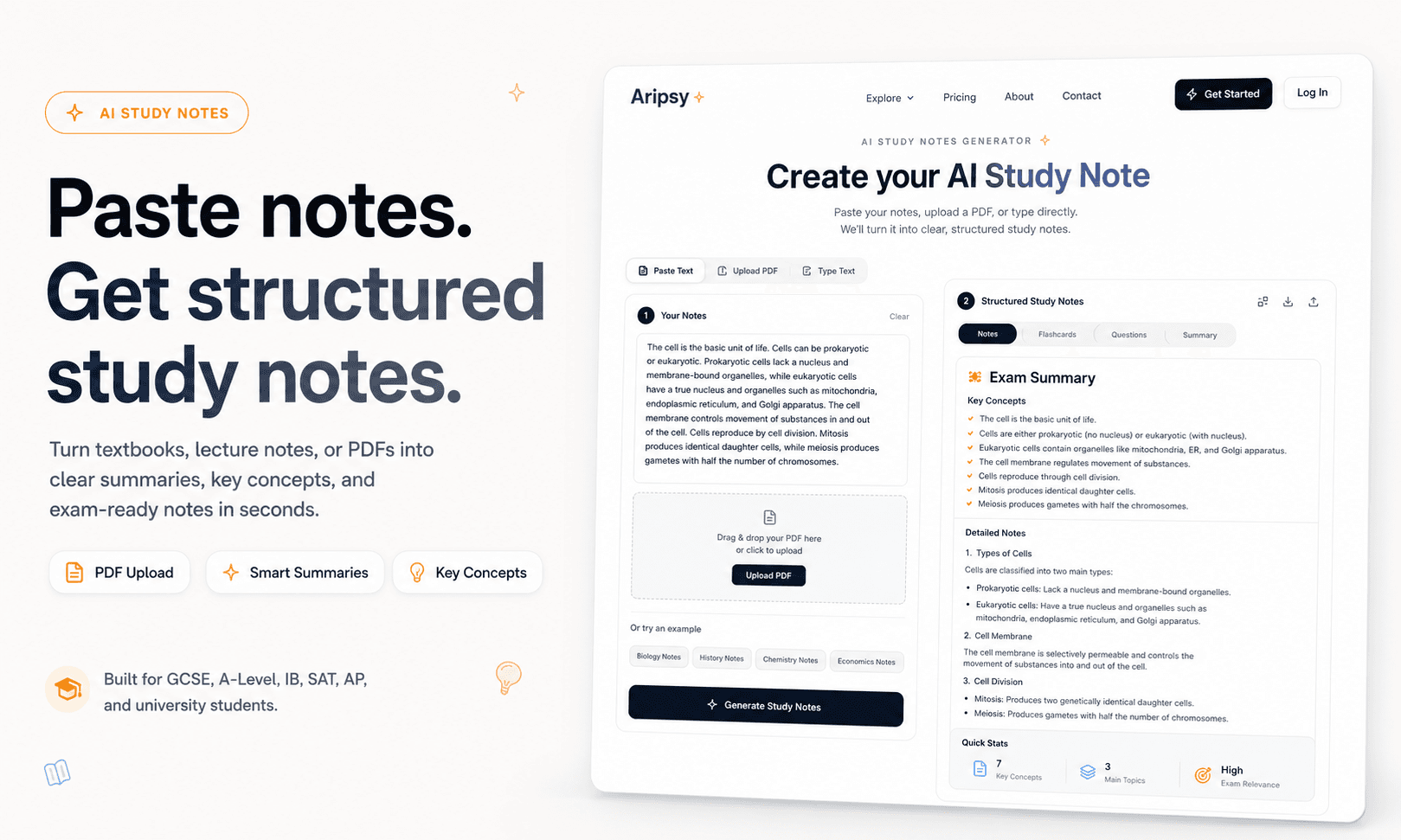
Product workflow preview
What the workflow looks like in Aripsy
AP students need concise notes that still preserve course vocabulary, examples, and exam-style thinking. The screenshot shows the same Aripsy workflow students use to add material, choose study settings, generate notes, then build recall practice from the saved session.
Related topics
AI notes for AP exam prep
AP courses often combine broad content with specific exam skills. Aripsy helps organize your notes into concepts, examples, definitions, and practice prompts so revision is easier to manage. For a course-specific workflow, use the AP Psychology revision tool.
Use your AP textbook and class material
Paste a textbook section, class notes, or review material into Aripsy. Signed-in Free users can try 1 successful PDF, PowerPoint, or Word upload before ongoing document uploads up to 15MB require Pro. Aripsy extracts document text; complex visuals and formatting should be checked.
Pair AP notes with active recall
After generating notes, create flashcards for key terms and practice questions for concepts you need to explain. This supports the retrieval practice needed for AP exams.
Check against College Board guidance
AI can help structure your revision, but AP students should still check important details against their teacher, textbook, and official College Board course guidance.
Useful student workflows
AP Biology process notes
Turn cell signaling or genetics material into definitions, steps, and recall prompts.
AP US History review
Structure dense period notes into causes, effects, people, documents, and possible comparisons.
AP Psychology terms
Convert a long list of theories and examples into clearer notes and flashcards.
AP notes need course vocabulary and practice
AP revision is not just memorizing a summary. Students often need precise terms, examples, connections across units, and practice explaining why an answer fits. Aripsy helps by turning AP study material into notes first, then letting students create flashcards, MCQs, or questions from the same session.
Aripsy beside official AP resources
Official College Board materials should guide what is assessed. Aripsy is useful for organizing your own class notes, textbook sections, and review sheets around those expectations. It should not replace AP Classroom, course guidance, or official practice questions; it helps make your day-to-day revision material easier to understand and test.
A repeatable AP revision loop
Choose one AP unit, paste focused material, generate notes, verify against your course, then create recall practice. For weak concepts, use Ask AI tutor to request a simpler explanation or example from the saved session. This is especially useful when AP topics stack across the year and old units need quick, structured review.
Sources and further reading
These independent education resources inform the study habits discussed on this page. Always follow your teacher, tutor, specification, or official exam guidance first.
AP Students
Official starting point for AP course and exam information.
The Learning ScientistsRetrieval practice
Explains why pulling answers from memory is usually stronger than rereading notes.
Education Endowment FoundationMetacognition and self-regulated learning
Evidence-informed guidance on planning, monitoring, and evaluating study.
Ready to revise with less friction?
Start with your own material and build a clearer revision workflow.
Turn one focused source into structured notes, key concepts, and recall prompts, then continue in the full study tool.
Supported Subjects
Biology, Chemistry, Physics, Mathematics, History, Geography, Economics, Business, Psychology, Computer Science and English Literature.