Spaced Repetition: How to Remember More With Less Cramming
A spaced repetition guide covering intervals, flashcard scheduling, the SM-2 method, and use across GCSE, A-Level, and university revision.
 Aripsy Study Team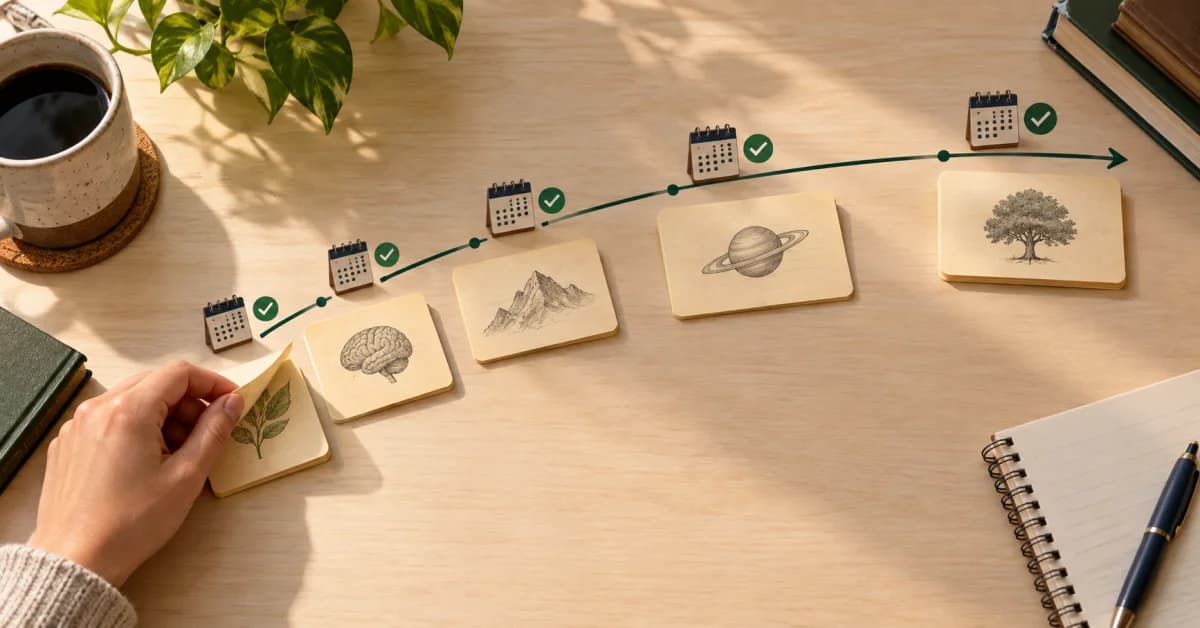
In this article13
Cramming the night before an exam can feel productive, but the material often fades within days. Spaced repetition is a study method built on a simple idea: you remember more when you revisit information at increasing intervals, rather than all at once.
It is not a trick or a shortcut. It is one of the most studied techniques in learning science, and it pairs naturally with flashcards, practice questions, and active recall. This guide explains how spaced repetition works, how to build a schedule, and how to use it without turning revision into a guessing game.
Quick answer: what is spaced repetition?
Spaced repetition means reviewing material at gradually longer intervals — for example, one day, then three days, then a week, then a month — instead of rereading it many times in one session.
The goal is to return after a delay, attempt recall, and adjust the next review from what you can remember. You cannot usually predict the exact moment you would forget something. A useful schedule makes room for retrieval and feedback rather than treating one set of intervals as ideal for everyone.
The basic cycle:
- Learn the material first so you understand it.
- Test yourself on it after a short delay.
- Rate how easily you recalled it.
- Schedule the next review based on that rating.
- Repeat with longer gaps for material you know well.
Spaced repetition works best for facts, definitions, formulas, terminology, dates, and procedures — things that benefit from being readily available in memory. It does not replace understanding, problem-solving, or essay practice.
Why spacing beats cramming
When you reread the same notes five times in one evening, each repetition feels easier than the last. That fluency is misleading: it reflects short-term familiarity, not durable memory.
| Study pattern | Short-term feeling | Typical long-term result |
|---|---|---|
| Cramming (massed practice) | Can feel fluent quickly | Immediate fluency may not last after a delay |
| Spaced review | Recall can feel harder after a gap | Gives opportunities to strengthen and check delayed recall |
| Single reread only | Can feel familiar | Familiarity does not show whether you can answer independently |
| Spaced review + active recall | Requires an answer before checking | Combines delayed retrieval with feedback on gaps |
The discomfort of returning to material you have half-forgotten is part of what makes the method work. Psychologists call this desirable difficulty — effort during learning produces stronger memory later.
The forgetting curve, in plain terms
Research by Hermann Ebbinghaus in the late 19th century described how memory decays over time when there is no review. The decline is steep at first, then flattens. Each well-timed review resets the curve and slows the next decline, so the same information needs fewer and fewer reviews to stay available.
You do not need to measure your own forgetting curve to benefit. The practical takeaway is simple: the best time to review is when recall has become slightly difficult but is still possible. If you review too early, you waste time. If you wait too long, you have to relearn.
How to build a spaced repetition schedule
You can run spaced repetition with paper flashcards, a spreadsheet, or an app. The principle is the same.
A simple fixed-interval schedule
If you prefer a predictable plan, use fixed steps:
| Review | Suggested interval from previous review |
|---|---|
| 1st review | 1 day after learning |
| 2nd review | 3 days later |
| 3rd review | 1 week later |
| 4th review | 2 weeks later |
| 5th review | 1 month later |
Mark the next date on each card. If you cannot recall the answer, send the card back to the start of the ladder.
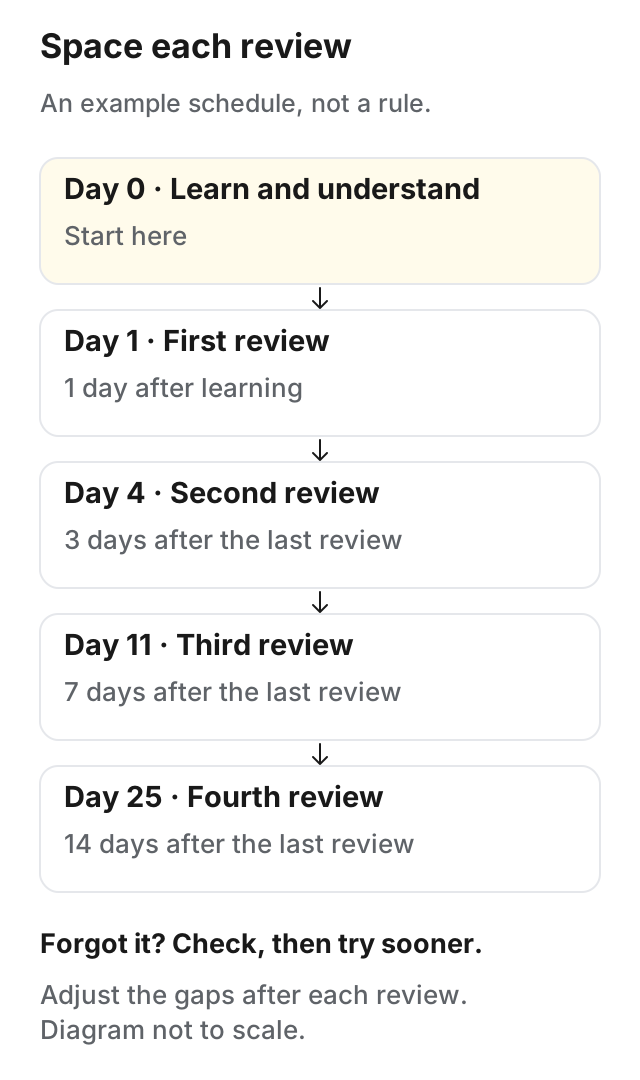
Count each gap from the previous review, not from the first learning session: day 1 plus three days gives day 4; another week gives day 11. These dates illustrate the table rather than an app’s exact scheduling algorithm. Review sooner when recall fails and adjust the later gaps to your course and exam date.
An adaptive schedule using self-rating
A more efficient approach adjusts the interval based on how well you remembered. After each card, rate your recall:
- Again — could not recall. Review again today, and reset the interval.
- Hard — recalled, but with significant effort. Shorten the next interval.
- Good — recalled with normal effort. Grow the interval steadily.
- Easy — recalled instantly. Grow the interval quickly.
This is the basis of algorithms like SM-2, which many flashcard tools use. The interval grows from each rating rather than following fixed steps, so well-known material is reviewed rarely and weak material is reviewed often. Aripsy’s flashcard review uses this same four-rating approach to schedule cards.
A weekly structure example
For a student revising across several subjects, a weekly rhythm is often more realistic than tracking individual cards:
| Day | Focus |
|---|---|
| Monday | New material + due reviews (e.g. Biology) |
| Tuesday | Due reviews + one weak topic (e.g. Maths) |
| Wednesday | New material + due reviews (e.g. History) |
| Thursday | Due reviews + practice questions |
| Friday | Due reviews + past-paper section |
| Weekend | Catch-up, longer reviews, and rest |
The exact split matters less than consistency. Short, regular sessions beat occasional long ones.
What to put on spaced repetition cards
Spaced repetition is only as good as the cards you make. Good cards are:
- Atomic — one clear idea or question per card.
- Specific — a precise answer you can check against your notes.
- Own-words friendly — you understand the concept behind the card.
- Source-grounded — tied to your specification, textbook, or class notes.
| Strong card | Weak card |
|---|---|
| “Define osmosis.” | “Everything about cells.” |
| “State Newton’s second law.” | “List all physics formulas.” |
| “What year did X happen, and why?” | “Know the whole chapter.” |
| “Name the stages of mitosis in order.” | “Mitosis stuff.” |
If a card asks for a list, break long lists into smaller cards. If a card asks for an explanation, write the key points in the answer rather than a full paragraph.
Spaced repetition for different subjects
The method flexes across subjects, but the card design changes.
Maths and calculation subjects
Use spaced repetition for formulas, definitions, and the conditions under which a method applies. Do not use it to replace practice questions — calculation fluency comes from solving problems, not memorising steps.
Example cards:
- “State the quadratic formula.”
- “When do you use the cosine rule instead of the sine rule?”
- “Define the derivative in your own words.”
Sciences
Cards work well for definitions, required-practical variables, units, and the names and findings of key studies. Pair them with application questions so you can use the facts, not only recall them.
Languages
Spaced repetition is well suited to vocabulary, verb conjugations, and gendered nouns. Review daily with short sessions, and mix old and new words so recent items do not crowd out older ones.
Humanities and essay subjects
Use cards for dates, key terms, case studies, quotes, and the structure of arguments. For essays, spaced repetition supports the building blocks, but practice writing full responses separately.
How to use spaced repetition alongside Aripsy
Spaced repetition is a method, not a product. Aripsy supports it by turning your own study material into flashcards you can review on a schedule.
A practical workflow:
- Paste a focused section of your own notes into the Aripsy study tool.
- Generate flashcards from that material.
- Review the cards and rate each one (again, hard, good, easy).
- Return on later days to review the cards that are due.
- Check the generated content against your textbook, specification, or class notes before relying on it.
This is most useful when you have already understood the topic. Spaced repetition reinforces and retrieves; it does not teach from scratch.
For broader revision planning, read Evidence-Informed Study Techniques. To connect spaced practice with exam practice, see How to Use Past Papers Effectively.
Common spaced repetition mistakes
- Cramming new cards in bulk. Adding hundreds of cards at once creates an unmanageable review pile. Add steadily.
- Reviewing too early. Re-reading a card ten minutes after learning it tests short-term memory, not durable recall.
- Rating too generously. Marking a card “easy” when you hesitated inflates intervals and weakens retention. Rate honestly.
- Leaking context onto cards. If you can guess the answer from the surrounding cards or the topic heading, the review is not testing recall.
- Skipping reviews. The schedule only works if you show up. A short daily session is more sustainable than a long weekly one.
- Using spaced repetition for everything. It is excellent for recall, weak for understanding and skill. Pair it with practice questions and past papers.
- Trusting cards you never checked. AI-generated or quickly written cards can contain errors. Verify important facts against trusted sources.
A 15-minute daily spaced repetition session
| Time | Task |
|---|---|
| 8 minutes | Review all due cards, rating each honestly |
| 4 minutes | Re-learn or correct the cards you got wrong |
| 3 minutes | Add a small number of new cards from today’s material |
Daily short sessions are more effective than one long weekly session, and they keep the review pile from growing uncontrollably.
Limitations and verification
Spaced repetition is powerful, but it is not a guarantee of exam success. Keep these limits in mind:
- It assumes the underlying material is correct. If a card contains an error, repeating it reinforces the mistake. Check your cards against official specifications, textbooks, mark schemes, or your teacher.
- It does not replace understanding. Recalling a definition is not the same as applying it. Use spaced repetition alongside problem-solving, essays, and past papers.
- It does not predict exam questions. Knowing a topic well does not mean it will appear, or appear in the form you expect.
- AI-generated cards can be wrong. Treat generated flashcards as drafts to review, not as authoritative content.
If a card keeps failing, the problem may be the card, not your memory. Rewrite it to be clearer or break it into smaller pieces.
FAQ
How much time should I spend on spaced repetition each day?
For most students, 10–20 minutes of daily review is enough to keep up with due cards and add a few new ones. The total depends on how many cards you have in rotation, but consistency matters more than session length.
Is spaced repetition better than rereading notes?
For retaining factual information over time, yes. Rereading feels easier and faster, but it produces weaker long-term memory. Spaced repetition combined with active recall is more efficient for material that needs to be remembered.
Should I use paper flashcards or an app?
Both work. Paper is simple and tangible; apps handle the scheduling automatically and track what is due. Choose whichever you will actually use consistently. The method matters more than the medium.
Does spaced repetition work for maths?
Yes, for formulas, definitions, and recognising when a method applies. It does not replace solving practice problems, which build the procedural fluency maths exams require.
Can I use spaced repetition the night before an exam?
It is not ideal. Spaced repetition depends on intervals built over days and weeks. The night before, focus on calm review of summaries, key formulas, and your mistake log rather than starting new cards.
Are AI-generated flashcards reliable?
They are a useful starting point but should be checked. AI can misstate definitions, invent details, or miss context-relevant points. Verify generated cards against your course material before adding them to your review rotation.
Sources and further reading
- Carpenter, S. K., et al. (2012–2022): spacing effects in learning
- Dunlosky, J., et al. (2013): improving students’ learning with effective techniques
- Roediger, H. L., & Karpicke, J. D. (2006): test-enhanced learning
- Carnegie Mellon University: retrieval practice
Next study steps in Aripsy
Keep exploring
Learning Science
Use active recall, spaced practice, flashcards, and mistake review as parts of a realistic revision routine.
Explore Learning Science guides
Written by
Aripsy Study Team
The Aripsy Study Team creates practical revision guides designed to support learning, source checking, and active practice.