How to Revise for Mocks in 2 Weeks: A Day-by-Day Plan for GCSE and A-Level
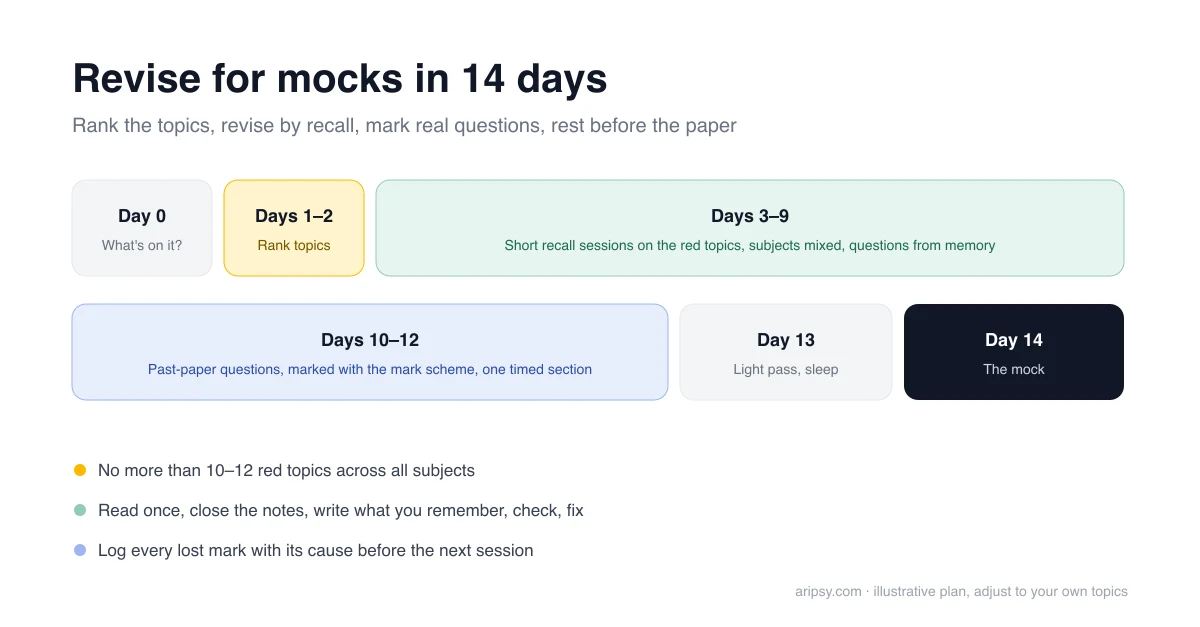
With two weeks until your mocks, find out exactly which topics and papers each mock covers, rank those topics by how badly you know them, spend days 3 to 9 on short recall sessions for the weakest ones, use days 10 to 12 for past-paper questions you mark against the mark scheme, and keep the last day light.
 Aripsy Study Team
In this article14
Two weeks before mocks, most students open the whole specification, start at topic one, and run out of days somewhere around the middle. The topics that actually lose marks in the mock, the ones at the end of the course or the ones nobody understood in class, never get touched.
The fix is not more hours. It is choosing the right ten topics, revising them in a way that forces you to remember, and spending the last three days answering real exam questions and marking them. This plan does that in fourteen days for GCSE and A-Level mocks, with a shorter version if you have one week or two days.
Quick answer: how do you revise for mocks in two weeks?
- Day 0: ask each teacher what the mock covers: which paper, which topics, which tier, and whether it is a past paper from an earlier series.
- Days 1 and 2: turn each subject’s topic list into a traffic-light list and pick the red topics. Aim for no more than ten to twelve red topics across all subjects.
- Days 3 to 9: revise the red topics by retrieval: read once, close the notes, write what you remember, check, fix, then answer questions on it. Three to five short sessions a day, subjects mixed.
- Days 10 to 12: answer past-paper questions on those topics and mark them with the mark scheme. Log every lost mark and its cause. Do one timed section on day 12.
- Day 13: a light pass over your top ten facts, equations or quotes. Pack your equipment. Sleep.
- Day 14: the mock. No new topics on the morning.
- After the mock: keep the marked papers. They are the best evidence you will have for the real revision plan in spring.
A worked example you can copy
The example below is illustrative. Priya is a fictional Year 11 student with three mocks in fourteen days: AQA GCSE Biology Paper 1, Pearson Edexcel GCSE Maths Higher Paper 1 (non-calculator), and English Literature on Macbeth. Her marks, topics and timings are invented to show the method, not to set a standard. The same steps work for A-Level mocks with longer sessions and fewer topics per day.
Day 0: find out what each mock actually covers
Ask the teacher, or check the school’s mock timetable, and write one line per subject: the paper, the topics, the tier, the length and whether calculators or formula sheets are allowed. Many schools set a past paper from an earlier exam series as the mock, so the question style is predictable even if the questions are not.
Why this matters: a mock on Biology Paper 1 does not test Paper 2 topics. Revising ecology for a Paper 1 mock is time taken from cell biology and bioenergetics, which will be on it.
Priya’s three lines read: “Biology Paper 1: cell biology, organisation, infection and response, bioenergetics. 1 h 45. Higher tier.” “Maths Paper 1: non-calculator, whole Higher content, 1 h 30.” “Literature: one Macbeth extract question, 30 marks plus 4 for spelling and grammar, 50 minutes.”
The failure to avoid is revising the whole course because you did not ask. The check: you can say, for each subject, what will not be on the mock.
Days 1 and 2: rank your topics before you revise anything
Take the topic list for each paper from the specification or your class checklist and mark each topic green, amber or red. Use evidence, not a feeling: end-of-topic tests, homework marks, and one honest test. Explain the topic aloud for two minutes without notes. If you stop within thirty seconds, it is red.
Then count. If you have more than twelve red topics across all subjects, rank them by marks: a topic that fills a whole question is worth more revision time than a topic that appears in one part of one question. The guide to building a plan around your weakest topics shows how to use mark schemes and examiner reports for this ranking when you have more time.
Priya ends day 2 with nine red topics: required practicals and osmosis in Biology, surds, algebraic fractions and circle theorems in Maths, and three Macbeth areas (Lady Macbeth’s language in Act 1, the supernatural, and writing about context without retelling the plot). Her split for the next week is roughly 60% of sessions on red topics, 30% on amber, 10% keeping green topics warm.
The check: your list fits on one page and every item is a topic you could be asked a question about, not a chapter title.
Days 3 to 9: revise by retrieval, not by rereading
This is the week that decides the mock. For each red topic, follow the same loop:
- Read the topic once, from your notes or textbook, with the specification points beside you.
- Close everything and write what you remember: definitions, steps, equations, quotes, a diagram.
- Open the notes and mark your own attempt. Add what you missed in a different colour.
- The next day, before reading anything, answer five questions on the topic from memory. Then check.
The reason to work this way is well documented. A 2013 review of ten learning techniques by Dunlosky and colleagues rated practice testing and spreading study over several days as the two most useful methods, and rereading and highlighting among the least useful. Earlier experiments by Roediger and Karpicke found that repeated testing produced better delayed recall than repeated study. The active recall versus rereading guide explains the evidence and its limits in more detail.
Keep sessions short. Twenty-five to thirty minutes with a five-minute break is a sensible starting point, not a rule. On school days aim for three sessions; at the weekend four or five. Mix subjects across the day rather than giving one subject a whole evening, so each topic gets more than one visit before the mock.
Flashcards earn their place for the pieces that are pure memory: Biology definitions and practical steps, Maths formulae that are not on the formula sheet, and quotes with the act and scene. Keep the deck small, review the cards you got wrong first, and do not spend the week making cards instead of using them.
Where this gets slow is turning notes into questions. If you paste a section of your own notes into Aripsy, it returns short recall questions and flashcards from that material, which you then answer without looking. Treat the output as a draft: check each card against your notes before you trust it, especially numbers, units and quotes. A free account covers a short mock cycle, with daily limits shown on the pricing page.
The failure to avoid is a beautiful set of rewritten notes and no attempt from memory. The check: on day 9, pick any red topic and answer its five questions cold. Topics you still fail move to the top of the past-paper days.
Days 10 to 12: past-paper questions, marked properly
Mocks are usually built from past papers, so the best preparation is to answer past-paper questions on your red and amber topics and mark them as an examiner would. Use the official mark scheme for that paper and, where one exists, the examiner report, which says what students typically got wrong.
Work by question type, not by whole papers, until day 12. For each lost mark write down the cause: did not know it, knew it but could not apply it, misread the question, ran out of time, lost the method marks. The past-paper method guide walks through this mark, review and retry loop.
On day 12 do one timed section per subject under exam conditions: Priya does the first 40 minutes of a Maths non-calculator paper, a 6-mark Biology extended-response question, and one full Macbeth extract answer in 50 minutes. Timing is a skill that only timed practice trains.
For written answers in English, History, Psychology or the sciences, marking your own work is the hardest part, because you know what you meant. The free answer marker takes a question, the marks available and your answer, and returns marking points in the style of your board, so you can see where a point was asserted rather than explained. It is a second opinion, not the examiner: check its points against the real mark scheme when you have one.
The failure to avoid is doing papers and never marking them. The check: your lost-marks log has at least one entry per subject with a cause you can fix tomorrow.
Day 13 and the morning of the mock
Day 13 is light on purpose. One short recall session per subject on the ten facts, equations or quotes you most often got wrong. Pack the equipment: black pens, pencil, ruler, calculator with working batteries if allowed, and anything the subject needs. Check the start time and room. Go to bed at a normal time; a late night of cramming costs more than it gains.
On the morning, do not open a new topic. Read your one-page list of red topics once, then stop. In the exam, read every question twice, start with the questions you are most confident on if the paper allows, and leave time to attempt every question, because a blank answer scores nothing and a partial answer often scores method marks.
The 14-day plan at a glance
The sessions and topics are Priya’s illustrative example. Replace them with your own red list.
| Day | Focus | Priya’s example |
|---|---|---|
| 0 | Find out what each mock covers | Three one-line briefs from her teachers |
| 1–2 | Traffic-light every topic, rank the reds | Nine red topics across Biology, Maths and Literature |
| 3–5 | Retrieval sessions on red topics, first pass | Osmosis, surds, Lady Macbeth’s language; three sessions a day |
| 6–7 (weekend) | Second pass on reds, first pass on ambers | Four or five sessions a day, subjects mixed |
| 8–9 | Cold-answer check on every red topic | Topics still failing move to the top of days 10–12 |
| 10–11 | Past-paper questions by topic, marked with the mark scheme | Lost-marks log with a cause for each |
| 12 | One timed section per subject | 40 minutes of Maths, a 6-marker, one Macbeth extract answer |
| 13 | Light recall of the top ten, equipment, sleep | No new topics |
| 14 | The mock | Read every question twice |
If you only have one week, or two days
One week: keep the same order and halve each stage. Day 0 for the briefs and the traffic-light list together, days 1 to 4 for retrieval on the reds only (ambers get one pass if time allows), days 5 and 6 for marked past-paper questions with one timed section, day 7 light. Expect to cover six to eight red topics rather than twelve.
Two days: this is triage, not revision. Spend the first morning on the briefs and a short red list of the four or five highest-mark topics. Spend the rest of day 1 on retrieval for those topics. On day 2 do marked past-paper questions on them, a short timed section, and stop by early evening. Everything you did not reach is information for the real plan, not a failure.
What mocks are for, and what they are not
A mock is a diagnostic. It shows which topics hold up under exam conditions, how you manage time, and what your handwriting and working look like after an hour. Treated that way, a poor mock is useful: it tells you where the marks are before the exam that counts.
Mocks are not the final grade, and the grade boundaries a school applies to a mock are usually borrowed from an earlier series, so a mock grade is an estimate. Many schools do use mock results, alongside classwork and other assessments, when they set predicted grades for college or university applications. UCAS asks schools to base predicted grades on evidence and professional judgement, so a strong mock is evidence in your favour, and a weak one can be answered with a stronger performance in the next assessment.
After the mock, ask for the paper back with the marks per question. That marked paper, plus your lost-marks log, is the starting point for the spring plan, when the four-week GCSE revision plan or the exam dates and countdown for the real series take over.
Mistakes that cost the most in mocks
- Revising topics that are not on the mock, because nobody asked what the paper covers.
- Rereading and highlighting for a week, then meeting the first question that asks for an explanation.
- Making a perfect revision timetable on day 1 and never adjusting it when a topic takes longer than planned.
- Doing past papers without marking them, so the same error repeats in the mock.
- Leaving timed practice to the night before, then running out of time on the last two questions.
- Treating the mock grade as a verdict instead of a list of the topics to fix next.
FAQ
Are mocks important?
Yes, as a diagnostic and as evidence. They show which topics fail under exam conditions while there is still time to fix them, and many schools consider mock results, with other work, when setting predicted grades. They are not the final grade.
How many hours a day should I revise for mocks?
Count sessions, not hours. Three sessions of 25 to 30 minutes on a school day and four or five at the weekend, all spent retrieving and answering questions, do more than four hours of rereading. Adjust to your energy and other commitments; the number is a starting point, not a target.
What if my mocks are in two days?
Pick the four or five highest-mark topics you know least well, do one retrieval pass on each, then answer and mark past-paper questions on them. Stop early on the second evening and sleep. Use the result to plan properly for the next set.
Do mock results decide my predicted grades?
Not on their own. Schools set predicted grades using the evidence they have, which often includes mocks, classwork and other assessments. UCAS asks that predictions be based on evidence and professional judgement, so later assessments can move a prediction in either direction.
Are A-Level mocks different?
The method is the same; the sizes change. There are fewer topics but each is deeper, so expect fewer red topics, longer sessions, and more weight on timed extended answers and marking against the board’s level descriptors. A-Level mock grades are also commonly used in predicted grades for university applications, so the evidence point matters more.
Should Year 10 revise for mocks?
Yes, with a lighter version of this plan. Year 10 mocks usually cover only the topics taught so far, so the traffic-light list is short. The main value is learning how you perform under timed conditions and building the retrieval habit a year early.
Next step
Build the fourteen days around your own red list with the free revision timetable generator: add the mock dates and subjects, set your daily hours, and print the plan. When you reach the past-paper days, use the answer marker to get a second opinion on written answers before you check them against the mark scheme.
Sources and further reading
- UCAS, Predicted grades: what you need to know: how schools are asked to set predictions, checked 30 October 2026.
- Dunlosky, Rawson, Marsh, Nathan and Willingham, Improving Students’ Learning With Effective Learning Techniques, Psychological Science in the Public Interest, 2013: practice testing and distributed practice rated most useful.
- Roediger and Karpicke, Test-Enhanced Learning, Psychological Science, 2006: repeated testing improved delayed recall compared with repeated study.
Keep exploring
GCSE & A-Level
Plan revision around specifications, active practice, past papers, and focused subject guides.
Explore GCSE & A-Level guides
Written by
Aripsy Study Team
The Aripsy Study Team creates practical revision guides designed to support learning, source checking, and active practice.


