How to Turn an Exam Mistake Log Into Targeted Practice Questions
For every missed question, record the exact topic, lost marks, attempted reasoning, failure cause, correct principle, and a prevention rule. Then create a fresh question that tests the same underlying skill in a different form, verify its answer against a reliable source, attempt it without notes, and keep it in a retry queue until performance remains accurate after a delay.
 Aripsy Study Team
In this article17
A mistake log should change what you practise next. If it only stores question numbers and red crosses, it is an archive—not a revision system.
The useful sequence is simple: capture the error, diagnose why it happened, confirm the correct idea, write a fresh question that tests the same weakness, and retry it after enough time has passed to make retrieval meaningful.
This guide shows how to build that sequence without turning the log into another administrative task.
Quick answer: how do you turn mistakes into practice questions?
For each lost mark, identify the smallest transferable problem: missing knowledge, weak understanding, wrong method, failed application, misread instruction, missing evidence, accuracy, or timing. Write a new question that tests that problem without copying the original wording. Check the question and answer against the specification, source material, worked solution, or mark scheme. Attempt it closed-book, record the result, and keep it in a practice queue until you can solve a fresh variation accurately after a delay.
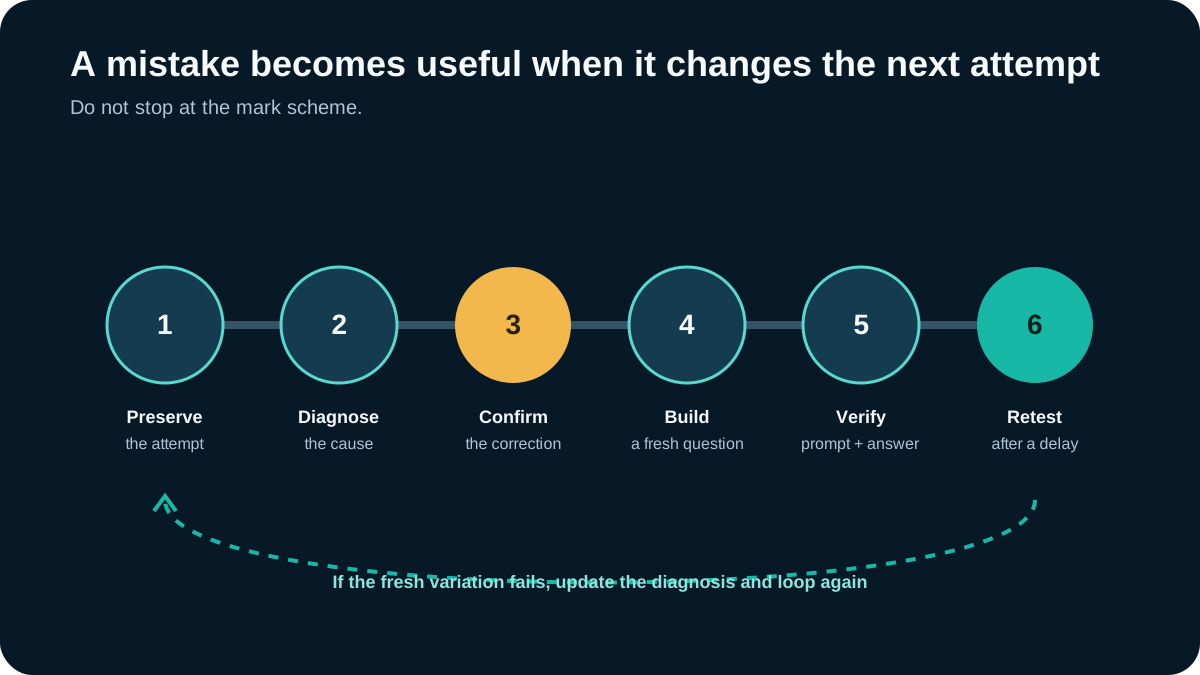
The correction is not complete when you read the answer. It is complete when you can use the corrected idea in a fresh attempt.
Why a list of wrong answers is not enough
A score tells you that something failed. It does not tell you what intervention will help.
Two students can lose the same mark for different reasons:
- one never learned the required definition;
- one knew the definition but could not apply it to unfamiliar data;
- one selected the right method but copied a negative sign incorrectly;
- one answered “describe” when the question required an explanation;
- one understood the task but ran out of time.
Giving all five students another generic content summary would waste at least part of their revision time. The mistake log becomes valuable only when it records the cause precisely enough to select the next task.
Research reviews classify practice testing and distributed practice as high-utility learning techniques. Research on learning from errors also stresses that errors can support learning when they are followed by accurate corrective feedback and attention to the reasoning that produced them. That does not mean every mistake automatically strengthens memory. An error left uncorrected—or corrected with an unreliable answer—can be repeated.
Step 1: preserve the evidence before reading the answer
Before opening the mark scheme, save enough information to reconstruct your thinking:
- the paper, section, or practice source;
- the exact topic or syllabus objective;
- marks available and marks earned;
- your answer or working;
- your confidence before checking;
- time used, if timing mattered.
Do not record only “Question 6 wrong.” In a week, that label may mean nothing without the paper beside it.
Confidence is useful because a high-confidence error deserves attention: it may reveal a misconception rather than a momentary lapse. Low confidence with a correct answer also matters, because the method may not yet be stable.
If the material is copyrighted or access-restricted, store a question reference and your own diagnosis rather than copying or uploading the whole paper without permission.
Step 2: diagnose the exact failure cause
Avoid “careless” as a final diagnosis. It describes how the mistake feels, not what needs to change.
Use a more specific category:
| Error type | Evidence in the attempt | Appropriate repair |
|---|---|---|
| Knowledge | A fact, formula, definition, quotation, or step could not be recalled | Relearn a small section, then retrieve it |
| Concept | Words were remembered but the relationship or mechanism was misunderstood | Explain why, compare cases, or use a worked model |
| Method | The wrong procedure was chosen or a correct procedure broke down | Annotate a worked example, then solve a parallel problem |
| Application | The principle was known but not recognised in a new context | Practise varied scenarios using the same principle |
| Command or evidence | The response did not perform the requested task or support the claim | Translate the command word and rebuild the answer structure |
| Accuracy | A sign, unit, number, label, term, or transcription step failed | Add a visible checking rule and practise that process |
| Timing or selection | Too long was spent, a question was skipped, or marks were allocated poorly | Use a timed micro-drill with a stop or selection rule |
Ask these questions in order:
- Could I state or explain the underlying idea without notes?
- Could I choose the correct method in an untimed version?
- Could I apply it when the surface details changed?
- Did my response match the command word and evidence requirement?
- Did execution, checking, or time cause the loss?
The first point that fails is usually the best starting diagnosis. A question can contain more than one error, but create separate repair actions rather than one vague label.
For a broader topic-level diagnosis, use the weak-topic prioritisation workflow.
Step 3: record a short, actionable log entry
A useful entry should take only a few minutes. Use these fields:
| Field | What to record |
|---|---|
| Date and source | When and where the attempt came from |
| Topic or objective | The smallest precise skill or concept |
| Marks and confidence | Result plus how certain you felt |
| Failure cause | One of the specific error types above |
| What happened | The exact wrong step, omitted idea, or decision |
| Correct principle | A concise correction checked against a reliable source |
| Prevention rule | What you will do differently next time |
| Targeted question | A fresh question testing the same underlying issue |
| Retry status | New, relearn, retry, mixed practice, or closed |
Filled example
| Field | Entry |
|---|---|
| Date and source | 3 October, chemistry topic set |
| Topic | Limiting reactants from balanced equations |
| Marks and confidence | 1/4; medium confidence |
| Failure cause | Method |
| What happened | Compared masses directly instead of converting both reactants to moles |
| Correct principle | Compare available moles with the stoichiometric ratio from the balanced equation |
| Prevention rule | Write the balanced ratio before using any quantities |
| Targeted question | Given a different equation and masses, identify the limiting reactant and justify the comparison |
| Retry status | Relearn, then retry tomorrow |
The log is not the correction. It is the routing information for the next practice task.
Step 4: convert the diagnosis into the right question type
The follow-up question should test the transferable weakness, not your memory of the original answer.
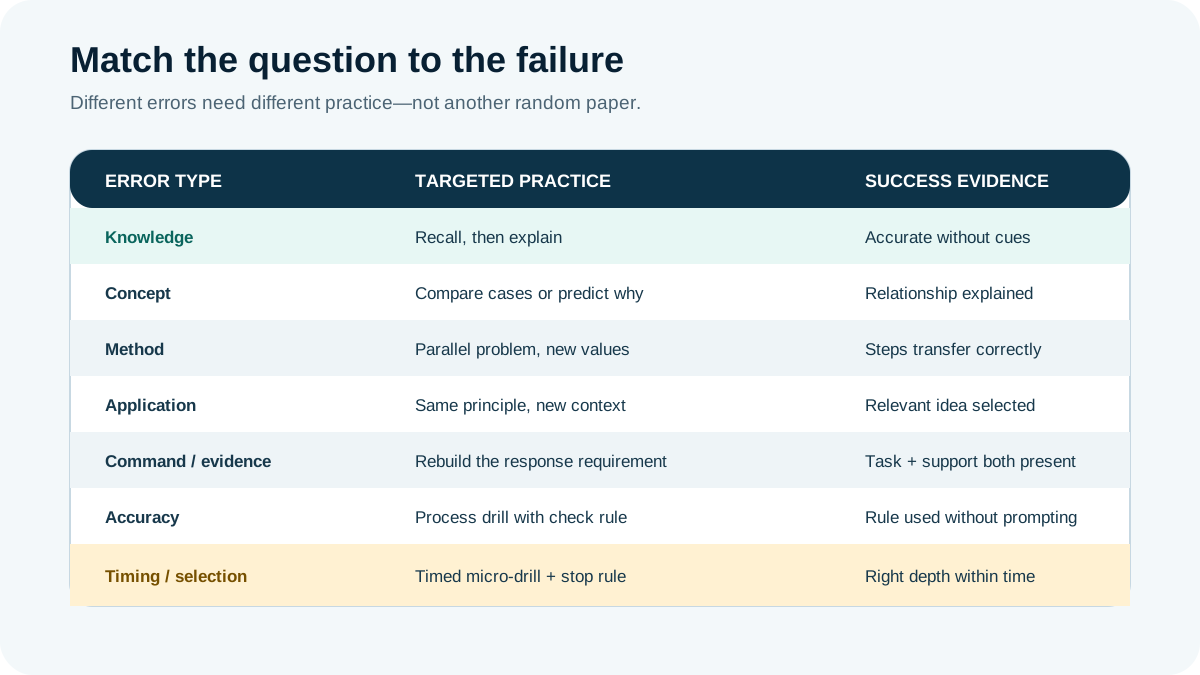
Knowledge error: retrieve, then explain
Begin with a direct prompt when the required knowledge was missing.
Original problem: you could not recall the role of mRNA in translation.
First question: What does mRNA carry from DNA to the ribosome?
Next variation: Explain how mRNA, tRNA, and the ribosome work together during translation.
The first question checks the missing fact. The second checks whether it sits inside a usable explanation.
Concept error: contrast two cases
Use a comparison, prediction, or “why” question when the words were familiar but the relationship was wrong.
Original problem: you assumed that a catalyst changes the equilibrium position.
Targeted question: A catalyst is added to a reversible reaction at equilibrium. Explain what changes, what does not change, and why.
This exposes the misconception more clearly than asking for the definition of a catalyst.
Method error: keep the structure, change the values
Build a parallel problem that requires the same sequence of decisions with different surface details.
Original problem: you used the percentage-change formula incorrectly.
Targeted question: A value rises from 80 to 98. Calculate the percentage increase, showing which value belongs in the denominator.
Do not merely redo the original numbers from memory. The new version should reveal whether the procedure transfers.
Application error: change the context
Keep the governing principle but move it into a new scenario.
Original problem: you knew that an increase in supply lowers equilibrium price, but misread a real-world example.
Targeted question: A production technology reduces the cost of making solar panels. Using a supply-and-demand diagram, explain the likely effect on equilibrium price and quantity, assuming other conditions remain unchanged.
The question should contain enough information to be answerable without silently inventing assumptions.
Command-word or evidence error: rebuild the response requirement
Write a prompt that forces the missing action.
Original problem: the answer described a trend but did not explain it using the data.
Targeted question: Explain the relationship shown in a new data table. Include two values and a reason for the pattern.
For essays, use an answer frame such as claim → evidence → reasoning → limitation, but adapt it to the subject and mark scheme rather than treating one structure as universal.
Accuracy error: practise the checking process
If the concept was secure but the execution failed, the task needs a constraint.
Original problem: the final answer omitted units.
Targeted question: Complete three short calculations. Before substituting, write the required unit beside the unknown; after calculating, check magnitude, rounding, and unit.
The prevention rule must be visible during practice. “Be more careful” is not a procedure.
Timing error: use a measured micro-drill
Do not respond to one unfinished section by immediately doing another full paper.
Targeted task: Plan two eight-mark responses in six minutes each. Stop when the time ends, compare the planned depth with the mark allocation, and record where time was lost.
Short drills isolate the timing decision without spending an entire paper to collect one more data point.
Step 5: use a difficulty ladder, not random repetition
One question is rarely enough to show that an error has been repaired. Move through the level the assessment actually requires:
- Recognition: identify the correct idea or method among alternatives.
- Recall: produce the fact, rule, sequence, or quotation without prompts.
- Application: use it in a fresh context or calculation.
- Explanation: justify why the answer or method works.
- Exam-format performance: complete the task under representative constraints.
Do not force every topic through every level. A vocabulary item may need accurate recall and use in context. A proof, essay, calculation, or practical method may need application and explanation. Match the ladder to the current syllabus and assessment format.
For multiple-choice practice, write distractors from real misconceptions rather than random wrong statements. Every option should be defensible as a plausible error, and the answer key should explain why the correct choice works and why the distractors fail.
Step 6: verify the new question before studying from it
A targeted question can reinforce the wrong lesson if the prompt is ambiguous or the answer key is inaccurate.
Check:
- the concept is inside the current syllabus or course outcomes;
- the wording matches the intended skill and command word;
- all necessary data and assumptions are included;
- calculations, units, terminology, quotations, and source details are correct;
- the answer follows from the question as written;
- the level and format resemble the assessment without pretending to be an official question;
- the question tests the diagnosed weakness rather than an unrelated detail.
Use the current specification, class materials, textbook, official mark scheme, checked worked solution, or qualified feedback as appropriate. A mark scheme can show what received credit on that paper, but it may not explain the full concept; use a teaching source when understanding is still missing.
If you cannot verify a generated question, do not use it to decide that a topic is secure or weak.
Step 7: turn the log into a practice queue
A record looks backward. A queue tells you what to do next.
Use five statuses:
- New: captured but not yet diagnosed.
- Relearn: the source must be revisited before testing.
- Retry: a verified targeted question is ready.
- Mixed practice: the first correction worked; now test transfer among other topics.
- Closed: a fresh variation was answered accurately after a delay.
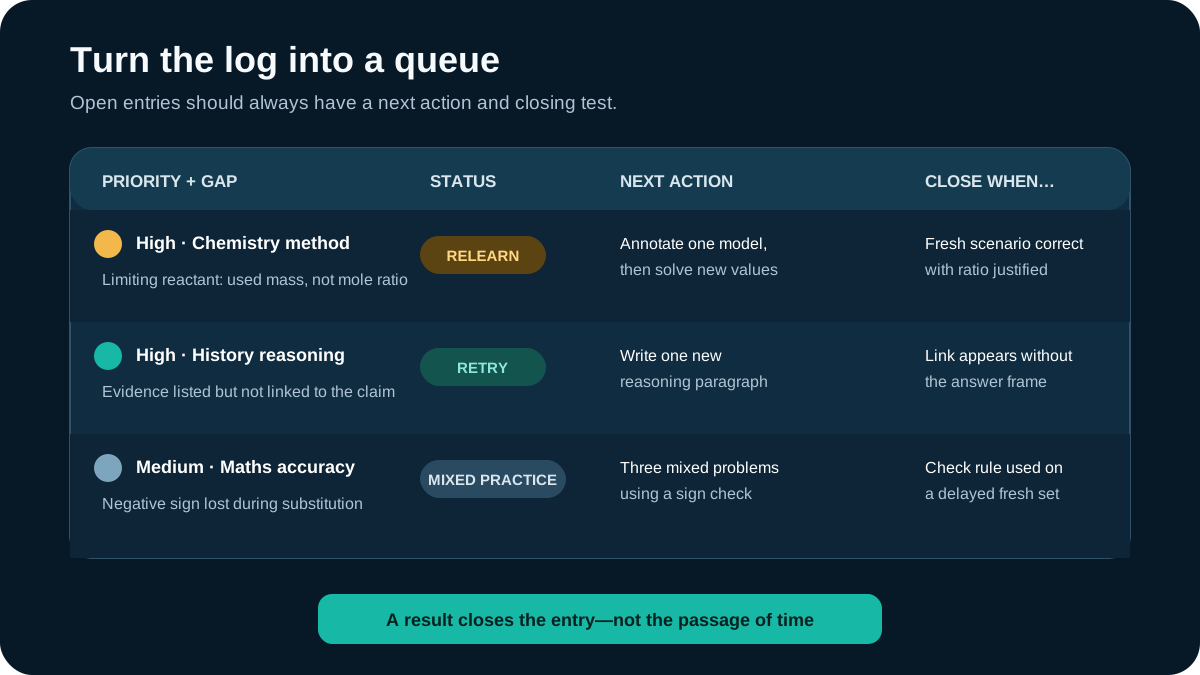
At the start of a session, select a small number of due retries before opening a new paper. Prioritise entries that:
- repeat across several questions;
- affect foundational knowledge or several later topics;
- carry meaningful marks under the current assessment;
- produced a confident misconception;
- remain wrong after correction;
- belong to the nearest exam without displacing more important work.
Frequency alone is not enough. Three one-off transcription slips may need a checking routine, while one major misconception could affect an entire unit.
How to schedule retests without pretending there is one perfect interval
Spacing practice across separate sessions generally supports longer-term retention better than massing all attempts together. The best interval varies with prior knowledge, difficulty, and time until the exam.
A practical starting sequence is:
| Stage | When | Purpose |
|---|---|---|
| Correction check | Same session | Confirm that the feedback and solution are understood |
| First closed-book retry | Next suitable session | Test whether the answer can be produced without the correction visible |
| Varied retry | Several days later | Change the values, wording, source, or scenario |
| Mixed practice | Later in the revision cycle | Retrieve the method among competing topics or question types |
Move an item forward sooner when retrieval fails. Lengthen the gap when several fresh variations are accurate. Do not mark a gap closed because the original wording looks familiar.
For the learning principle, see how active recall supports exam revision. For adaptable review intervals, use the spaced-practice guide.
A complete worked example
Suppose a student answers a history question about why a policy failed. The response lists two events but never connects them to failure, earning limited credit.
1. Diagnose
- Knowledge: the events were recalled accurately.
- Failure cause: explanation and evidence linkage.
- Correct principle: each piece of evidence must support a causal claim that answers the question.
2. Write the prevention rule
After every piece of evidence, write one sentence beginning “This contributed to failure because…”
3. Build targeted questions
- Recall: What is the difference between describing an event and explaining its consequence?
- Application: Using a different policy, write one claim-evidence-reasoning paragraph.
- Transfer: Compare two causes and judge which had the greater effect, using evidence for both.
4. Verify
Check the events, terminology, and expected response against the course material and an appropriate marked example or mark scheme.
5. Retest
Attempt the application paragraph without the prevention rule visible. Later, use the same reasoning in a timed paragraph on another topic. Close the entry only when the linkage appears without prompting.
The goal is not to memorise the corrected paragraph. It is to transfer the missing reasoning move.
Using AI to draft targeted questions safely
AI can reduce the time needed to draft variations, but it cannot diagnose a vague entry reliably or guarantee exam-board accuracy.
Give it:
- the checked concept or method;
- the exact failure cause;
- the required question type and difficulty;
- the permitted scope;
- the source wording needed to verify the answer;
- an instruction to state any assumptions.
Example prompt:
Using only the checked notes below, write three new questions about limiting reactants. The original error was comparing masses without converting to moles. Create one method question, one unfamiliar application, and one explanation question. Give worked answers and identify where the mole ratio is used. Do not claim the questions are official.
You can create draft practice questions from checked notes. Review every prompt and answer before adding it to the queue. Generated questions should supplement official or instructor-approved material, not replace it.
Do not upload restricted exam content, confidential feedback, or material you do not have permission to process. A question reference plus your own checked correction may be enough.
What to do in the final week before an exam
Use the log to narrow practice, not to create panic.
- Review repeated, high-impact open entries first.
- Attempt verified questions before rereading corrections.
- Use short mixed sets to test selection between methods.
- Retest the error types that recur under time pressure.
- Check formulas, definitions, units, evidence, and command-word rules that are genuinely required.
- Stop creating large new queues that cannot be reviewed.
- Protect sleep and follow the official exam instructions.
The log is most useful across the weeks of past-paper practice. The final week is for consolidating the highest-value open items, not learning an entire missing course from scratch.
Common mistake-log failures
Recording subjects instead of precise gaps
“Weak at chemistry” cannot generate a targeted question. “Selects limiting reactant by mass instead of mole ratio” can.
Copying the mark scheme without explaining the error
A model phrase does not identify why your reasoning failed. Record the missing principle and the decision that should change.
Repeating the original question word for word
Familiarity with one answer can imitate mastery. Change the values, context, representation, or required explanation.
Calling every slip careless
Name the failure: copied value, missing unit, sign error, instruction skipped, poor time allocation, or no final check.
Generating more questions than you can review
One verified question that tests the right weakness is more useful than twenty unchecked variations.
Closing an entry immediately after reading the correction
Understanding feedback while it is visible is not the same as retrieving and applying it later.
Copyable mistake-log template
- Date and source:
- Topic or syllabus objective:
- Marks available / earned:
- Confidence before checking:
- Exact failure cause:
- What my answer did:
- Checked correction:
- Prevention rule:
- Targeted practice question:
- Answer source:
- Next retry:
- Status: New / Relearn / Retry / Mixed practice / Closed
For the complete workflow around selecting, marking, and correcting official papers, read how to use past papers effectively. Add due retries to your syllabus-based study plan so the log changes the calendar rather than becoming another forgotten document.
FAQ
What is a mistake log in exam revision?
A mistake log records where marks were lost, the precise reason, the checked correction, and the next action. A useful log also includes a fresh practice question and retry status, so it functions as an active queue rather than a passive list of wrong answers.
How do you turn a mistake log into practice questions?
Identify whether the error involved knowledge, understanding, method, application, command words, evidence, accuracy, or timing. Then create a fresh question that tests that exact weakness using different wording, values, or context. Verify the question and answer before attempting it without notes.
How often should I review my mistake log?
Review due entries at the start of relevant study sessions and audit the whole queue weekly. A same-session correction check followed by a later closed-book retry and a fresh variation is a reasonable starting pattern. Adjust the interval using performance and the time remaining before the exam.
What should I write in a mistake log?
Record the date and source, precise topic, marks, confidence, failure cause, what went wrong, the checked principle, a prevention rule, a targeted question, its answer source, the next retry, and the current status. Keep entries concise enough to maintain consistently.
What is the difference between a knowledge gap and an accuracy mistake?
A knowledge gap means the required fact, concept, or method could not be recalled or understood. An accuracy mistake happens during execution, such as copying a value incorrectly, omitting a unit, or losing a sign. The first needs relearning and retrieval; the second needs a specific checking process and practice under that constraint.
Can I use a mistake log for GCSEs, A-Levels, IB, AP, SAT, or university exams?
Yes, when the assessment provides questions or tasks that can be reviewed. Adapt the categories and practice format to the current course: calculations need fresh problems, essays need evidence and reasoning practice, languages may need production, and practical subjects may need method or interpretation tasks.
Sources and further reading
Keep exploring
Find a study workflow
Choose the source, output, or course route that fits your next study task.
Browse study workflows
Written by
Aripsy Study Team
The Aripsy Study Team creates practical revision guides designed to support learning, source checking, and active practice.