How to Build a GCSE Revision Plan Around Your Weakest Topics
Turn each specification into a topic checklist, then sit mocks or past-paper questions and mark them with the official mark scheme. Log every lost mark by topic, question type and cause, use the examiner report to see why marks are usually lost, confirm each gap with fresh questions, and give the top one or two topics per subject focused sessions each week while stronger topics get short mixed review.
 Aripsy Study Team

In this article21
Most GCSE students revise the topics they already like, or reread whole subjects from the beginning. Both feel productive. Neither tells you which topics are losing you marks, and with eight or more subjects that guesswork gets expensive.
A useful revision plan starts with evidence: your exam board’s specification, mocks and past-paper questions marked with the official mark scheme, and the examiner reports that explain where students usually lose marks. It turns each lost mark into a topic, a question type and a cause, then gives the most important gaps repeated practice while the rest of each subject stays fresh.
This guide shows how to build that plan across several subjects, with worked examples for AQA GCSE Biology, Pearson Edexcel GCSE Maths and AQA GCSE English Literature. It does not promise a grade. It shows you where your next revision session will do the most good.
Quick answer: how do you build a GCSE revision plan around your weakest topics?
- Turn each specification into a topic checklist, using the exact specification your school entered you for.
- Gather evidence: mocks, past-paper questions and class tests, done without notes.
- Mark it with the official mark scheme, not by how the answer feels.
- Log every lost mark by topic, question type and cause: knowledge, application, exam technique, misread or time.
- Read the examiner report for the same paper to see how marks are commonly lost.
- Confirm the gap with fresh questions before rebuilding your week around it.
- Rank the confirmed gaps by repeated evidence, marks at stake, how much else depends on them and how soon the paper is.
- Give the top one or two topics per subject focused sessions each week, retry them later in the week, and keep stronger topics in short mixed review.
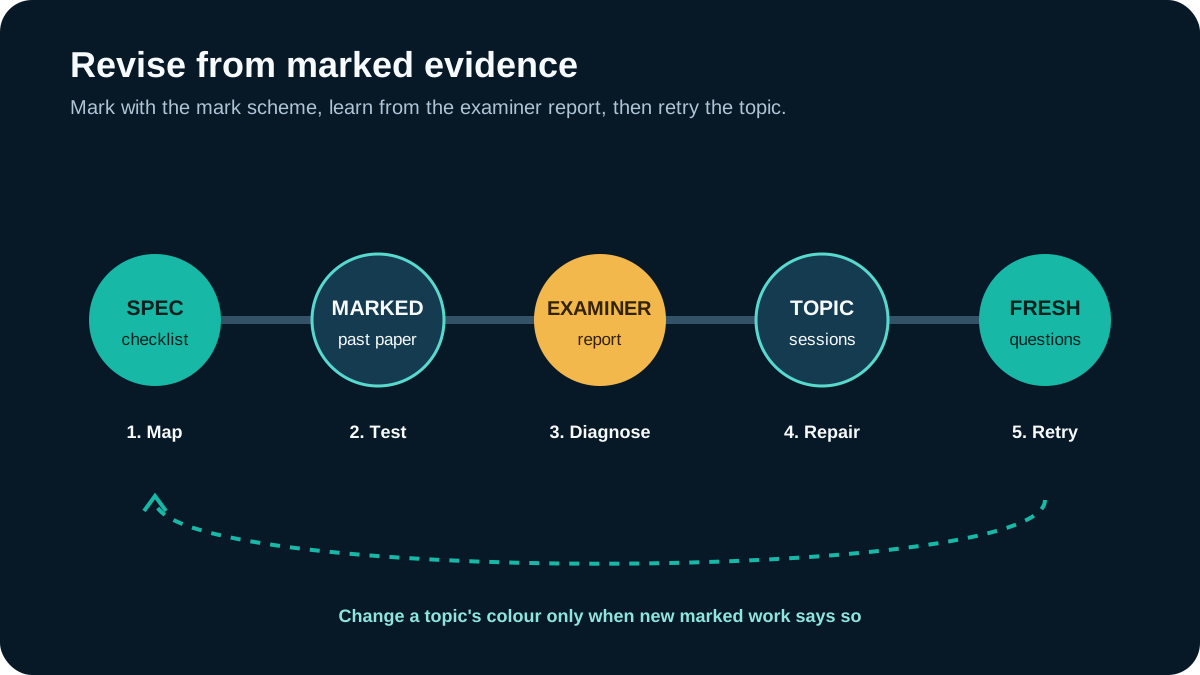
A mock grade tells you roughly where you are. The marked questions underneath it tell you what to revise.
GCSEs in summer 2027 at a glance
- Grades: GCSEs in England are graded 9 to 1, with 9 the highest. The Department for Education treats grade 4 as a standard pass, and grade 5 as a strong pass in its English and maths performance measure. Students who do not get at least a grade 4 in English or maths generally keep studying that subject after 16.
- Tiers: some subjects, such as maths and the sciences, have Foundation and Higher tiers with different content and grade ranges. In Pearson Edexcel GCSE Maths, for example, Foundation covers grades 1 to 5 and Higher covers grades 4 to 9, with grade 3 allowed. Check which tier you are entered for before you plan.
- Grade boundaries: boundaries are set after each exam series and change from year to year. Use a board’s published boundaries for the series you are practising, and treat any estimate as an estimate.
- Formula sheets: Ofqual has confirmed that formulae and equation sheets will be provided in GCSE maths, physics and combined science exams in 2027. You still need to know when and how to use each one.
The Joint Council for Qualifications (JCQ) key dates for the June 2027 series:
| Date | What happens |
|---|---|
| 10 May 2027 | First exam on the common timetable |
| 18 June 2027 | Last GCSE exam on the common timetable |
| 23 June 2027 | Contingency day, kept free in case of national or significant local disruption |
| 19 August 2027 | GCSE results released to students |
Each exam board publishes its own paper-by-paper timetable, so check your board’s latest version for your exact papers. Aripsy’s GCSE exam dates 2027 page turns your papers into a countdown and a calendar file.
Step 1: turn each specification into a topic checklist
Your board’s specification is the official list of what can be examined. Download the right one: the board and the specification code matter. AQA GCSE Biology is 8461; Pearson Edexcel GCSE Maths is 1MA1. Your teacher or the front of a past paper will confirm yours.
For each subject, list the topics in the specification’s own headings and numbering. Add the details that change how you revise:
- Higher-only content, if you sit Higher tier;
- required practicals in the sciences, which can be examined in the written papers;
- set texts in English Literature, and other optional routes your school chose;
- which paper each topic appears on, where the specification splits them.
AQA GCSE Biology, for example, examines topics 1 to 4 (Cell biology; Organisation; Infection and response; Bioenergetics) on Paper 1 and topics 5 to 7 (Homeostasis and response; Inheritance, variation and evolution; Ecology) on Paper 2. That split tells you which weak topics need fixing before which exam.
Rate each topic red, amber or green as a prediction, then treat that rating as something to test. The weak-topic diagnostic guide explains why a confident rating often turns out wrong.
Step 2: gather evidence from mocks and past papers
Good evidence comes from questions answered without notes, under conditions close to the exam:
- mock exams, once they have been marked;
- past papers and past-paper questions from your board;
- specimen and sample papers for a newer specification;
- class tests and homework questions, as long as you note which topic each lost mark belongs to.
The most recent exam series is usually kept for schools for a while, so teachers can use it as a mock. AQA publishes question papers, mark schemes and reports on the exam on its public website a year after the series; Pearson’s student page says most question papers and mark schemes more than nine months old are available. OCR lists past papers, mark schemes and examiners’ reports on each qualification’s assessment page, with the full set of materials on Teach Cambridge for teachers. If your school has used the newest paper as a mock, your teacher has the marks you need.
Do not use up every past paper in the first fortnight. Keep at least one full paper per subject for a later checkpoint.
Step 3: mark with the mark scheme, then read the examiner report
Mark every answer against the official mark scheme. Be strict: if the mark scheme credits a specific point, term or step and your answer does not contain it, the mark was not earned.
Longer answers are often marked with levels of response. The mark scheme describes what an answer at each level does, such as how well it links ideas or supports an argument. Compare your answer with the level descriptions, not just the indicative content, and note which feature held it down.
Then read the examiner report for the same paper. Boards call it different things: AQA publishes a “report on the exam”, Pearson Edexcel an “examiner report” and OCR an “examiners’ report”. These reports describe how students actually answered each question, including common misunderstandings and the features of answers that scored well. If the report says many students lost marks the same way you did, you have found a known trap with a known fix.
The past-paper method guide covers marking and retrying papers in more detail.
Step 4: log every lost mark by topic, question type and cause
A useful GCSE error log has a few more columns than “right” and “wrong”:
| Column | Example |
|---|---|
| Subject, paper and topic | AQA Biology, Paper 1, Bioenergetics |
| Question type | 6-mark extended response |
| Marks lost | 3 of 6 |
| Why, using the mark scheme | Described photosynthesis but did not link light intensity to rate |
| Cause | Knowledge, application, exam technique, misread or time |
| Next task | A fresh 6-mark question on rate of photosynthesis, Thursday |
The cause decides the fix. A knowledge gap needs relearning and retrieval. An application gap needs varied questions. An exam-technique gap, such as ignoring the command word or not using the data given, needs practice on that question type across topics. A misread needs a reading routine, and time pressure needs timed sets.
Group the log at the end of each week. If one topic keeps appearing, the topic is weak. If one question type keeps appearing across topics, the technique is weak and should be practised everywhere.
The exam mistake-log guide shows how to turn each entry into a retest queue.
Try it: get a second opinion on one lost-mark answer. Paste the question, the marks available and your rewritten answer into Aripsy’s free Mark my answer tool and choose your board (AQA, Pearson Edexcel or OCR) and GCSE. You get an estimated mark, the points you earned and missed, and one way to improve; your first check needs no sign-up. To turn your corrected notes on that topic into structured revision notes and flashcards, use the GCSE revision notes generator; a free account adds a short multiple-choice and fill-in-the-blank sample, and full sets of both need Pro. Every mark Aripsy gives is an estimate, not your exam board’s marking, so check it against the official mark scheme, and check generated notes against your specification.
Step 5: confirm that the weakness is real
One bad question does not prove a topic is weak. The question may have been unusual, the slip may have been a misread, or the marks may have come from a technique problem that has nothing to do with the topic. Before you rebuild your week, try fresh questions on the same topic from a different paper.
| Evidence | Likely meaning | Next action |
|---|---|---|
| Lose marks on the same topic across several questions | Knowledge gap | Relearn, then practise retrieval without notes |
| Short recall questions right, longer or unfamiliar ones wrong | Application gap | Practise varied questions and compare with mark schemes |
| Same question type fails across topics | Exam technique | Practise that question type across several topics |
| Right untimed, wrong under time | Pacing | Short timed sets with a time per mark |
| Fresh questions mostly right | The first miss was probably isolated | Keep it in mixed review |
Step 6: rank the gaps across all your subjects
With several subjects, the hardest decision is not what to revise but what to revise first. Rank each confirmed gap on:
- Evidence: how consistently does it lose marks on fresh questions?
- Marks at stake: how much of the paper does the topic or question type cover? Extended-response questions and topics that appear on every paper usually matter more.
- Dependency: do other topics rely on it? Rearranging equations, for example, comes up across maths and science papers.
- Exam date: a paper that comes earlier in May needs its priorities settled earlier.
A practical order:
- repeated gaps in high-mark topics or question types;
- foundational skills that affect several topics or subjects;
- exam-technique patterns, such as command words or using the data given;
- isolated misses, kept in mixed review;
- green topics, kept with brief maintenance.
If you are close to a grade boundary, the GCSE grade calculator can show roughly how many marks separate your mock total from the next grade, using the boundaries you enter for your board. Boundaries change every series, so use it to compare options, not to predict your result.
Step 7: write one observable target for each priority
“Revise Bioenergetics” cannot guide a session. Write the target as something you can do and check:
- Biology: explain how a named factor affects the rate of photosynthesis, using data from a graph, in a 6-mark answer.
- Maths: rearrange a formula to change its subject, including when the new subject appears twice, without a calculator.
- English Literature: move from close analysis of the Macbeth extract to the whole play, with a quotation and a point about context in each paragraph.
Attach a success check:
Answer a fresh exam question on the topic without notes, mark it with the official mark scheme, and explain why each earlier mark was lost.
Step 8: build focused revision sessions
A 45–60 minute session can follow this structure. Shorter sessions work too; keep the order.
| Time | Activity | Output |
|---|---|---|
| 5 minutes | Reread one log entry and state the target | One written objective |
| 10–15 minutes | Relearn the content or method from your notes or textbook | A short checked explanation |
| 15–20 minutes | Answer exam questions on that target, notes closed | Written answers |
| 10 minutes | Mark them with the official mark scheme | Marks and missing points |
| 5–10 minutes | Update the log and set a retry date | Cause, correction and next retry |
End every session with answered and marked questions, not just notes or highlighted pages. Retrieval without notes is the part that shows whether the gap is closing.
Step 9: turn priorities into a weekly revision timetable
Start with the time you can actually protect around school, homework and rest. A realistic week you keep beats an ambitious one you abandon by Wednesday.
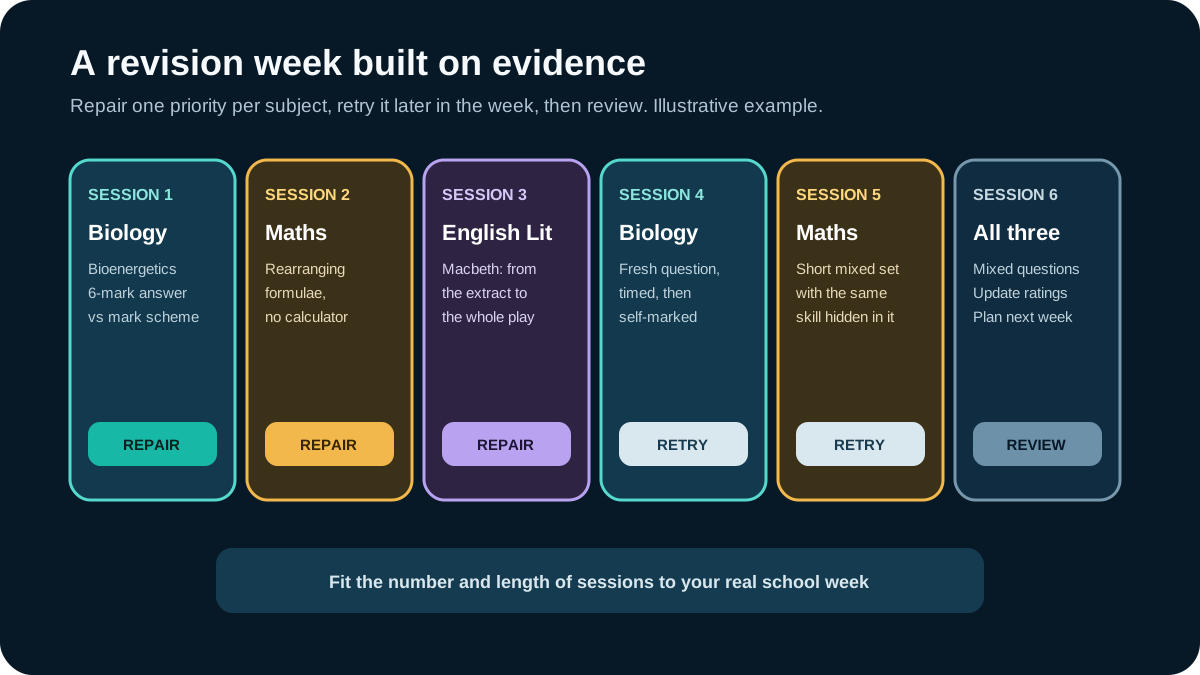
Illustrative example. Each subject’s top priority gets a repair session, the priority comes back later in the week as a retry, and the week ends with mixed review.
| Session | Subject | Focus |
|---|---|---|
| 1 | Biology | Bioenergetics: relearn, then a 6-mark answer marked against the mark scheme |
| 2 | Maths | Rearranging formulae: worked examples, then non-calculator questions |
| 3 | English Literature | Macbeth: plan and write one extract-to-whole-play answer |
| 4 | Biology | A fresh timed question on the same topic, self-marked |
| 5 | Maths | A short mixed set with rearranging hidden among other topics |
| 6 | All three | Mixed questions, update the ratings and plan next week |
Spread each subject’s sessions across the week rather than revising one subject for a whole day; coming back to a topic after a gap is part of what makes it stick. Rotate the other subjects through short mixed sessions so nothing goes cold.
Aripsy’s free revision timetable generator can lay out the days for you: add each subject, the date of its first paper and how confident you are, and it gives weaker subjects more time and moves towards exam-style practice as each paper gets closer. It plans by subject, so choose the topic for each session from your error log. For the calendar method behind this, see the syllabus-and-exam-date study-plan guide.
Choose a plan that fits the time left
There is no fixed number of revision hours that guarantees a grade. Your starting point, the number of subjects, the quality of practice, sleep and wellbeing all matter.
| Time before the exams | Planning emphasis |
|---|---|
| Autumn term | Build the checklists, fix gaps as each topic is taught, and use mocks as your first full diagnostic |
| January to March | Rank gaps across subjects, run weekly repair-and-retry cycles and add timed past-paper questions |
| Easter holidays | Full timed papers in your weakest subjects, marked and logged, with targeted repair between them |
| May and June | Short retrieval sessions on open errors, exam-style practice for the next paper and plenty of sleep |
If you only have four weeks left, the four-week GCSE revision plan shows how to compress this into a shorter sequence.
Worked example: AQA GCSE Biology
Illustrative student and marks.
A student’s mock for Paper 1 shows:
- 3 of 6 marks lost on an extended response about factors affecting the rate of photosynthesis;
- 2 marks lost reading values from a graph in a required practical question;
- a scattering of single marks in Cell biology and Organisation;
- most Infection and response questions correct.
The examiner report for a past paper describes a similar pattern: answers that describe photosynthesis without linking the factor to the rate. The plan becomes:
- Priority topic: Bioenergetics, rate of photosynthesis, as a 6-mark extended response.
- Secondary skill: reading and using data from graphs, practised across topics.
- Sessions: relearn limiting factors, write one 6-mark answer, mark it against the levels in the mark scheme, then retry a fresh question later in the week.
- Checkpoint: a fresh Paper 1 section two or three weeks later.
The mock grade said “Biology is weak”. The marked questions said exactly what to revise. For notes on this course, Aripsy’s AQA GCSE Biology revision notes page shows how to turn your own material into a draft to check against the specification.
Worked example: Pearson Edexcel GCSE Maths
Illustrative student and marks.
Edexcel GCSE Maths has three equally weighted papers of 1 hour 30 minutes and 80 marks each; Paper 1 is non-calculator and Papers 2 and 3 allow a calculator. Individual papers are not graded; the grade comes from the total across all three.
A Higher-tier student’s mock shows marks lost across several algebra questions on Paper 1, all involving rearranging, plus careless errors on the last page of each paper. Calculator papers are stronger.
The plan becomes:
- Priority skill: rearranging formulae, including when the subject appears twice, without a calculator.
- Execution rule: a quick re-check of every algebraic step before moving on.
- Timing: a short timed set each week with a time-per-mark target, so the last page is not rushed.
- Checkpoint: a mixed non-calculator set with rearranging hidden among other topics.
Algebra makes up a larger share of the Higher tier than of Foundation, so a confirmed algebra gap is worth fixing early. Aripsy’s Edexcel GCSE Maths revision notes page covers turning your own notes into checked revision material.
Worked example: AQA GCSE English Literature
Illustrative student and marks.
AQA GCSE English Literature Paper 1 (Shakespeare and the 19th-century novel) is 1 hour 45 minutes for 64 marks, 40% of the GCSE. The Shakespeare question starts with an extract and then asks about the play as a whole. All AQA English Literature exams are closed book.
A student’s mock answer on Macbeth analyses the extract well but says little about the rest of the play and quotes almost nothing from memory. The plan becomes:
- Priority skill: linking the extract to the whole play with remembered quotations.
- Knowledge support: a short set of key quotations per character and theme, practised from memory.
- Sessions: timed plans for several past extract questions, then one full answer each week marked against the levels in the mark scheme.
- Checkpoint: a fresh Macbeth question under timed, closed-book conditions.
Aripsy’s Macbeth themes page can help you organise quotations by theme; check them against your own copy of the play.
Use the right official resource for each job
| Resource | Best use |
|---|---|
| Specification | The official topic list, tiers, paper split and required practicals |
| Past papers and specimen papers | Exam-style questions for diagnosis and retries |
| Mark schemes | Exactly which points and levels earn marks |
| Examiner reports (AQA: reports on the exam) | How students actually lost marks on each question |
| Grade boundaries for each series | Turning a mock total into an estimated grade |
| JCQ key dates and your board’s timetable | Your exam dates and the order of your papers |
No single resource does every job. A mark scheme shows what earns marks but not why students miss them; a past paper tests you but cannot rebuild a missing topic.
The same evidence-first method is set out for US exams in the SAT study plan for your weakest skills.
Track progress honestly
For each priority, keep a short record: the topic, the starting evidence, the cause, your marks on fresh questions and the next retry date.
Look for several signals together: marks earned on questions you have not seen before, fewer repeats of the same cause, answers that hit the mark-scheme points without prompting, and less time lost on the same kind of question. Move a topic from red to amber, or amber to green, only when new marked work says so.
If nothing improves after a few weeks, change the diagnosis before adding more hours. The real problem may be an earlier topic, a misread command word or how you use your time in the exam.
Common mistakes to avoid
- Revising whole subjects instead of topics. “More chemistry” hides the two topics that cost the marks.
- Marking generously. If you cannot point to the mark-scheme point you earned, you did not earn it.
- Skipping the examiner report. It tells you how marks are commonly lost, which is often the fastest fix.
- Making notes instead of answering questions. Notes help you relearn; questions show whether you can use it.
- Using every past paper at once. Keep some for later checkpoints.
- Ignoring your tier and specification. Higher-only content, set texts and required practicals change what you need to revise.
Final weeks and the days between papers
In the last few weeks:
- retry the most important open errors from your log;
- use short, timed past-paper questions rather than constant full papers;
- check the time, date and paper number for each exam on your board’s timetable;
- keep green topics ticking over with brief retrieval;
- between papers, focus on the next paper’s topics and question types;
- protect sleep and avoid starting a new revision system.
The final weeks cannot guarantee a grade. Their job is to make what you know easier to recall in the exam and to remove avoidable mistakes.
FAQ
How do I find my weakest GCSE topics?
Use marked evidence rather than how a topic feels. Sit mocks or past-paper questions without notes, mark them with the official mark scheme, and log every lost mark by topic, question type and cause. A topic is weak when it keeps losing marks on fresh questions.
How do I make a GCSE revision timetable around weak topics?
Count the hours you can realistically protect each week, then give each subject’s top one or two confirmed gaps a repair session and a later retry, with a short mixed review to finish the week. The free revision timetable generator can spread the time across subjects by confidence and exam date; choose the topic for each session from your error log.
Should I revise my weakest subject or my weakest topics first?
Usually your weakest topics, ranked across subjects by evidence, marks at stake and exam date. A subject with one or two serious gaps may need less time than its grade suggests, while a stronger subject with a high-mark weakness may need more.
Where can I find GCSE examiner reports?
On your exam board’s website, alongside past papers and mark schemes. AQA calls them reports on the exam, Pearson Edexcel examiner reports and OCR examiners’ reports. Reports for the newest series may be available to teachers first.
When do GCSE exams start in 2027?
The JCQ key dates put the first exam on the common timetable on 10 May 2027 and the last GCSE exam on 18 June 2027, with 23 June as a contingency day. GCSE results are released to students on 19 August 2027. Check your board’s timetable for individual papers.
How many hours a day should I revise for GCSEs?
There is no official number. Plan the time you can sustain alongside school, sleep and rest, and judge your revision by the marks you earn on fresh questions rather than the hours spent.
Sources and further reading
Official pages checked on 24 October 2026:
- JCQ: key dates and timetables
- JCQ: key dates for the June 2027 examination series (PDF)
- Ofqual: GCSE 9 to 1 grades, a brief guide for parents
- Ofqual: decisions on formulae and equation sheets in GCSE maths, physics and combined science in 2025, 2026 and 2027
- AQA: GCSE Biology (8461) specification
- AQA: GCSE English Literature (8702) specification at a glance
- AQA: past papers and mark schemes
- AQA: assessment materials, what’s available when
- Pearson Edexcel: GCSE Mathematics (1MA1)
- Pearson: past papers information for students
- OCR: GCSE qualifications
- OCR: results reports, examiners’ reports and mark schemes
Keep exploring
GCSE & A-Level
Plan revision around specifications, active practice, past papers, and focused subject guides.
Explore GCSE & A-Level guides
Written by
Aripsy Study Team
The Aripsy Study Team creates practical revision guides designed to support learning, source checking, and active practice.


