AI Textbook Chapter Summarizer
Turn long textbook chapters into clear revision notes. Aripsy helps students extract the core ideas, definitions, examples, and processes from dense reading.
Paste
Free text
3 formats
PDF · PPTX · DOCX
Export
By plan
Auto-detect
Auto
General
Free includes 50 AI generations per month, up to 10 per day, 5,000 words per input, notes, audio file uploads, 15 flashcards per session, 15 flashcard generations per month, and 1 successful document upload after sign-in.
Short answer
What does the Aripsy chapter summarizer do?
Turn long textbook chapters into clear revision notes. Aripsy helps students extract the core ideas, definitions, examples, and processes from dense reading.
Best input
Paste a chapter section, lecture notes, article extract, or copied PDF text that you want to turn into study notes.
Responsible use
Use Aripsy as revision support alongside your source material, specification, or mark scheme.
How Aripsy helps you study this material
Turn long textbook chapters into clear revision notes. Aripsy helps students extract the core ideas, definitions, examples, and processes from dense reading.
Why use this tool?
How to summarize a chapter for revision
Common Questions
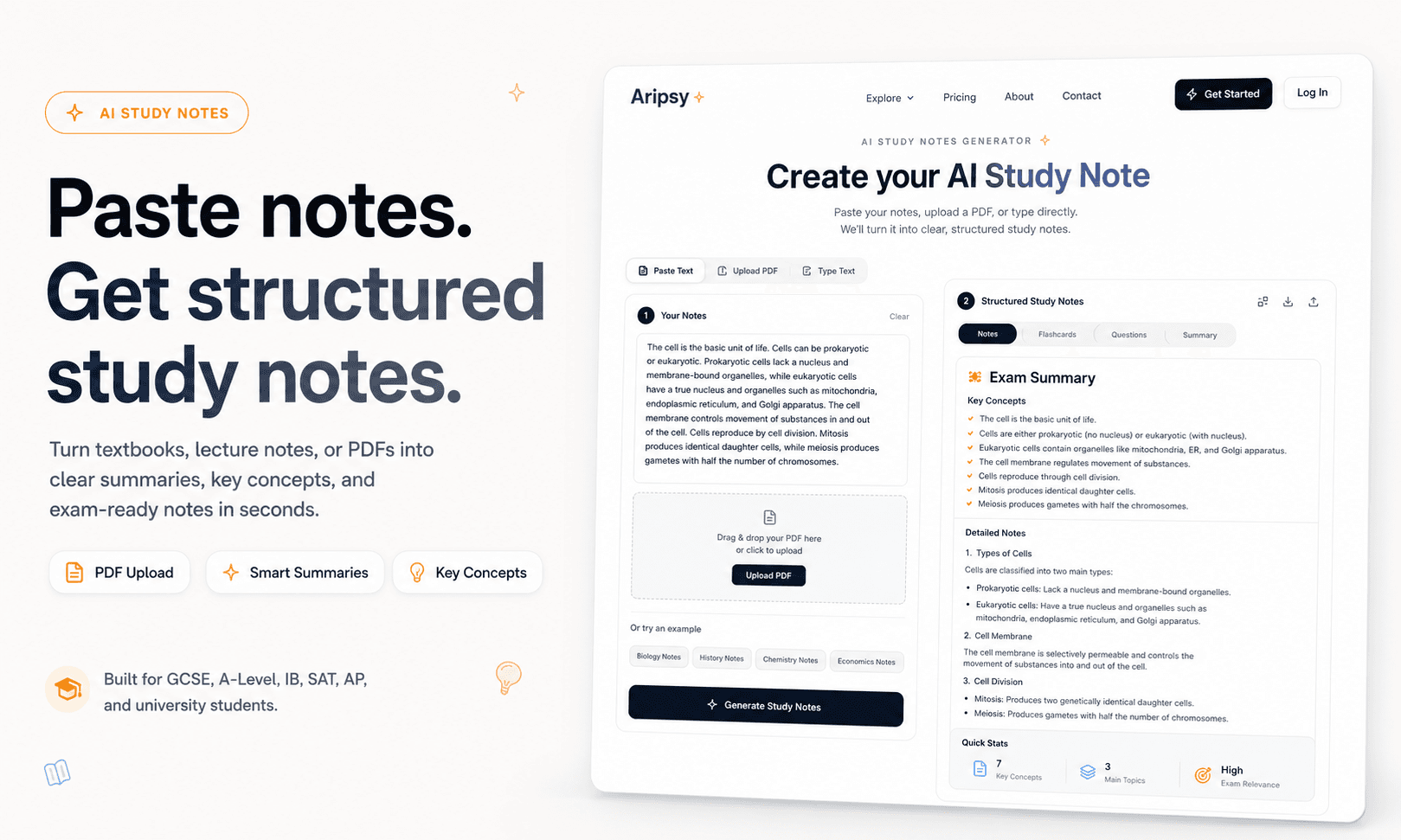
Product workflow preview
What the workflow looks like in Aripsy
Textbook summaries should help students preview, understand, and test the chapter, not skip reading entirely. The screenshot shows the same Aripsy workflow students use to add material, choose study settings, generate notes, then build recall practice from the saved session.
Related topics
Summarize chapters without losing structure
Good textbook summaries keep the chapter logic intact. Aripsy organizes key ideas under headings so you can see how definitions, examples, and processes connect.
Best for heavy reading subjects
Biology, history, law, medicine, psychology, economics, and literature often require long reading. A chapter summarizer helps reduce friction before deeper review.
Use summaries as a starting point
A summary is not a replacement for the textbook. Use it to understand the structure, then return to the original chapter for examples, diagrams, and details your teacher emphasizes.
Turn summaries into active recall
After summarizing a chapter, create flashcards or practice questions from the same material so you test recall instead of only rereading.
Useful student workflows
Chapter preview
Summarize headings and key ideas before deep reading so the structure is easier to follow.
After-reading review
Paste your chapter notes and create a cleaner summary with definitions and examples.
Key term extraction
Turn a long chapter into terms, explanations, and flashcards for later recall.
A chapter summary should support reading
A textbook chapter summarizer is most useful when it helps students understand the structure of a chapter, not when it replaces reading. Aripsy can turn a chapter section into clearer notes, but students should still work through examples, diagrams, source evidence, and assigned questions from the book.
How Aripsy handles long textbook material
The best approach is to split a chapter by heading or concept. Generate notes for each section, verify important facts, then combine the pieces into a study guide or recall set. Pro users can handle longer inputs and PDF, PowerPoint, or Word uploads, while Free users can paste focused text sections.
From textbook summary to exam preparation
After summarizing, identify which ideas need memory and which need application. Use flashcards for definitions, MCQs for distinctions, fill-in-the-blanks for precise wording, and Ask AI tutor for confusing explanations. This turns a passive chapter summary into an active revision session.
Sources and further reading
These independent education resources inform the study habits discussed on this page. Always follow your teacher, tutor, specification, or official exam guidance first.
Reading textbooks effectively
Practical advice for previewing, questioning, and reviewing textbook chapters.
Cornell Learning Strategies CenterThe Cornell Note Taking System
Shows a practical structure for separating notes, cues, and summaries.
The Learning ScientistsRetrieval practice
Explains why pulling answers from memory is usually stronger than rereading notes.
Ready to revise with less friction?
Start with your own material and build a clearer revision workflow.
Free includes 50 AI generations per month, up to 10 per day, 5,000 words per input, notes, audio file uploads, 15 flashcards per session, 15 flashcard generations per month, and 1 successful document upload after sign-in.
Supported Subjects
Biology, Chemistry, Physics, Mathematics, History, Geography, Economics, Business, Psychology, Computer Science and English Literature.