GCSE Macbeth Summary Notes
Revise Macbeth with the five-act summary below, then connect plot turning points to ambition, guilt and kingship. Use your own scene annotations in the tool to build a checked revision guide.
15
free packs a month
300
Pro packs a month
30K
words per input on Pro
Auto-detect
GCSE / SAT
General
Free includes 15 AI study packs per month, up to 5 per day, 5,000 words per input, notes, up to 10 flashcards per set, practice questions, a 3-question multiple-choice sample, 3 AI answer checks and 5 tutor questions per day, audio file uploads, and 1 successful document upload per month.
Short answer
How can Aripsy help me revise Macbeth summary?
Revise Macbeth with the five-act summary below, then connect plot turning points to ambition, guilt and kingship. Use your own scene annotations in the tool to build a checked revision guide.
Best input
Paste notes about Macbeth Act 1, including the witches, Duncan, Macbeth, Lady Macbeth, ambition, prophecy, and key turning points.
Responsible use
Use this as revision support. Review quotations and scene references before using notes for assessment.
How Aripsy helps you study this material
Revise Macbeth with the five-act summary below, then connect plot turning points to ambition, guilt and kingship. Use your own scene annotations in the tool to build a checked revision guide.
Why use this tool?
How to summarize a chapter for revision
Common Questions
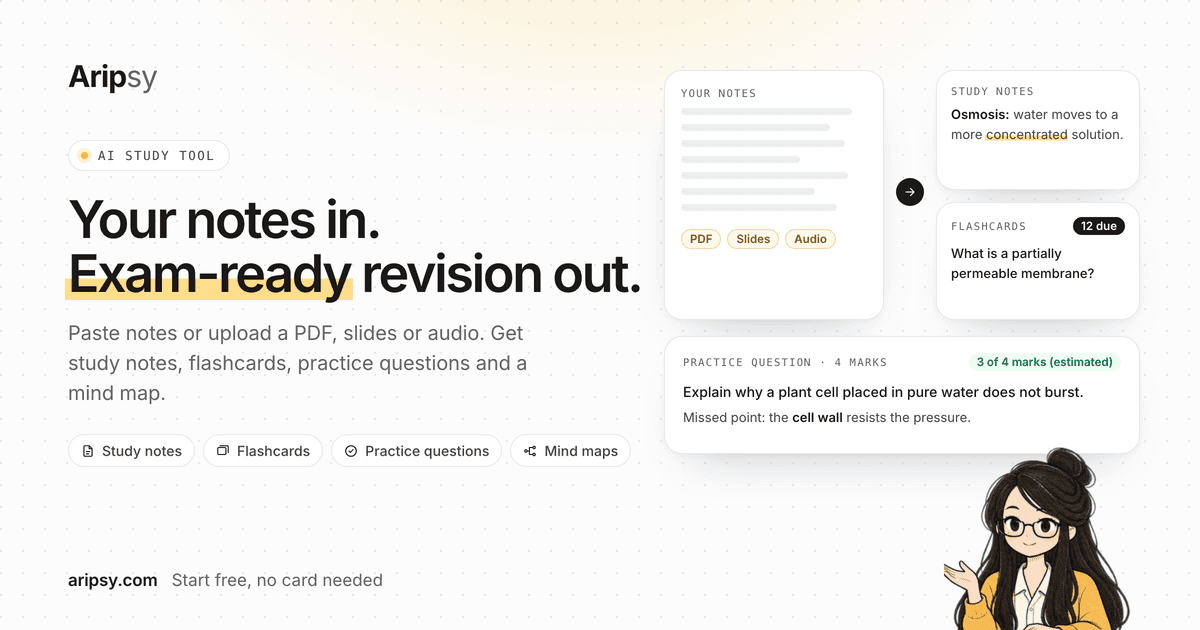
Product workflow preview
What the workflow looks like in Aripsy
Macbeth revision requires connecting plot events with characters, themes, and key quotes. The screenshot shows the same Aripsy workflow students use to add material, choose study settings, generate notes, then build recall practice from the saved session.
Related topics
From plot to interpretation: the banquet
In Act 3, scene 4, Macbeth reacts to Banquo’s ghost in front of his guests. Plot point: his public composure breaks down. Interpretation: a ruler who tries to secure power through secret violence cannot keep its consequences out of the public court. The staged interruption links guilt with political instability. Explain how the scene works dramatically rather than adding a theme label alone. Check the scene in Folger’s text of Macbeth or your classroom edition.
Three recall questions before an essay
Why does Fleance’s escape matter? It leaves the threat Macbeth associates with Banquo’s descendants unresolved. How does Lady Macbeth’s behaviour change? Contrast her attempt to manage the murder’s immediate aftermath with her sleepwalking later in the play. How does Macbeth misread the apparitions? He treats conditional, ambiguous assurances as protection. Answer first, then check the relevant scenes; these are revision prompts, not official exam questions.
Can I download these Macbeth notes as a PDF?
This page provides an online summary, not a ready-made downloadable revision PDF. You can generate your own notes and use the export formats available on your plan; see current export options. For revision, write a short explanation from memory before generating more material. Keep exact quotations and scene references checked against your edition.
Macbeth plot summary in five acts
Macbeth moves from victory and prophecy to ambition, regicide, insecure rule, tyranny, and downfall. The five-act structure shows how Macbeth gains power but loses trust, relationships, judgement, and finally the crown, while Malcolm and his allies restore political order.
What to include in a GCSE summary
A strong revision summary should include act-by-act turning points, why each event matters, how Macbeth and Lady Macbeth change, and which themes are connected to each scene. It should also separate plot recall from essay analysis.
Common mistakes to avoid
Students often retell the whole plot without explaining why events matter. Better revision links each event to a theme, a character decision, and a possible exam question.
Use Aripsy responsibly
Paste your class notes, annotations, or a short scene summary. Then review final details, quotations, and scene references against your class materials before revising from the output.
Useful student workflows
Act-by-Act Plot Breakdown
Paste scene summaries or class annotations to organize turning points from prophecy to downfall.
Character & Theme Mapping
Connect Macbeth and Lady Macbeth changing motives with ambition, guilt, and the supernatural.
Exam Essay Preparation
Turn plot notes into active recall prompts and quote-checking lists for GCSE exam questions.
Macbeth Act 1 summary
Scotland has defeated a rebellion, and Macbeth is praised as a brave soldier. The witches predict that he will become Thane of Cawdor and king, while Banquo’s descendants will be kings. When part of the prophecy quickly comes true, Macbeth begins considering the crown. Lady Macbeth challenges his hesitation, and they plan to murder King Duncan while he stays at their castle.
Macbeth Act 2 summary
Macbeth kills Duncan and returns shaken, while Lady Macbeth places the daggers near the sleeping guards. Macduff discovers the murder the next morning. Duncan’s sons, Malcolm and Donalbain, flee because they fear for their lives, which makes them look suspicious. Macbeth is then positioned to take the crown, but the murder has already created guilt, fear, and disorder.
Macbeth Act 3 summary
Now king, Macbeth fears Banquo because of the witches’ prediction about Banquo’s descendants. He arranges the murder of Banquo and Fleance, but Fleance escapes. At the banquet, Macbeth is disturbed by Banquo’s ghost and alarms the guests. Macbeth decides to return to the witches, while opposition to his rule begins to grow around Malcolm and Macduff.
Macbeth Act 4 summary
The witches show Macbeth apparitions that make him feel protected, although their promises are dangerously misleading. After learning that Macduff has gone to England, Macbeth orders the killing of Macduff’s wife and children. In England, Malcolm tests Macduff’s loyalty before joining him and an English army against Macbeth. Macduff’s grief becomes a personal reason to fight the tyrant.
Macbeth Act 5 summary
Lady Macbeth sleepwalks and reveals the psychological damage caused by guilt. Malcolm’s forces advance using branches from Birnam Wood, making one prophecy appear to come true. Macbeth learns that the witches’ assurances were based on deceptive wording. Macduff kills Macbeth, Malcolm becomes king, and the play ends with the promise that order will return to Scotland.
Turn the plot summary into GCSE analysis
Plot recall is the starting point, not the whole exam response. After each act, add one sentence explaining what changes in Macbeth, which theme develops, and how the turning point might support an argument about ambition, kingship, guilt, violence, or the supernatural. Keep quotations in a separate checked quote bank so the summary stays accurate and easy to revise.
Macbeth act summary example structure
For each act, students can write four short lines: the situation at the start, the main decision, the consequence, and the theme link. Act 1 can be framed around prophecy and temptation. Act 2 can be framed around murder and immediate guilt. Act 3 can be framed around Macbeth protecting power through violence. Act 4 can be framed around false security and tyranny. Act 5 can be framed around isolation, battle, and the collapse of Macbeth’s rule. This gives students enough plot coverage to answer questions without copying the play.
Macbeth summary source checks
A summary should not invent quotations or scene numbers. Students should keep their edition, class annotation, or trusted study notes beside the generated output. Check whether the wording describes events accurately, whether Lady Macbeth’s change is handled carefully, whether Banquo and Macduff are placed in the right sequence, and whether the final answer links plot to Shakespeare’s tragic structure rather than simply retelling events.
Summary revision next step
After checking the summary, choose one weak act and write a five-sentence recap from memory. Then add one character link, one theme link, and one checked quotation note. This gives the next revision session a clear task instead of another broad reread. If the recap still feels vague, return to one scene and rewrite the turning point in your own words before generating more practice prompts.
Structuring Macbeth for GCSE Revision
A strong GCSE Macbeth revision guide goes beyond plot retelling. Students need to understand how Shakespeare uses structure—from the initial prophecy in Act 1 to the climax and resolution in Act 5—to explore themes of ambition, tyranny, and guilt. Aripsy structures your class notes into act-by-act turning points, linking each scene to character motives and essay themes.
How to Connect Plot Summaries to Exam Questions
In GCSE English Literature exams (AQA, Edexcel, OCR, WJEC), marks are awarded for analyzing character development, dramatic methods, and thematic context. Use Aripsy to turn your plot notes into active recall flashcards focusing on key quotes, structural turning points, and character shifts.
Verifying Quotations and Textual Context
Always cross-reference generated summaries and quote explanations with your official Shakespeare text or school study edition. Verify exact line quotes and context before memorizing them for exam day.
Sources and further reading
These independent education resources inform the study habits discussed on this page. Always follow your teacher, tutor, specification, or official exam guidance first.
Topics supported
Ready to revise with less friction?
Start with your own material and build a clearer revision workflow.
Free includes 15 AI study packs per month, up to 5 per day, 5,000 words per input, notes, up to 10 flashcards per set, practice questions, a 3-question multiple-choice sample, 3 AI answer checks and 5 tutor questions per day, audio file uploads, and 1 successful document upload per month.
Supported Subjects
Biology, Chemistry, Physics, Mathematics, History, Geography, Economics, Business, Psychology, Computer Science and English Literature.