How to Find and Prioritize Weak Topics Before an Exam
Find weak topics by listing the current syllabus, rating confidence, testing each area without notes, and logging marks lost by topic and error type. Prioritise low-performing topics that carry meaningful marks or support other content, then retest them before changing their status.
 Aripsy Study Team
In this article16
When an exam is close, “revise more” is not a useful instruction. You need to know which specific topics are costing you marks, why they are weak and what action will improve them.
A difficult-feeling topic is not always your weakest topic. You might understand the content but work too slowly. You might feel confident because the page looks familiar, then fail to retrieve the answer without notes. Or you might repeatedly practise a low-value detail while a foundational gap affects several parts of the paper.
This seven-step system replaces that guesswork with evidence.
Quick answer: how do you find weak topics before an exam?
Start with the current syllabus or specification and rate every topic by confidence. Then test those ratings using closed-book questions and official past-paper material. Log every lost mark by topic and cause, separate knowledge gaps from exam-technique problems, and rank the results by weakness, mark value, topic connections and time needed to improve.
A topic is not strong because it feels familiar. It is strong when you can retrieve, explain or apply it under appropriate conditions and mark the answer against a reliable standard.
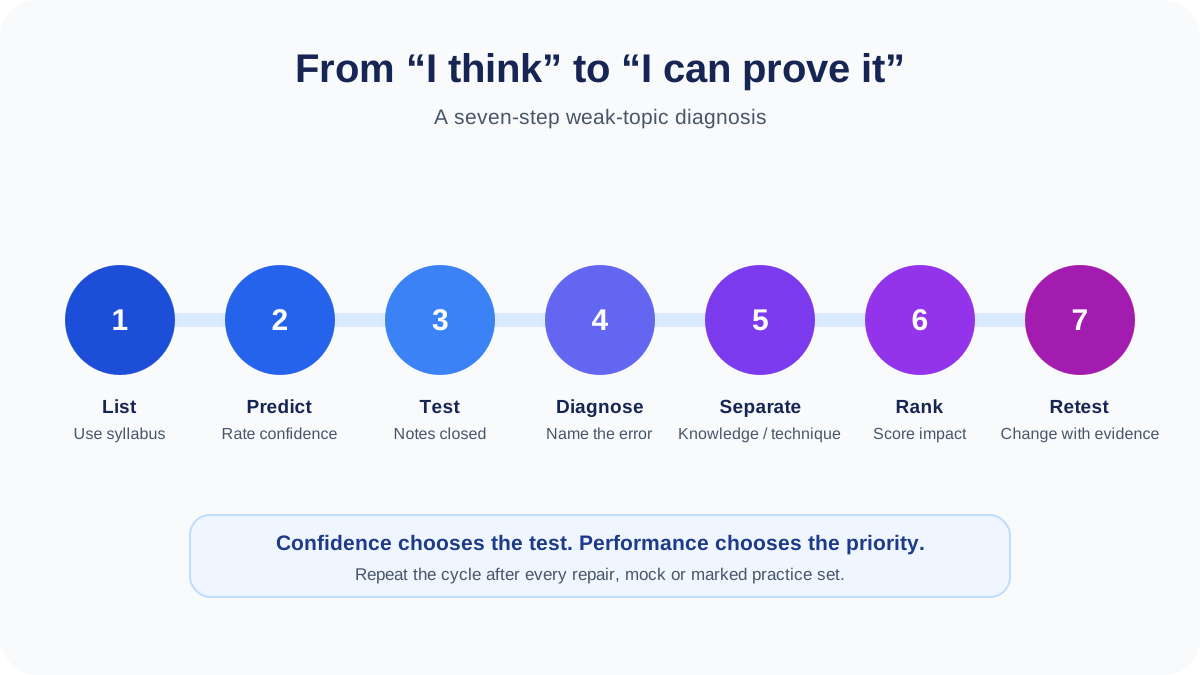
Use confidence to choose where to test first, not as the final verdict. Performance evidence should be allowed to change your rating.
Step 1: build a complete topic list from the syllabus
Do not start from memory or from the chapters you happened to make notes on. Open the current specification, syllabus, course outline or teacher checklist for your exact exam.
For each paper or module, record:
- the topic and subtopic;
- the paper or component where it can be assessed;
- the skills involved, such as recall, calculation, analysis or evaluation;
- any required practicals, texts, case studies or methods;
- the official source used for the list.
This prevents an important blind spot: material that is absent from your notes can also be absent from your mental revision list. AQA’s revision guidance points students to the specification to see the subject content and skills they are expected to have learned, alongside official past papers and mark schemes.
Keep topics small enough to diagnose. “Chemistry” is not a useful target. “Rearranging equilibrium expressions” or “explaining the effect of concentration on equilibrium” is actionable.
Step 2: make a confidence prediction
Before opening your notes, give each topic an initial rating.
| Rating | What it means before testing |
|---|---|
| 1 | I cannot explain the central idea yet |
| 2 | I recognise the topic, but cannot produce a useful answer |
| 3 | I know the basics, but make errors or need prompts |
| 4 | I can answer a normal question with minor gaps |
| 5 | I can answer and check a demanding question without notes |
Write the rating quickly. It is a prediction, not a judgement about your ability and not the final priority score.
Next to it, write one testable statement: “I can explain why increasing temperature changes the equilibrium constant” or “I can plan a comparison paragraph using two quotations.” That makes the rating easier to challenge with evidence.
The common mistake is awarding a 4 because a highlighted page looks familiar. Recognition is easier than producing an answer. A closed-book attempt in the next step will show whether the confidence is justified.
Step 3: test the rating without notes
Choose one short diagnostic task for each topic. The task should resemble the kind of thinking the exam requires.
- Knowledge-heavy topic: write the definition, sequence or explanation from memory.
- Calculation topic: solve a fresh problem and show each step.
- Essay topic: produce a timed plan or paragraph using evidence.
- Source or data topic: interpret an unfamiliar extract, graph or table.
- Practical skill: explain the method, variables, limitations and conclusion.
Use official specimen questions, past papers, question banks provided by the awarding organisation or questions selected by your teacher when possible. Past papers show format and assessment style, but they should not be used to predict that a topic will or will not appear next.
Mark the attempt against the official mark scheme, a checked worked answer or comments from your teacher. Record three things:
- marks available and marks earned;
- whether the answer was completed within a reasonable time;
- how certain you were before checking.
Research on retrieval practice suggests that practice tests can help learning and can give students better evidence for monitoring what they know. A confidence score becomes much more useful when it sits beside an actual attempt.
Step 4: log the exact reason each mark was lost
“Got osmosis wrong” is too vague. The next revision action depends on why the mark disappeared.
| Error type | Evidence | Appropriate response |
|---|---|---|
| Knowledge | Fact, definition or step could not be recalled | Relearn a focused section, then retrieve it |
| Concept | You recalled words but could not explain the relationship | Use a clearer explanation or worked example, then explain it yourself |
| Method | You selected or applied the wrong procedure | Study one model, annotate the decisions and solve a parallel problem |
| Application | You knew the idea but could not use it in a new context | Practise varied examples and explain which clue selects the idea |
| Evidence | An essay point lacked data, quotation, case or working | Add the missing evidence and practise connecting it to the claim |
| Command word | You described when asked to explain, compare or evaluate | Translate the command word into an answer checklist |
| Accuracy | Unit, sign, copying, terminology or arithmetic error | Create a specific final-check rule |
| Timing | The answer was unfinished or disproportionately long | Practise a timed section and set a stop point |
Avoid the label “careless.” It hides the mechanism. “Copied 0.06 as 0.6” suggests a line-by-line substitution check. “Forgot units” suggests writing the unit beside the unknown before calculating.
After two or three diagnostic sets, count marks lost by both topic and error type. You may discover that the apparent weak topic is actually a repeated technique problem across several topics.
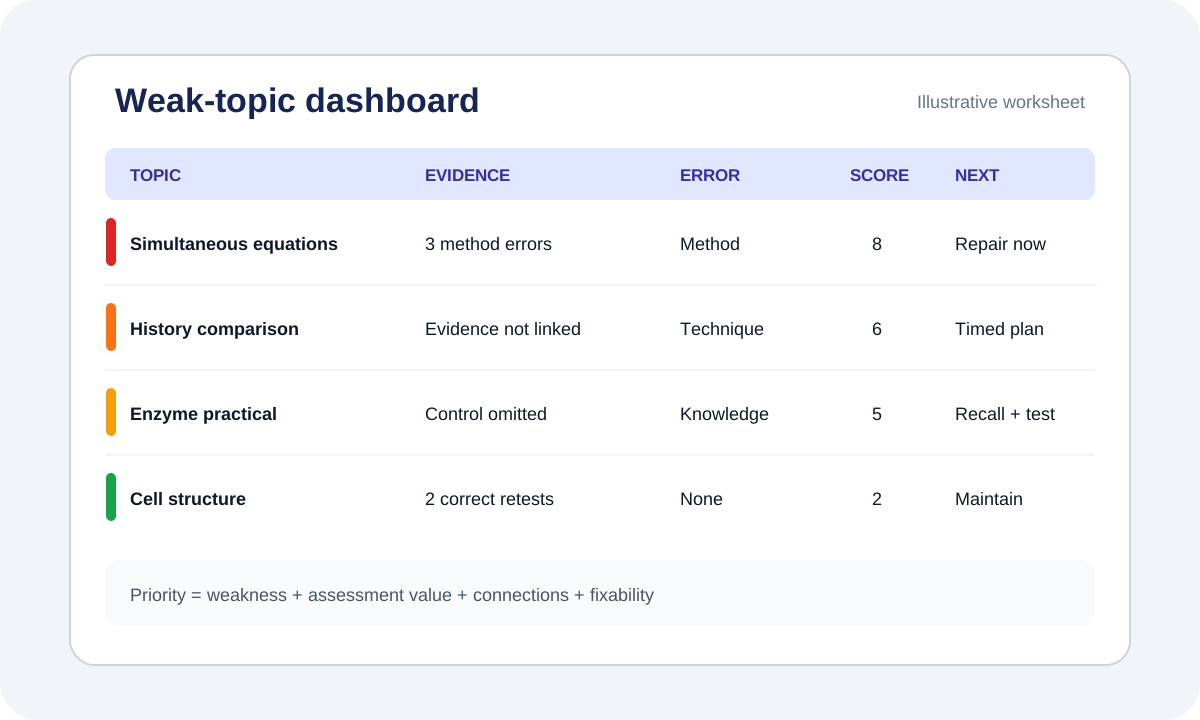
This is a worksheet mockup, not an Aripsy product screenshot. The useful unit is one precise subtopic with evidence and a next action.
Step 5: separate knowledge weakness from exam technique
Use this decision sequence:
- Can you explain the idea accurately without notes? If no, start with knowledge or understanding.
- Can you apply it to an untimed question? If no, practise method or application.
- Can you do it under the expected time and format? If no, work on technique, selection or fluency.
- Can you repeat the performance after a delay? If no, the knowledge is not stable yet.
This distinction prevents mismatched revision. Rereading is unlikely to fix an answer that is already accurate but too slow. Timed papers are a poor first fix when the underlying concept is still unclear.
Some topics have more than one weakness. Record the first failing point in the sequence, repair it and test again. Once knowledge is secure, a timing or application problem may become visible.
Step 6: rank topics by potential impact
Do not revise every red topic in the order it appears in the textbook. Rank it using four factors:
- Current evidence: how badly and consistently are you performing?
- Assessment value: can the topic or skill contribute meaningful marks under the current specification?
- Connection: does it support several other topics or question types?
- Fixability: can a focused session produce a useful improvement before the exam?
Use a simple 0–2 score for each factor:
| Factor | 0 | 1 | 2 |
|---|---|---|---|
| Weakness | Mostly correct | Partial or inconsistent | Cannot retrieve or apply |
| Assessment value | Small or narrow role | Moderate role | Meaningful or repeated role across the assessment |
| Connection | Mostly isolated | Supports another area | Foundational to several areas |
| Fixability | Needs long-term teaching | Improvement may take several sessions | Clear gap with a focused repair |
Add the four numbers. A score of 6–8 is a strong candidate for the next revision block; 3–5 needs planned work; 0–2 can receive maintenance. This is a planning aid, not a prediction of marks or grades.
Use official assessment information for value and coverage. Recent papers can reveal formats and recurring skills, but no pattern guarantees the next paper. Cambridge’s learner guidance also advises revising every syllabus topic, even while you allocate extra practice to gaps.
Step 7: assign one action and a retest date
A priority list becomes useful only when each entry tells you what happens next.
Record:
- the exact subtopic;
- the evidence that made it weak;
- the error type;
- one repair action;
- one retest task;
- the retest date;
- its current red, amber or green status.
For example:
| Topic | Evidence | Repair | Retest | Status |
|---|---|---|---|---|
| Simultaneous equations | Chose substitution incorrectly in 3 questions | Annotate one worked example, then solve 4 varied problems | Two unseen questions in 3 days | Red |
| History interpretations | Evidence is known but not compared | Practise two comparison plans using the command-word checklist | One timed paragraph on Friday | Amber |
| Cell structure | Full recall and correct application twice | No relearning; one short delayed check | Five questions next week | Green |
Move a topic only after evidence changes. One comfortable session can move red to amber, but green should mean you can repeat the result after a delay and in an appropriately difficult task.
A red–amber–green system that does not lie to you
Traffic-light systems fail when colours describe feelings rather than performance. Use operational rules:
- Red: you cannot retrieve the core idea, cannot begin the method, or repeatedly lose a large share of available marks.
- Amber: you can produce a partial answer but have a specific gap in accuracy, application, evidence or speed.
- Green: you have answered appropriate questions accurately on more than one occasion, including after a delay.
Green does not mean “finished forever.” Give strong topics brief maintenance so they remain available. Red also does not mean “bad at the subject.” It identifies the next problem to work on.
What should you revise first when time is short?
Choose the highest-impact topic you can realistically improve, not automatically the hardest topic in the course.
If the exam is several weeks away
Start with foundational concept gaps, then return to them through spaced retrieval. Include official topic questions and occasional mixed practice so improvements transfer beyond one exercise.
If the exam is one week away
Prioritise common skills, high-value gaps, formulas, definitions, methods and question types that can improve through focused practice. Continue short checks of stronger material.
If the exam is tomorrow
Do not attempt to rebuild an entire unfamiliar unit overnight. Review high-value essentials, your error log, formulas, definitions and a few representative questions. Protect sleep and arrive able to use what you already know.
These are planning principles, not guarantees. Your teacher may know about course-specific priorities, access arrangements or material that needs particular attention.
Turn one weak topic into a revision block
Use this 40-minute structure:
| Time | Task |
|---|---|
| 5 minutes | Attempt one diagnostic question without notes |
| 10 minutes | Review only the concept, method or evidence that failed |
| 10 minutes | Retrieve the explanation or method with the source closed |
| 10 minutes | Complete a fresh question |
| 5 minutes | Mark it, update the log and schedule a delayed retest |
If the first diagnostic is already correct and timely, do not spend the remaining 35 minutes rereading the topic. Update its status and move to the next priority.
Use AI-generated questions carefully
Generated questions can add targeted practice after you identify a gap, particularly when you have your own checked notes. They do not replace official papers, mark schemes or teacher judgement about assessment standards.
You can create focused practice questions from your checked notes. Verify the question and answer against the source before using the result to change a topic’s status. A flawed generated answer can otherwise create a false weakness—or hide a real one.
For official-paper diagnosis, use the mark–review–retry method. For the learning method behind closed-book testing, see how active recall improves exam revision. If a weak topic first needs clearer notes, use the exam-note workflow.
Mistakes that make a weak-topic list unreliable
Rating topics only by confidence
Confidence is useful for choosing where to test. It should not override the result of a properly marked attempt.
Treating one paper as the whole course
One paper may omit a topic or sample it narrowly. Use the current specification as the coverage map and several suitable questions as evidence.
Ranking only by past-paper frequency
Past frequency does not predict the next paper. Assessment value, foundational importance and current performance matter more than a guessed topic forecast.
Mixing subjects and subtopics
“Maths: red” gives no next action. “Completing the square when the coefficient of x² is not 1” does.
Changing red straight to green after rereading
The colour should change after a fresh attempt, ideally after a delay—not when an explanation feels clear with the page open.
Ignoring technique patterns
If you know the content but repeatedly misread command words, omit evidence or run out of time, more content notes will not address the main loss.
Copyable weak-topic audit
- [ ] I used the current syllabus or specification to list every topic.
- [ ] Each entry is a precise subtopic or skill, not an entire subject.
- [ ] I recorded an initial confidence prediction.
- [ ] I tested the topic without notes using a suitable question.
- [ ] I marked it against an official or teacher-checked standard.
- [ ] I recorded marks lost, time used and the exact error type.
- [ ] I separated knowledge, method, application and technique problems.
- [ ] I ranked topics using weakness, assessment value, connections and fixability.
- [ ] Every priority topic has one repair action and one retest task.
- [ ] A topic changes colour only when new performance evidence supports the change.
- [ ] I still maintain stronger topics and cover the complete syllabus.
FAQ
How do I find my weak topics before an exam?
Start with a confidence audit across your syllabus, then test those ratings with past-paper or exam-style questions. Any topic you cannot retrieve or apply without notes needs attention, even if it feels familiar when you read it again.
What is the fastest way to prioritise weak topics?
Rank them by demonstrated weakness, assessment value, connection to other topics and how realistically they can improve before the exam. Low-performing, high-value foundational topics usually deserve earlier attention because they offer greater potential return on revision time.
Should I revise weak topics by rereading my notes?
Not on its own. Rereading can support initial understanding, but it does not prove retrieval. Close the notes and use recall, flashcards or appropriate questions to test whether the knowledge is available when you need it.
How many weak topics should I work on at once?
Keep the active list tight. Work on the highest-priority red topics first, while giving amber and green topics short scheduled checks. Too many simultaneous targets make it difficult to complete repairs and measure progress.
How do I know if a topic is weak because of knowledge or technique?
If you cannot explain the concept or recall the needed information, start with knowledge. If you can answer correctly when untimed but lose marks through timing, structure, command words or execution, the weakness is mainly technique.
Sources and further reading
Keep exploring
GCSE & A-Level
Plan revision around specifications, active practice, past papers, and focused subject guides.
Explore GCSE & A-Level guides
Written by
Aripsy Study Team
The Aripsy Study Team creates practical revision guides designed to support learning, source checking, and active practice.