7 Best ChatGPT Alternatives for Studying
Choose Aripsy for a connected source-to-exam workflow, NotebookLM for cited questions across a source pack, StudyFetch for a broad multimedia workspace, Turbo AI for lecture-led conversion, Quizlet for shared study sets, Anki for controlled spaced repetition, or Claude for guided academic discussion.
Turn your material into structured notes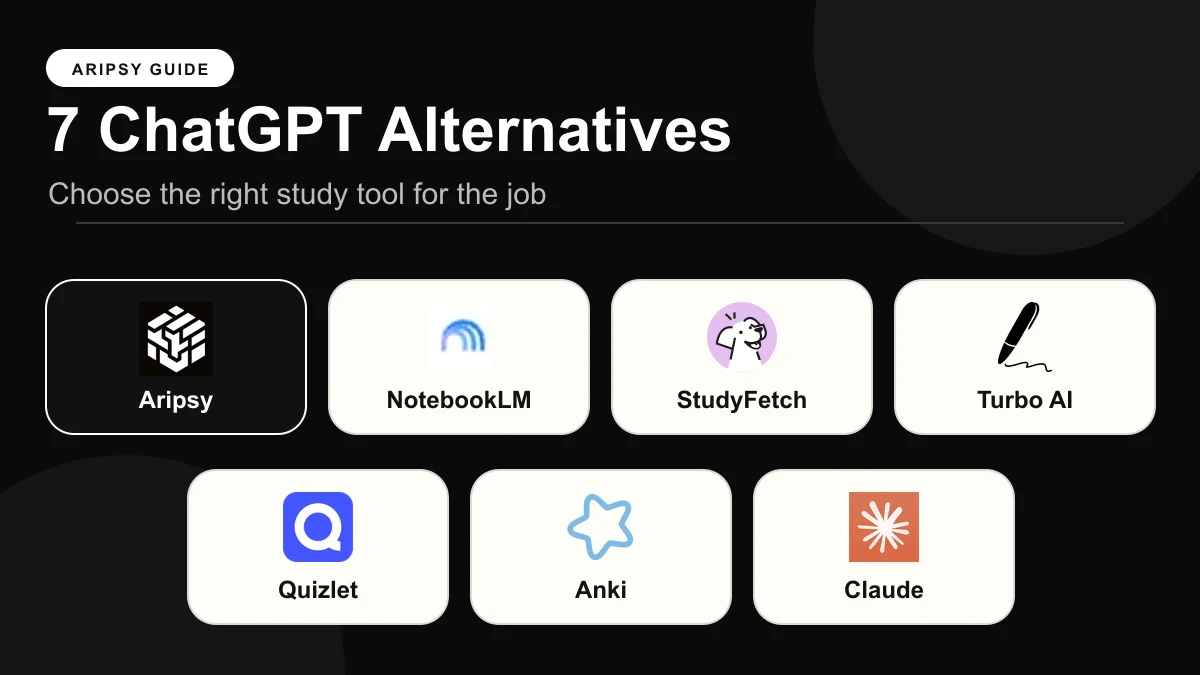
ChatGPT can explain a difficult topic, question your reasoning, and work with study files when uploads are available. The problem begins when the conversation is only one stage in a larger revision process: notes are copied into one app, flashcards into another, and missed questions disappear into chat history.
A better alternative is not automatically a better chatbot. It is the tool that removes the specific bottleneck between your course material and the way you need to practise.
Disclosure: Aripsy is our product. We include it because it fits this comparison, but we state its limitations and use the same workflow criteria for every option. Product information was checked against official sources on 21 September 2026. Features, plan access, and limits can change.
Quick answer: what are the best ChatGPT alternatives for studying?
Choose according to the study job ChatGPT is not handling well:
- Aripsy: best for turning your own material into connected notes, flashcards, quizzes, and exam-focused practice.
- NotebookLM: best for asking source-grounded questions across several documents and inspecting citations.
- StudyFetch: best for students who want many study modes around the same uploaded materials.
- Turbo AI: best when lectures, recordings, videos, or transcripts are the main input.
- Quizlet: best for familiar flashcard review, shared sets, and practice-test workflows.
- Anki: best for detailed spaced-repetition control and long-term card scheduling.
- Claude: best for guided academic discussion and reasoning, particularly where Learning mode is available.
If ChatGPT already explains concepts effectively for you, keep it. Consider an alternative when you repeatedly rebuild the same prompt, cannot trace answers to the right source, need a durable review queue, or spend more time moving content than retrieving it.
This comparison is about bottlenecks, not feature counts
Our broader guide to the best AI-powered study apps compares an overall category. This article answers a narrower question: what should a student use when a general ChatGPT conversation is the wrong shape for the next study task?
We assessed each option against six practical jobs:
- Keeping an answer tied to supplied course sources.
- Converting lectures or documents into study material.
- Producing judgeable flashcards and practice questions.
- Returning weak material at useful review intervals.
- Preserving work in an organised study workflow.
- Allowing students to verify, edit, or move the output.
This is an editorial workflow comparison, not a controlled accuracy benchmark. We did not score vendor promises, number of buttons, or the size of generated output. Every AI-generated answer still needs checking against the original material and the requirements of the course.
ChatGPT alternatives compared by study job
| Tool | Use it instead of ChatGPT when… | Best next action | Main trade-off |
|---|---|---|---|
| Aripsy | You want one source to feed notes and several recall formats | Verify the notes, then practise with cards or questions | It is less suitable for broad, open-ended conversation |
| NotebookLM | You need answers grounded in a selected source collection | Open the cited passage and check it in context | A cited explanation is not automatically active recall |
| StudyFetch | You want tutoring, notes, quizzes, media, and planning together | Test its most important mode with one real lecture | A broad suite may be more than a focused task needs |
| Turbo AI | Your starting point is a lecture, recording, video, or transcript | Correct transcription errors before generating cards | One transcript error can spread into every output |
| Quizlet | You want shared sets and familiar card or test modes | Compare a set with your own syllabus or lecture objectives | Public sets may target another course or contain errors |
| Anki | You already have checked cards and need long-term scheduling control | Import a small deck and test fields, media, and formatting | Card creation and maintenance require more setup |
| Claude | You need a thinking partner for explanation and critique | Ask it to question your reasoning before showing an answer | The workflow remains conversation-led unless you organise it elsewhere |

A fair test: use one source pack and one correction log
Feature pages are built from clean examples. Student material is not. A real source pack may contain repeated slide headers, unexplained diagrams, handwritten additions, conflicting terminology, and a transcript that misspells every technical term.
Use the same representative topic in each shortlisted tool. For example, a biology student could test a glycolysis pack containing:
- One lecture PDF.
- The matching slide deck.
- Cleaned notes from the lecture.
- A learning objective covering pathway order, ATP accounting, and regulation.
Ask each tool for a concise study guide, 12 focused flashcards, and six mixed practice questions. Then record:
- Unsupported or untraceable claims.
- Essential ideas the output omitted.
- Cards containing more than one question.
- Questions with ambiguous answers or weak distractors.
- Minutes spent correcting the sample.
- Whether corrected material can be reviewed again without rebuilding it.
The winning tool is not the one that produces the most content. It is the one that gets your representative topic into a checked, usable study loop with the least repeated work.
1. Aripsy: best for a connected source-to-exam workflow
Aripsy is designed for students whose bottleneck is turning existing course material into a repeatable revision session. Pasted text and supported document workflows can feed structured notes, flashcards, and practice activities without requiring a new conversation for every output.
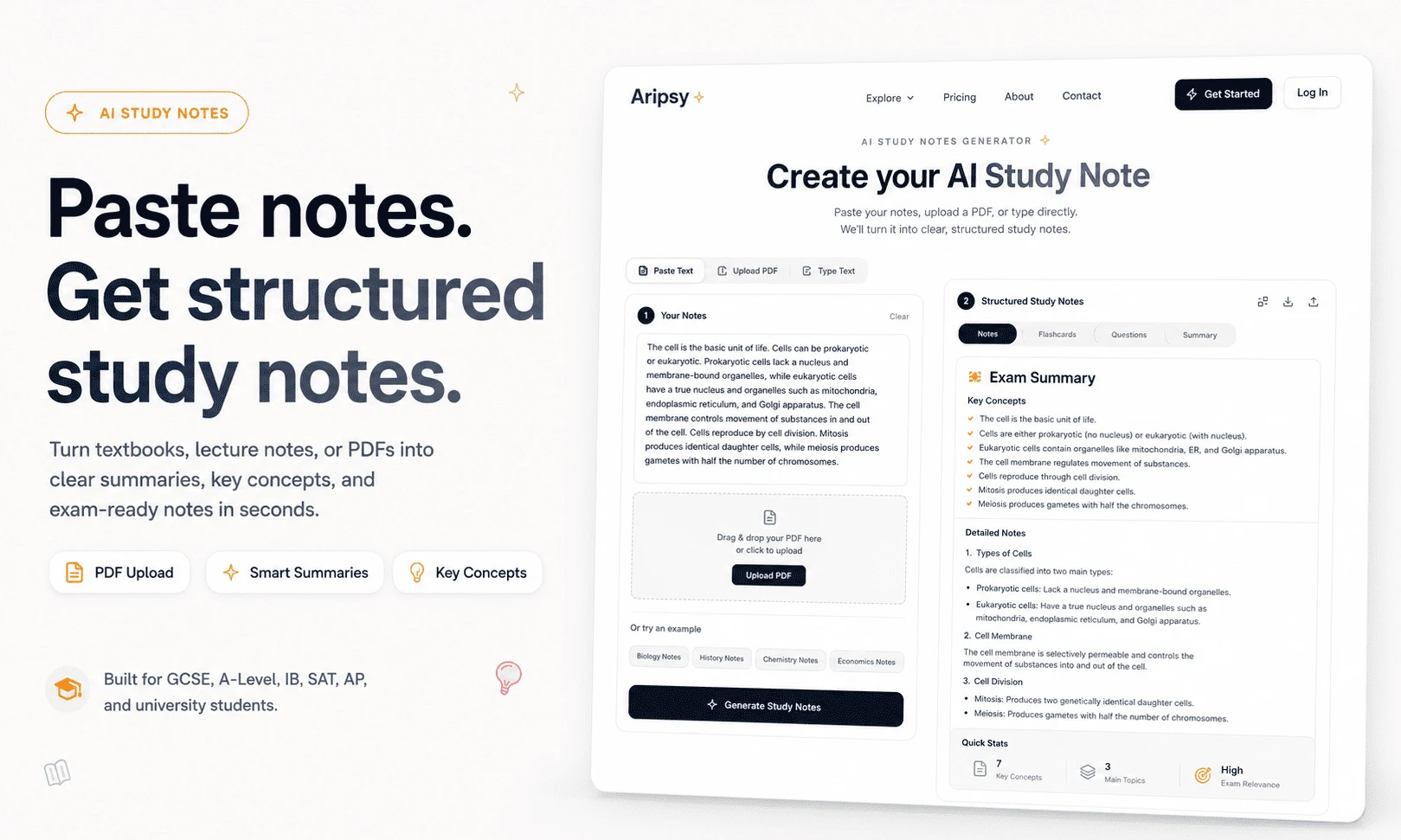
For the glycolysis test, the useful sequence is:
- Start with the relevant source section.
- Inspect the generated notes for the pathway stages and energy accounting.
- Correct extraction errors or missing context.
- Generate focused recall prompts from the checked material.
- Use missed questions to decide what to review next.
That continuity is Aripsy’s clearest difference from a blank chatbot. It is useful when the student already trusts the source and needs to move from material into retrieval practice.
It is not the strongest fit for unrestricted research, long open-ended debates, or maintaining a highly customised card database over several years. AI-generated study material can also be wrong or incomplete. Complex layouts, scans, formulas, and diagrams deserve extra checking against the original file.
Choose Aripsy if: you repeatedly turn PDFs, slides, or notes into several exam-revision formats and want the source, corrections, and practice to remain part of one workflow.
2. NotebookLM: best for questions that must stay close to sources
NotebookLM is a strong ChatGPT alternative when the central question is not “Can the AI explain this?” but “Can I inspect the evidence behind this explanation?”
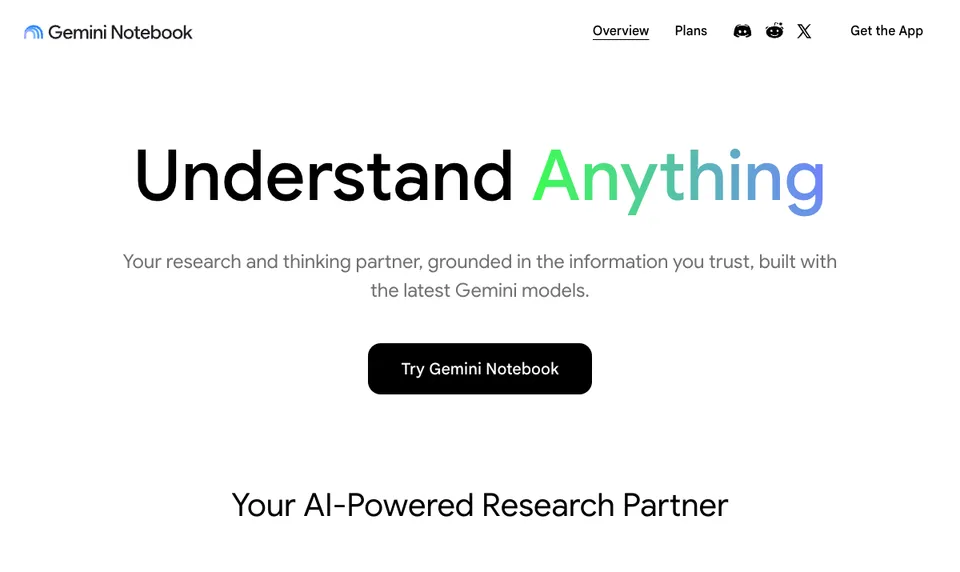
Google describes NotebookLM chat as working from selected notebook sources and providing citations that take the reader back to relevant passages. That makes it useful for comparing readings, tracing a claim through a source pack, or checking where two documents use different terminology.
In the glycolysis example, the student could ask how the lecture slides and assigned chapter describe phosphofructokinase regulation, then inspect the cited passages. This is more useful than accepting an answer drawn from unspecified general knowledge.
Source grounding does not remove the need for judgment. A citation can point to the relevant text while the generated interpretation remains incomplete. NotebookLM can also produce study artefacts such as flashcards and quizzes where available, but a student still has to answer without looking and correct weak prompts.
Choose NotebookLM if: your main bottleneck is investigating several supplied sources and tracing the answer back to them.
3. StudyFetch: best for a broad study workspace
StudyFetch combines course-material uploads with notes, flashcards, quizzes, practice tests, tutoring, lecture tools, audio, video, games, and planning features. Its support information says generated study tools can cite the original materials.
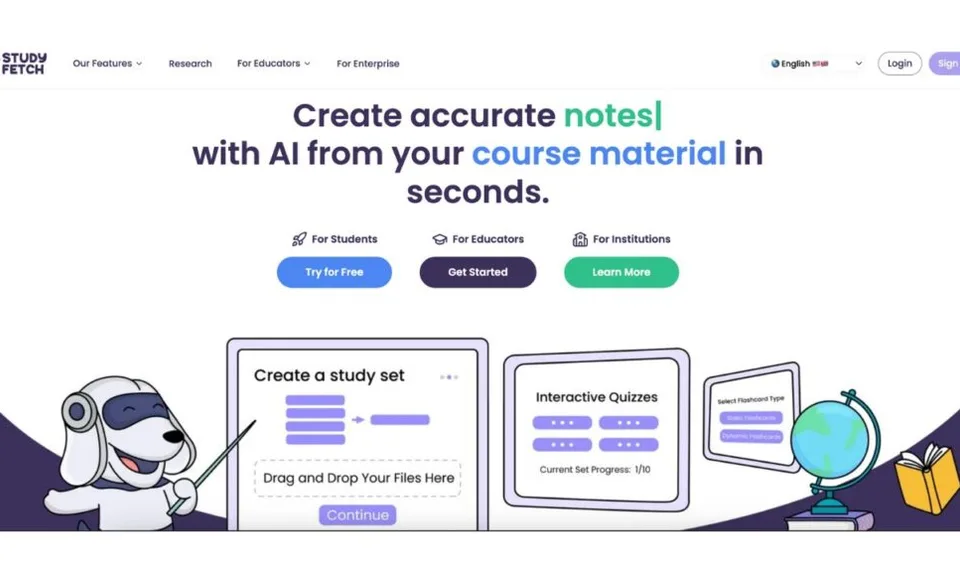
That breadth can suit a student who wants one service for several kinds of study activity. The glycolysis topic could become a note set, tutor conversation, cards, questions, and an audio recap without exporting the source to several separate apps.
The test is whether its most important output is useful—not whether every format exists. If the exam requires short explanations, inspect those questions before spending time on videos or games. If source traceability matters, open several citations and check whether they support the entire answer rather than one nearby phrase.
Choose StudyFetch if: you want a wide multimedia workspace around the same course materials and will actually use several of its study modes.
4. Turbo AI: best when lectures are the starting point
Turbo AI, formerly TurboLearn, focuses on turning PDFs, videos, audio, and recorded lectures into editable notes and study resources such as flashcards and quizzes.
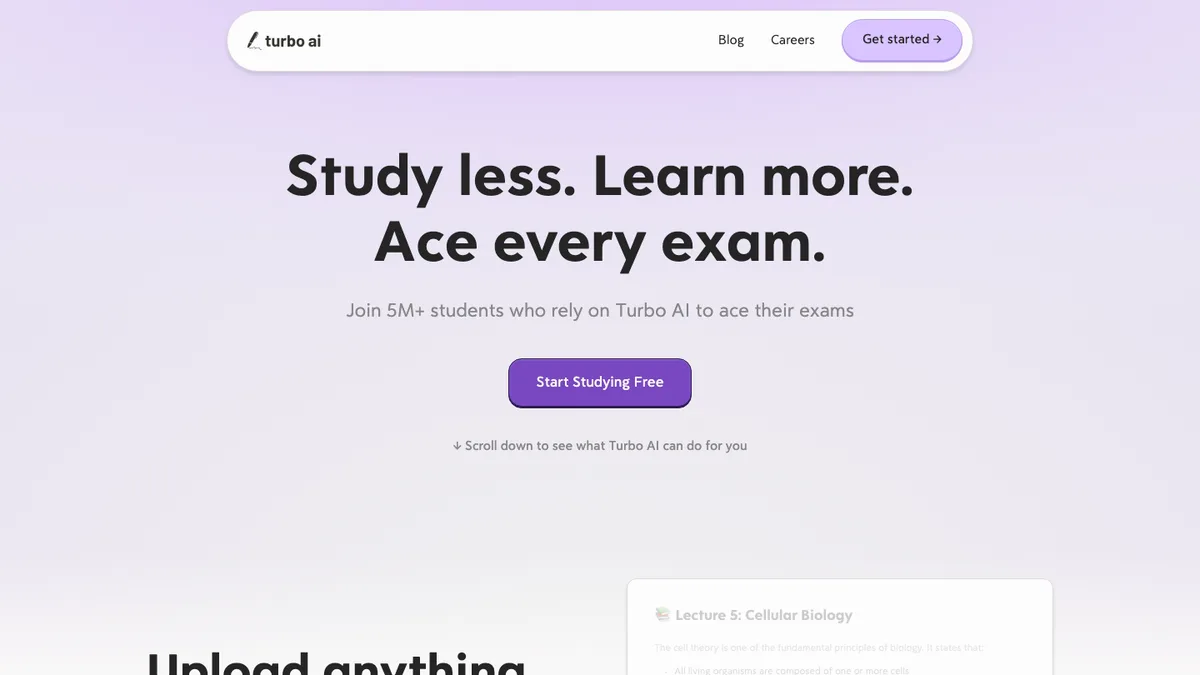
This is a useful alternative when ChatGPT enters the workflow too late. If the important information is spoken in class rather than written in the slides, capturing the lecture can preserve examples, qualifications, and exam guidance that a slide-only summary would miss.
Transcription is also the failure point. A plausible misspelling of an enzyme, case name, drug, formula, or foreign-language term can spread into notes, cards, and questions. Correct the transcript or generated notes before producing downstream material. Do not memorise the same recognition error in three formats.
Choose Turbo AI if: recordings, videos, or live lectures are your main raw material and you want to convert them into editable study resources.
5. Quizlet: best for familiar sets, cards, and practice tests
Quizlet combines its established study-set ecosystem with AI flashcard, study-guide, PDF-summary, and practice-test tools. Its official help documentation says Practice Tests can generate questions from uploaded notes or flashcard sets, with access depending on account, language, age, region, and plan.
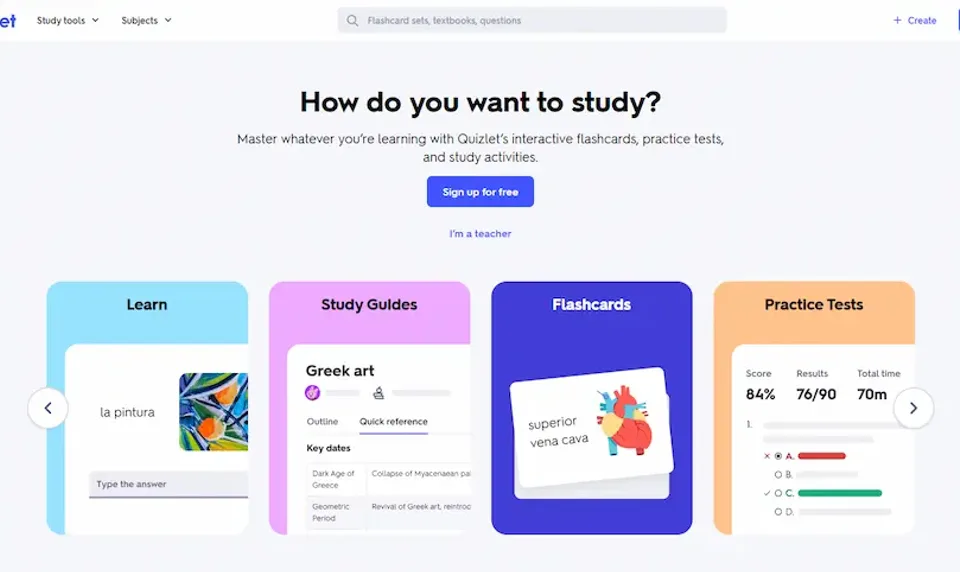
Quizlet is convenient when classmates or educators already use the platform, or when a student wants familiar card and test modes rather than a general conversation. The risk is provenance. A polished public set may follow another textbook edition, exam board, lecturer, or depth of study.
For glycolysis, a card saying “four ATP are produced” is not necessarily false, but it is incomplete if the assessment expects the distinction between gross production and a net gain of two ATP per glucose. Compare shared sets with your learning objectives before adding them to regular review.
Choose Quizlet if: shared study sets and familiar flashcard or practice-test modes matter more than keeping a deep source-analysis workflow.
6. Anki: best for controlled long-term spaced repetition
Anki is fundamentally a flashcard and scheduling system rather than a general tutor. Its official documentation describes both its older scheduler and FSRS, including control over desired retention and review scheduling.
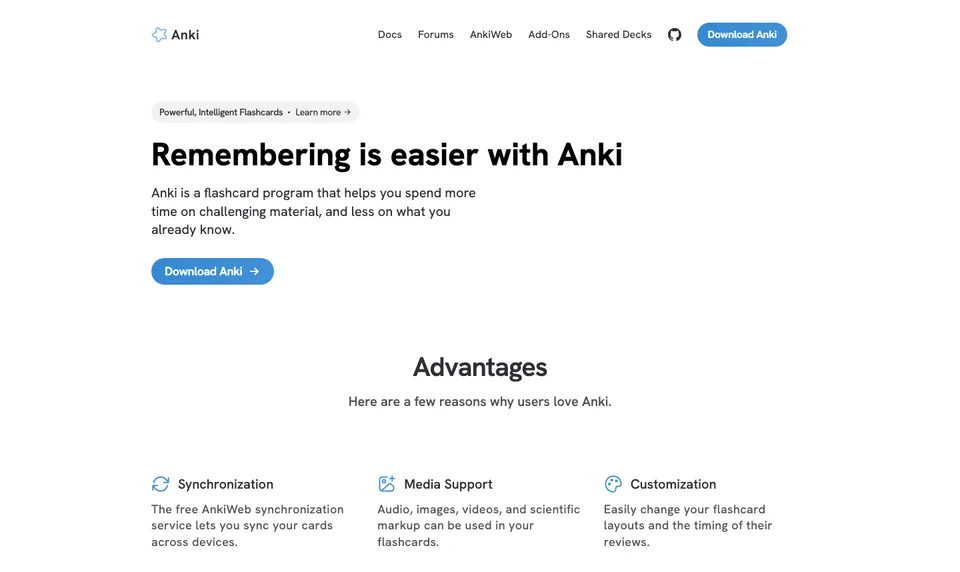
Anki becomes the stronger alternative after the content is already checked. A medical, language, law, or science student can maintain a large card collection and decide how much scheduling control is worth the setup.
The trade-off is preparation. Anki does not remove the need to choose source material, split overloaded prompts, and fix bad cards. Test any import with a small deck first. Check that questions and answers remain separate, special characters survive, and media links work.
Aripsy can help produce draft cards from course material, while Anki can manage long-term review after those cards have been checked. The detailed differences are covered in Does Anki Use AI? Anki vs Aripsy.
Choose Anki if: scheduling control and a durable personal card collection matter more than fast source conversion.
7. Claude: best for guided academic discussion
Claude for Education includes a Learning mode designed to guide reasoning with questions rather than immediately supplying an answer. Anthropic describes it as working within Projects for participating higher-education institutions; access therefore depends on the account and institution.
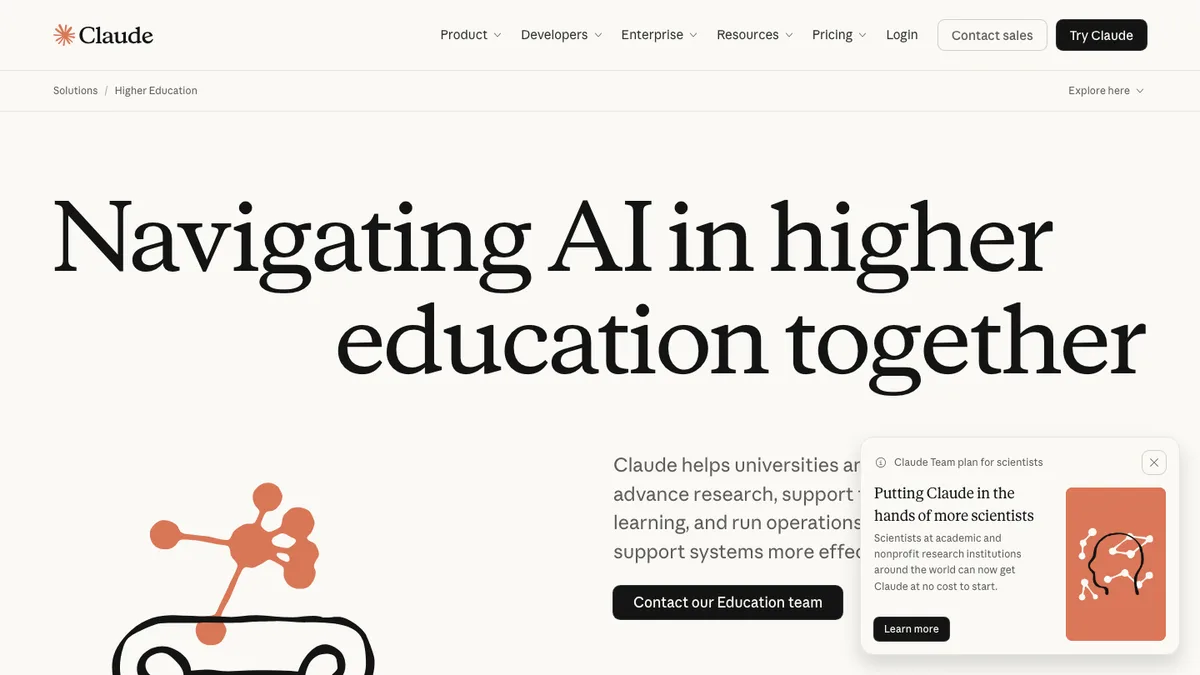
This makes Claude useful for critiquing an explanation, challenging an assumption, or developing an argument through conversation. A student could explain why phosphofructokinase regulates glycolysis and ask Claude to identify the missing causal link without rewriting the full answer.
Like ChatGPT, the workflow remains conversation-led. The student must still define the output, verify it, and decide where durable cards or practice questions will live. Do not describe an institution-only Learning mode as universally available to every Claude user.
Choose Claude if: you want a conversational thinking partner for explanation and critique, and your account provides the relevant learning features.
Which alternative should you choose instead of ChatGPT?
Use this decision rule:
- Choose Aripsy when repeated conversion from trusted source material into exam practice is the bottleneck.
- Choose NotebookLM when traceable answers across several documents are the bottleneck.
- Choose StudyFetch when several media and study modes need to share one workspace.
- Choose Turbo AI when capturing and converting lectures is the bottleneck.
- Choose Quizlet when shared sets and familiar review modes are the bottleneck.
- Choose Anki when maintaining a controlled long-term review queue is the bottleneck.
- Choose Claude when guided discussion and critique are the bottleneck.
You do not need to replace ChatGPT completely. A student might use ChatGPT or Claude to repair one difficult explanation, NotebookLM to trace evidence across readings, Aripsy to create a checked revision set, and Anki to schedule selected cards. Add another tool only when it removes enough friction to justify another account and another place to manage study material.
Common mistakes when comparing ChatGPT alternatives
Choosing the longest feature list
Ten output formats are irrelevant if the one you need produces vague questions. Test the task you will repeat every week.
Testing with an unrealistically clean document
Use a representative lecture, scan, table, formula, or transcript. A tool that works on a marketing sample may struggle with your real course files.
Treating citations as proof
Open the cited passage. Confirm that it supports the whole answer, including qualifiers, exceptions, numbers, and causal claims.
Exporting before checking a sample
Review the first 10 to 20 cards or questions. Fix source problems before multiplying them across a large library.
Uploading restricted or sensitive material
Do not upload confidential records, patient information, unpublished research, restricted exam materials, or content you are not permitted to process. Check the provider’s current privacy terms and your institution’s policy.
Sources checked for this comparison
- Aripsy study tool
- Aripsy pricing
- Google: Learn about NotebookLM
- StudyFetch support
- Turbo AI for students
- Quizlet AI study tools
- Quizlet: Studying with Practice Tests
- Anki: spaced-repetition algorithms
- Anthropic: Claude for Education and Learning mode
- Roediger and Karpicke retrieval-practice study
FAQ
What is the best ChatGPT alternative for studying?
The best alternative depends on the missing workflow. Aripsy fits source-to-exam revision, NotebookLM fits cited multi-source questions, StudyFetch fits a broad multimedia workspace, Turbo AI fits lecture conversion, Quizlet fits familiar study sets, Anki fits controlled spaced repetition, and Claude fits guided academic discussion.
What is the best free ChatGPT alternative for students?
Free allowances change frequently and apply different limits to files, generations, storage, models, and study modes. Test one representative task, then confirm current access on the provider’s official plan page before moving a full course.
Which ChatGPT alternative can turn a PDF into flashcards?
Aripsy, StudyFetch, Turbo AI, and Quizlet provide relevant source-to-flashcard workflows, with availability depending on the service and plan. PDF quality matters: selectable text is easier to process than a scan containing complex columns, formulas, or unlabeled diagrams.
Is NotebookLM better than ChatGPT for studying?
NotebookLM is usually the stronger starting point when answers must stay grounded in a selected source pack with inspectable citations. ChatGPT is more flexible for open-ended tutoring and step-by-step conversation. The better choice depends on whether source traceability or conversational flexibility is the main need.
Is Anki better than an AI study assistant?
Anki offers deeper control over flashcard scheduling and long-term review. An AI study assistant can reduce the preparation required to turn source material into draft notes, cards, and questions. Students can combine them after checking that the generated cards are accurate and export cleanly.
Can AI study tools create reliable exam questions?
They can create useful drafts, but reliability requires review. Confirm that each answer is supported by the source, the wording permits one defensible interpretation, and every distractor is wrong for a clear reason. Official past papers remain better evidence of real assessment style.
Are ChatGPT alternatives safe for private course material?
Safety depends on the service, account, institution, and material. Review current privacy controls, remove personal or confidential information, respect copyright, and do not upload restricted assessments or professional records without permission.
Try the same checked topic in one alternative before moving an entire course. If your goal is a connected route from your own material into notes and retrieval practice, open the Aripsy study tool.
Example study workflow
Use one focused source section at a time:
Paste a textbook section, lecture extract, or copied PDF text. Create structured notes, compare important details with the source, then mark the points that still need explanation or practice.
Which workflow should you use?
| Need | Best next step | Aripsy path |
|---|---|---|
| Understand a source | Create structured notes, then verify details. | PDF to notes |
| Remember key facts | Convert definitions and errors into recall cards. | Flashcards |
| Test exam readiness | Use MCQs and mistake review after notes. | Quiz and MCQ practice |
Related study paths
Editorial note
Aripsy articles are written for educational support and exam revision. We review posts for clarity, plan-limit accuracy, permission-aware upload guidance, and cautious AI-use guidance. AI-generated study materials can contain errors, so students should review important points against their source material, syllabus, or mark scheme.
Turn long notes
into revision.
Free users can paste text within Free limits to create notes and limited flashcards. Pro users can upload PDF, PowerPoint, and Word files up to 15MB and generate extra practice formats such as MCQs and fill-in-the-blanks.
Input material
Paste text or upload documents on Pro
Choose focus
Set subject, level and exam board
Revise actively
Review notes, flashcards and practice
Written by
Aripsy Study Team
The Aripsy Study Team writes and reviews practical revision guides for clarity, plan-limit accuracy, and safe exam-use guidance. Articles are designed to support learning, not replace course feedback or source checking.