Best AI Study Tools for AP Exam Prep (2026): Notes, Flashcards and Practice Compared
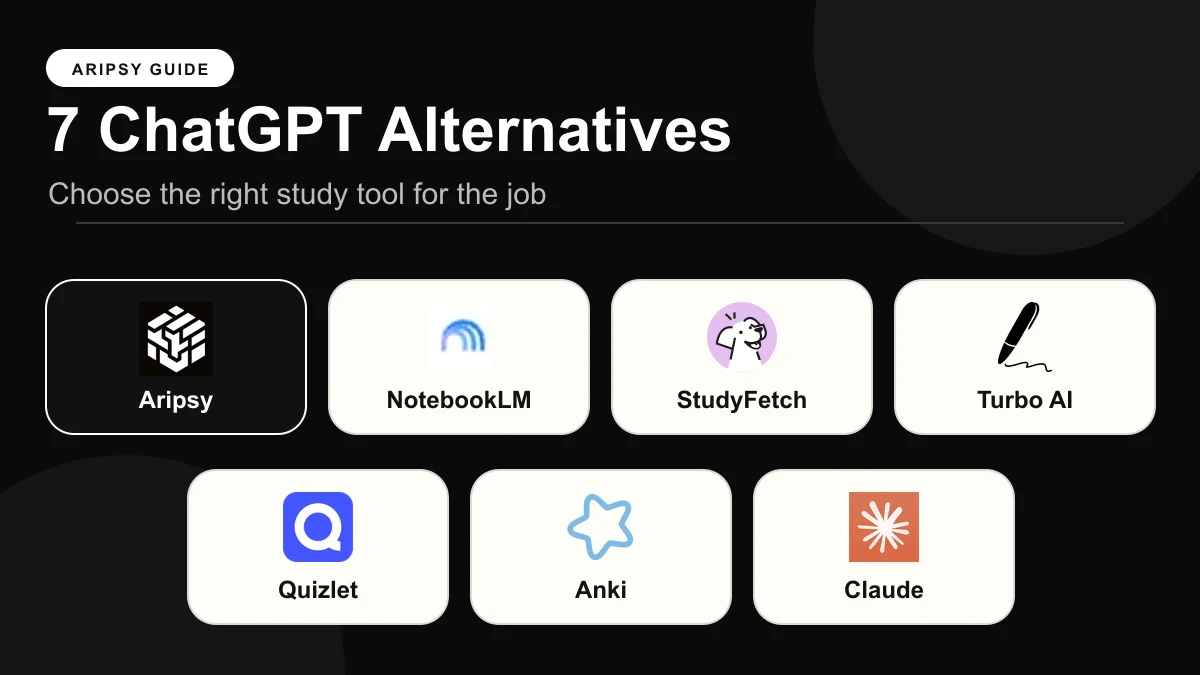
There is no single best AI tool for every AP student. Aripsy is a strong fit for turning your own class material into notes, flashcards and practice; Knowt offers a dedicated AP exam hub; Gemini Notebook is useful for studying across several sources; ChatGPT Study Mode and Khanmigo support guided explanation; Quizlet provides familiar flashcard and test workflows; and StudyFetch offers a broad multimedia study workspace. Official College Board questions and scoring guidance should remain the final exam-practice benchmark.
 Aripsy Study Team
In this article17
More than 1.3 million students in the U.S. public high school class of 2025 took at least one AP Exam during high school. College Board reports that 875,778 graduates—24.8% of that graduating class—earned a score of 3 or higher on at least one AP Exam. Those figures describe participation across a graduating class, not the pass rate for one test, but they show how widely AP preparation now matters.
AI can reduce the setup work around revision: reorganising a chapter, drafting flashcards, explaining a difficult idea or producing extra questions. It cannot guarantee an AP score, reproduce the calibration of an official exam or decide whether an answer meets a current scoring guideline. The useful question is therefore not “Which app has the most AI?” It is “Which tool supports the study job I need to do next?”
Disclosure: Aripsy publishes this comparison and is one of the products included. We checked competitor features against official product or help pages on 28 September 2026. Features, limits, names, prices and regional availability can change, so verify the current terms before building an entire AP course around one platform.
Quick answer: what is the best AI study tool for AP prep?
There is no universal winner. Choose Aripsy when you want to turn your own AP notes or supported documents into a connected set of notes, flashcards and practice outputs. Choose Knowt when a ready-made AP hub with course pages, unit resources and practice is the priority. Choose Gemini Notebook when you need to question and compare several sources. Choose ChatGPT Study Mode or Khanmigo for guided explanations and step-by-step reasoning. Choose Quizlet for a familiar flashcard and practice-test ecosystem. Choose StudyFetch when recordings, video, audio or a broad multimedia workspace matter.
Whatever tool you choose, keep official course descriptions, AP Classroom resources, released free-response questions, scoring guidelines and feedback from your AP teacher in control of the final study target. College Board specifically directs students to AP Classroom, their course exam page, released questions and Bluebook previews where available.
Seven AI study tools for AP students compared
This table compares the tools by workflow rather than declaring that one feature list is objectively “best.” Free access can vary by account, age, location and plan.
| Tool | Best AP use | Notes and sources | Flashcards and practice | Main limitation |
|---|---|---|---|---|
| Aripsy | Turning your own AP material into a connected revision set | Pasted text; signed-in Free users can try one supported document upload; ongoing PDF, PowerPoint and Word uploads require Pro | Limited flashcards on Free; MCQs and fill-in-the-blank practice on Pro; Anki export on Pro | No built-in AP question bank; generated material needs source checking |
| Knowt | Ready-made AP course hubs and practice | AP unit guides, vocabulary, cram sheets and user material | Multiple-choice, free-response practice, schedules and full-length mocks with plan limits | Ready-made material may not match your teacher’s sequence or exact source |
| Gemini Notebook | Studying across several trusted documents | Source-grounded notebook chat and generated study material | Native flashcards and quizzes with difficulty controls and CSV flashcard export | A notebook is only as complete and reliable as the sources added to it |
| ChatGPT Study Mode | Guided explanations and flexible practice | Can work with uploaded notes, images, slides and PDFs when uploads are available | Can ask questions, create practice and provide flashcard-style review | Flexible conversation is less structured than a dedicated saved study workflow |
| Quizlet | Familiar flashcards, shared sets and practice tests | Notes, files and existing sets can feed study material | Flashcards plus AI practice tests; full access depends on plan, language, age and location | Public sets can contain errors or cover a different AP course version |
| Khanmigo | Step-by-step reasoning and concept support | Works inside Khan Academy’s learning experience | Socratic tutoring rather than a full notes-to-deck pipeline | Learner access is a paid U.S. subscription; free Khanmigo tools are for eligible teachers |
| StudyFetch | Broad multimedia study sets | PDFs, slides, notes, recordings, video and other supported inputs | Notes, flashcards, quizzes, practice tests and spaced-repetition review | The wide feature set may be more than a student needs for one focused task |
How we evaluated the tools
We did not run a controlled study claiming that one app produces higher AP scores. The comparison uses five practical criteria:
- Source control: Can you start from material your teacher or course actually uses?
- Retrieval: Does the workflow make you answer before seeing the solution?
- AP fit: Can it accommodate course-specific depth, stimulus work, calculations or written responses?
- Correction: Can you inspect, edit and verify generated material?
- Official-practice compatibility: Does the workflow leave room for released questions, scoring guidance and timed practice?
That emphasis is evidence-informed. Reviews of learning research identify practice testing and distributed practice as broadly useful techniques, while retrieval practice has also outperformed concept mapping in experiments involving comprehension and inference questions. This does not mean every generated quiz is good. Incorrect retrieval can reinforce errors, which is why feedback and source checking matter.
1. Aripsy: best for an AP workflow built from your own material
Aripsy’s AP study notes generator is designed for the source-to-revision part of AP prep. A student can paste a focused section of class notes or textbook text, choose AP context, generate structured notes and then continue into flashcards or practice material. Signed-in Free users can try one successful supported document upload; ongoing PDF, PowerPoint (.pptx) and Word (.docx) uploads require Pro.
The main advantage is workflow continuity. An AP Biology student might turn one section on cellular energetics into checked notes, create cards for definitions and relationships, and then use questions to test data interpretation. An AP U.S. History student could instead isolate evidence, causation and comparison prompts. The same interface supports both, but the student still has to judge whether the output matches the current course framework.
Free includes notes and limited flashcards. Pro adds ongoing document uploads, MCQs, fill-in-the-blank practice and Anki-compatible export within the current plan limits. Aripsy does not provide an official AP question bank or automatic College Board scoring. Treat every generated output as a study draft and compare important wording, formulas, examples and claims with the source.
Best for: students who already have course material and want one path from source to notes and active-recall practice.
2. Knowt: best for a ready-made AP exam hub
Knowt’s Exam Hub offers dedicated AP pages alongside other exams. Its current help documentation lists schedules, multiple-choice practice, free-response practice, full-length mock exams, unit guides, vocabulary and cram sheets. Full-length mocks and practice rooms are limited on the free plan and expanded with Ultra.
This makes Knowt different from a pure generator. It can be a shorter route when you want to browse an AP course structure before adding your own notes. The trade-off is alignment: a ready-made guide may organise the course differently from your teacher, omit a class example or simplify a concept that your course treats in more depth.
Use the hub as a revision layer, then confirm scope and terminology against the current course and exam description. For written responses, compare your work with official scoring information rather than relying on a predicted score alone.
Best for: students who want AP-specific course pages, schedules and practice in one existing library.
3. Gemini Notebook: best for studying across several trusted sources
Google’s current product documentation calls the service Gemini Notebook; many students will know its earlier NotebookLM name. It is strongest when you have several sources to reconcile—for example, a course description, teacher handout, textbook extract and your own class notes.
The notebook can generate native flashcards and quizzes from its sources. Students can choose difficulty, request a focus, review missed cards and export flashcards as CSV. That corrects an important outdated comparison claim: the product is no longer only a source-grounded chat or summary tool.
Its limitation is coverage. Source grounding reduces unsupported drift, but it cannot repair a missing or outdated source. Before using a notebook as an AP revision base, check that it includes the current framework, the exact unit material you studied and any class instructions that matter.
Best for: students who need to ask questions across multiple trusted documents and keep the sources visible.
4. ChatGPT Study Mode: best for flexible guided explanation
ChatGPT Study Mode can guide a student with questions, layered explanations and understanding checks instead of only returning a final answer. OpenAI’s current documentation says Study Mode is available across ChatGPT plans and can reference uploaded notes, images, slides and PDFs when file uploads are available for the account.
That flexibility helps when a student is stuck on one mechanism, calculation or argument. You can ask it to wait for your attempt, give a hint, test a misconception or create a similar problem. It can also draft practice questions and flashcard-style review.
The weakness is the same flexibility: unless you define the source, AP course, topic and expected response style, the conversation can become generic. Study Mode can make mistakes and does not replace a teacher, current course document or official scoring guidance.
Best for: students who want adaptive explanations and are willing to provide precise context and check the result.
5. Quizlet: best for a familiar flashcard and test ecosystem
Quizlet Practice Tests can generate questions from uploaded notes or flashcard sets, with controls for question number, type and timing. Quizlet’s help material says limited free access is available, while broader use depends on subscription, language, age and region.
Quizlet remains convenient when your teacher already uses a set or you have a mature flashcard habit. The large shared-set ecosystem is also its main risk. A public deck may follow an older framework, mix courses or contain an incorrect answer. Check authorship and update date, then verify cards against your own course sources before memorising them.
Flashcards are strongest for compact retrieval targets such as terms, examples, stages and relationships. They are not a substitute for calculations, source analysis, laboratory reasoning or extended writing.
Best for: students who want familiar flashcard review and practice tests built around sets.
6. Khanmigo: best for step-by-step problem support
Khanmigo is useful when the missing step is explanation rather than material generation. Its guided style can support students working through maths, science and other concepts without making a finished deck the centre of the experience.
Access needs careful wording. Khan Academy currently lists Learner and Parent subscriptions for U.S. users and free Teacher Tools for eligible teachers. The free teacher plan does not provide the same learner experience, so AP students should not assume Khanmigo itself is universally free.
Use it to work through reasoning, then return to the exact AP task: write the calculation, explain the mechanism, analyse the stimulus or produce the paragraph yourself. For course coverage and exam format, keep your teacher and official materials in control.
Best for: students who need guided reasoning more than automated notes or flashcard exports.
7. StudyFetch: best for a broad multimedia study workspace
StudyFetch can turn PDFs, slides, notes and supported multimedia sources into notes, flashcards, quizzes, practice tests and study plans. Its current documentation also describes a spaced-repetition flashcard mode and tutor-style support grounded in a study set.
This breadth is useful when lectures, recordings or video are central to the course. It also means the platform can be more extensive than necessary for a student who only needs ten verified cards from one textbook section. Test the workflow with one AP unit before importing an entire course.
As with every product-generated test, “practice test” does not mean “official AP simulation.” Check question style, content scope and answer explanations, then use released College Board material for the closest available exam benchmark.
Best for: students whose course material spans recordings, video, slides and documents.
Notes, flashcards or practice questions: which output do you need?
The strongest tool choice depends on the learning job, not the AP subject label alone.

| Output | Use it for | Quality check | Not enough on its own for |
|---|---|---|---|
| Structured notes | Reorganising one unit, connecting ideas and locating gaps | Compare every important claim with the source and current framework | Retrieval, timing or scoring practice |
| Flashcards | Definitions, examples, formulas, sequences and compact relationships | Keep one target per card; edit vague or multi-part answers | Long calculations, essays, DBQs or laboratory analysis |
| MCQs | Distinguishing misconceptions and practising decisions under time | Require one defensible answer and plausible distractors | Showing full reasoning or written argument |
| Free-response prompts | Explanation, evidence use, calculation setup and written structure | Compare with official questions, scoring guidelines and samples | Reliable automatic scoring by an AI system |
| Tutor dialogue | Unblocking a concept and exposing a reasoning step | Attempt the answer first and verify the explanation | Course coverage or independent timed performance |
Match the workflow to the AP subject
AP courses do not reward one identical study method.
| AP course type | Useful AI-supported work | Official or human check that still matters |
|---|---|---|
| Biology and Psychology | Definitions, processes, study findings, data interpretation and misconception questions | Current course framework, diagrams, research-method wording and released responses |
| U.S., World and European History | Timelines, causation, comparison, evidence sorting and prompt generation | Course themes, primary sources, DBQ/LEQ rubrics and feedback from your AP teacher |
| Chemistry and Physics | Concept explanations, formula selection, units, representations and extra calculations | Reference information, laboratory context, complete working and released problems |
| Calculus and Statistics | Worked examples, error diagnosis and targeted problem variants | Correct notation, assumptions, complete reasoning and official scoring guidelines |
| English Language and Literature | Practice prompts, thesis alternatives, evidence organisation and revision questions | Original text, feedback from your AP teacher, rhetorical/literary analysis and timed writing |
| Computer Science A | Code tracing, debugging prompts, algorithm explanation and small practice tasks | Executing the code, edge cases, current course scope and written justification |
Flashcards often fit content-dense courses, but even AP Biology and AP Psychology require application. Quantitative courses need worked problems, not just formula cards. Writing-heavy courses need timed composition and evidence use. A tool is useful only when its output matches the action the exam requires.
Build an AP study stack without replacing official practice
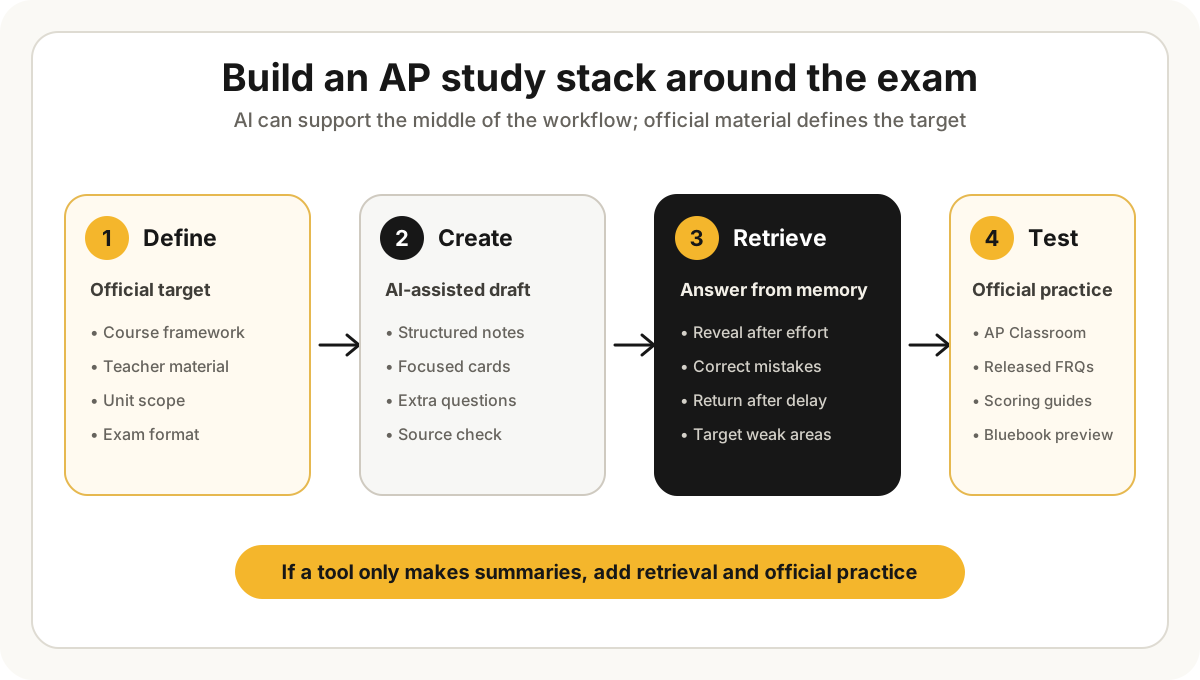
A simple four-part workflow keeps AI in a supporting role:
- Define the target. Use the current course and exam description, your teacher’s sequence and one focused source section.
- Create and verify study material. Generate a note, explanation or small flashcard set, then correct it against the source before review.
- Retrieve and diagnose. Answer cards or questions without looking. Label each miss as a content, reasoning, calculation, evidence or reading error.
- Use official exam practice. Complete AP Classroom work your teacher assigns and use released free-response questions, scoring guidelines and samples. For digital subjects, use Bluebook previews where College Board provides them.

Do not impose one arbitrary spacing schedule on every card. Review timing depends on how well you know the item, when the exam occurs and whether the platform adapts after each answer. The useful principle is to return after a delay, retrieve before revealing the answer, correct errors and revisit difficult material more often than secure material.
What AI should not do in AP preparation
Avoid using an AI tool to:
- replace assigned work or violate your school’s academic-integrity policy;
- invent citations, quotations, data or historical evidence;
- assign a confident AP score to a nuanced free response without official calibration;
- turn restricted assessment material into generated content;
- accept sensitive personal information that is unnecessary for studying;
- become the only source for a formula, definition, date or current exam rule.
For a safer workflow, remove personal information before uploading, use material you are allowed to process and check important output against the original. AI is most useful when it creates more opportunities to think—not when it performs the assessed thinking for you.
Final recommendation
Start with the gap in your current AP workflow.
- Choose Aripsy for a connected source-to-notes-to-practice workflow from your own course material.
- Choose Knowt for a ready-made AP hub and exam-oriented library.
- Choose Gemini Notebook for cross-source study with native flashcards and quizzes.
- Choose ChatGPT Study Mode or Khanmigo for guided explanation.
- Choose Quizlet for a familiar flashcard and test ecosystem.
- Choose StudyFetch for broad multimedia inputs and study formats.
Then test the tool with one real topic. Check the output, answer without looking and compare your performance with official questions. If the workflow only produces attractive summaries, it is not yet doing enough for AP revision.
You can start with Aripsy’s AP study notes generator, continue with the AP flashcard generator, and use the AP Chemistry multiple-choice practice set as an example of timed question review with worked explanations.
FAQ
What is the best AI study tool for AP exam prep?
There is no single best option for every AP course. Aripsy is a strong fit when you want to turn your own class material into notes, flashcards and practice questions; Knowt is useful for a ready-made AP hub; Gemini Notebook suits multi-source study; and ChatGPT Study Mode or Khanmigo can help with guided explanation. Use official College Board material as the final authority.
Are AI flashcards useful for AP exams?
Yes, when each card tests one clear idea, the answer is checked against a trusted source and review is spread over time. Flashcards work well for definitions, processes, examples and formulas, but they should be combined with application, calculation or written-response practice where the course requires it.
Can AI replace AP practice papers?
No. AI can draft MCQs and free-response prompts, but released College Board questions, scoring guidelines, sample responses, AP Classroom resources and Bluebook previews are better references for authentic format and expectations. Use AI for extra retrieval practice, not as a replacement for official questions.
Should AP students use ChatGPT for revision?
ChatGPT Study Mode can support explanations, guided questions, uploaded course material and practice generation. It works best when the student provides the exact AP course, topic, source and goal, attempts answers before asking for help and checks important output against course material. It should be a support tool rather than the sole revision system.
Which AP subjects benefit most from flashcards?
Content-dense courses such as AP Biology, AP Psychology and AP history courses often provide many useful flashcard targets. AP Calculus, Chemistry, Physics and Statistics also use cards for formulas and concepts, but they require substantial problem solving. AP English courses need textual analysis and timed writing beyond flashcard review.
Sources and further reading
- College Board: AP Program Results for the Class of 2025
- College Board: How to practise for AP Exams
- College Board: Released AP free-response questions and scoring information
- Carpenter, Pan and Butler: spacing and retrieval practice
- Karpicke and Blunt: retrieval practice and meaningful learning
- Dunlosky et al.: effective learning techniques
- Gemini Notebook: generate flashcards or quizzes
- OpenAI: use Study Mode in ChatGPT
- Quizlet: study with Practice Tests
- Khan Academy: Khanmigo subscription features
- Knowt: Exam Hub study material
- StudyFetch: study tools
Continue studying

Written by
Aripsy Study Team
The Aripsy Study Team creates practical revision guides designed to support learning, source checking, and active practice.