Cornell Notes: What They Are and How to Take Them, With an Example
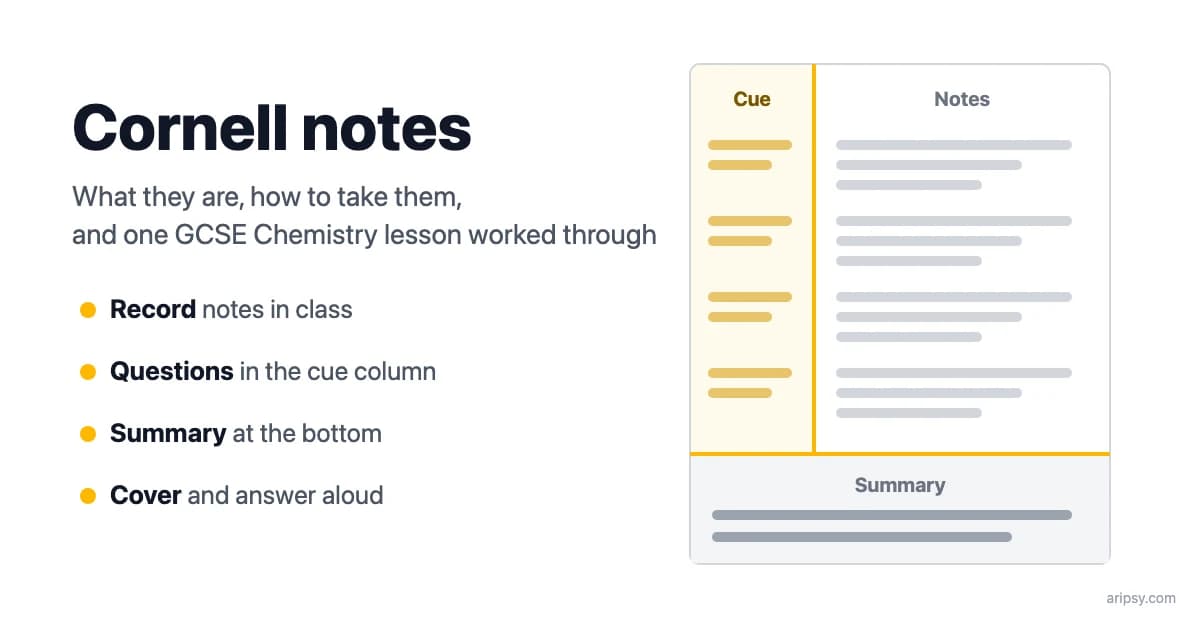
Cornell notes split each page into three parts, a narrow cue column on the left for questions, a wide notes column on the right for what you record in class and a summary strip across the bottom. After class you write the questions and the summary, then you revise by covering the notes and answering the questions from memory.
Published 12 min read
In this article10
Walter Pauk, a Cornell University education professor, devised the method in the 1950s and set it out in his 1962 book How to Study in College. Below, one GCSE Chemistry lesson is made into a Cornell page twice, by hand and by AI.
The Cornell notes layout
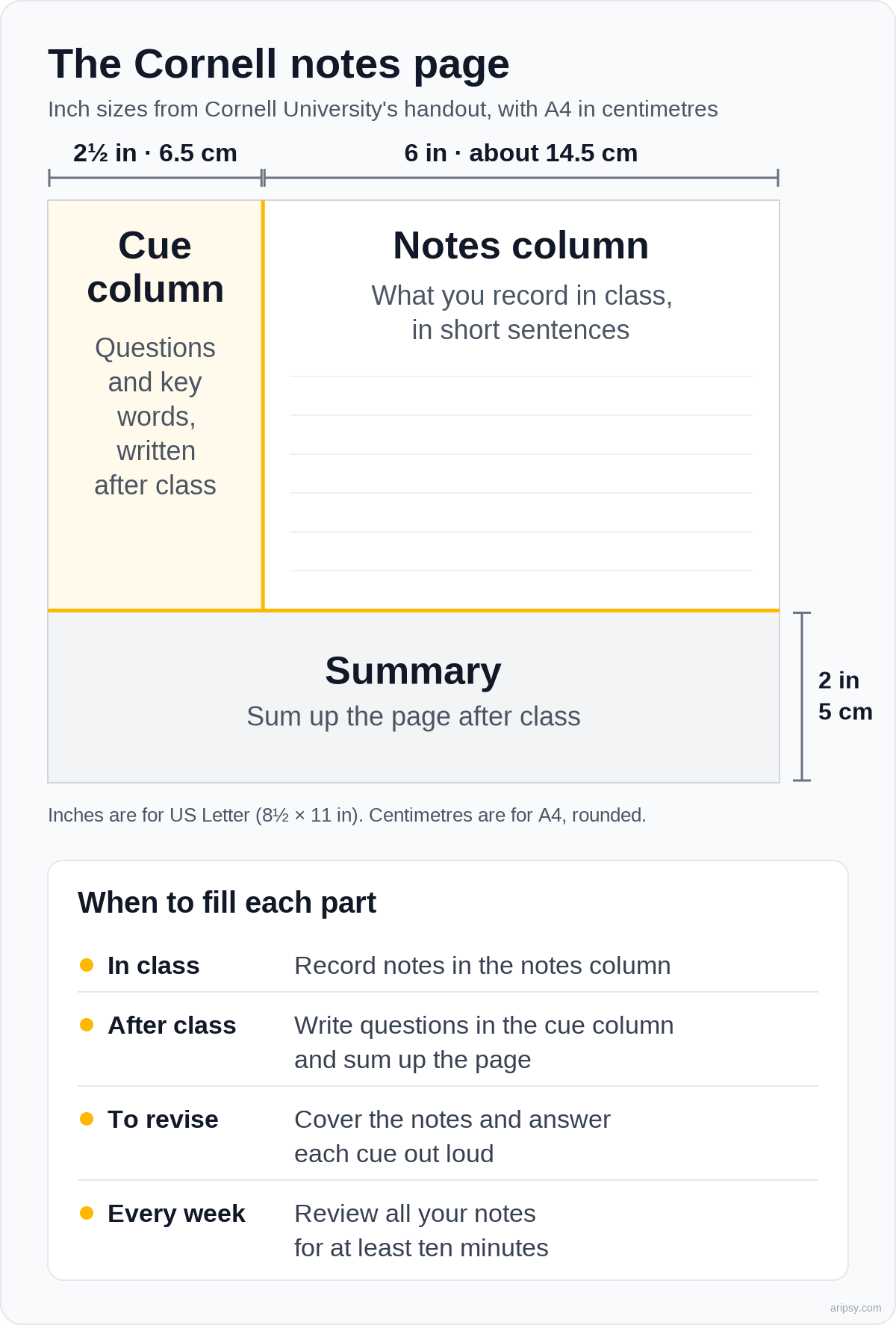
The Cornell notes page, with the inch sizes from Cornell University’s handout and rounded A4 centimetres.
| Part | US Letter | A4 | What goes in it |
|---|---|---|---|
| Cue column (left) | 2½ inches wide | about 6.5 cm | Questions and key words, written after class |
| Notes column (right) | 6 inches wide | about 14.5 cm | What you record in class, in short sentences |
| Summary (bottom) | 2 inches deep | about 5 cm | A summary of the page, written after class |
The shape matters more than the exact sizes. Keep the cue column about a third of the page and the notes about two thirds.
To set up a page, draw a vertical line about 2½ inches (6.5 cm) from the left edge and a horizontal line about 2 inches (5 cm) above the bottom, or print a free Cornell notes template in A4 or US Letter.
How to take Cornell notes in five steps
Cornell’s handout, adapted from the seventh edition of Pauk’s book, names five steps.
- Record. During class, write in the notes column in short, telegraphic sentences, keeping only the words that carry the meaning, so you can keep listening.
- Questions. As soon after class as you can, write questions in the cue column about the notes beside them. The handout says writing questions “sets up a perfect stage for exam-studying later”.
- Recite. Cover the notes column with a sheet of paper. Read each question or cue word and say the answer out loud, in your own words.
- Reflect. Ask what the facts mean, what principle they rest on, how you could apply them and how they fit with what you already know.
- Review. Spend at least ten minutes every week reviewing all your earlier notes.
Write the summary after class too. The handout gives it a space at the bottom of each page and does not number it as a step. Some guides call the steps the 5 Rs and swap Questions for Reduce, where you cut the notes down to key words in the cue column.
A worked example with GCSE Chemistry notes
Here is one lesson worked through twice, first by hand and then by Aripsy. The notes are a page of AQA GCSE Chemistry class notes on rates of reaction. They are short and messy, with a reminder about two marks lost in a mock.
We make Aripsy. The hand-made page is ours, and the Aripsy page is its real output, shown unedited.
The page made by hand
We kept the class notes in the notes column, tidied into short lines. Then we wrote a question beside each chunk and three sentences for the summary.
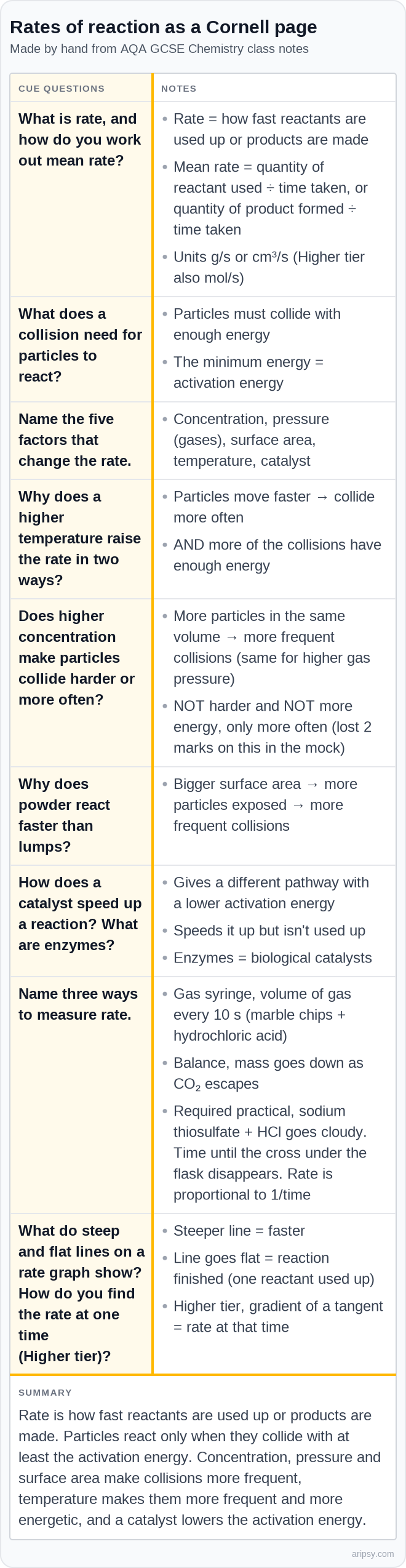
Our hand-made Cornell page from the rates of reaction notes, typed up to fit this page.
Three choices did most of the work.
- Cues are questions, not headings. “Temperature” lets you nod along. “Why does a higher temperature raise the rate in two ways?” makes you give both reasons.
- The mock mistake gets its own cue. The notes warn that higher concentration makes particles collide more often, not harder. That line cost two marks, so the cue asks “harder or more often?” at every revision.
- The summary links the ideas. It says what each factor changes instead of listing the factors again.
The same notes in Aripsy’s Cornell view
We pasted the same notes into Aripsy on 2 November 2026 with AQA, GCSE and Chemistry selected. It made revision notes, ten flashcards and six practice questions. Its Cornell view puts each flashcard question in the cue column with its answer beside it, and the notes’ one-minute recap becomes the summary.
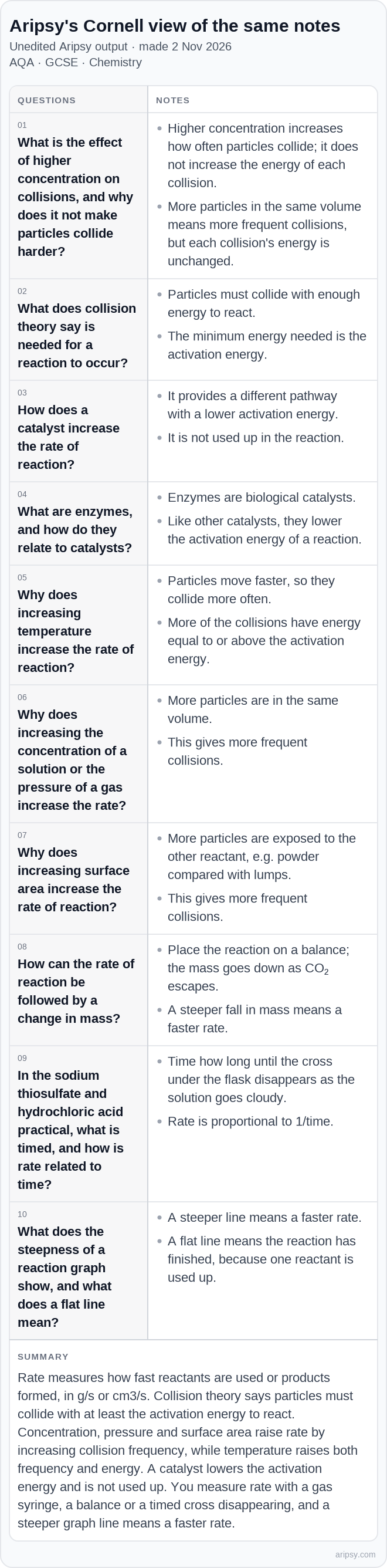
Aripsy’s Cornell layout of the pack it made from the same notes on 2 November 2026. The text is unedited Aripsy output, redrawn to fit this page. The pack’s notes, flashcards and questions are on our AI study notes generator page, unedited.
What Aripsy got right, and what we would change
Aripsy got the hardest part right. All ten cues are full questions you can answer from memory, and the first is the mock mistake about concentration, asking for the reason as well as the fact. Its summary is fuller than ours, because it also covers measuring rate and reading graphs.
Two answers go a step beyond the notes. One says enzymes lower the activation energy like other catalysts, and another says a steeper fall in mass means a faster rate. Both follow from the notes, but lines like these are the ones to check.
We would make four changes.
- Add a cue for mean rate. The notes give the formula and its units, and no row asks for them.
- Add a Higher-tier cue for the tangent. The notes say the gradient of a tangent gives the rate at one time, and no row covers it.
- Merge rows 1 and 6. Both ask about concentration. The spare row can go to the gas syringe, which appears only in the summary.
- Keep the revision notes beside it. Aripsy’s right column holds short answers, not the lesson. That makes it a sharper self-test but a thinner record, so check details in the Notes view.
The same checks work on any Cornell page, made by hand or by AI. Every formula and every past mistake needs its own cue, and no idea needs two.
Cornell notes by subject
- Maths. Write each worked example in the notes column and the question it answers in the cue column, such as “How do you solve a quadratic by factorising?” To revise, cover the working and redo the example.
- English. Put quotations and your analysis in the notes column, with cues about themes and characters, such as “Which quotation shows Macbeth’s guilt after the murder?”
- Science. Ask “why” and “how” questions in the cue column as well as “what is”, as in the Chemistry example. Draw diagrams in the notes column and add a cue to sketch each one from memory.
How to revise from Cornell notes
Cover the notes column, read the first cue and answer it out loud. Then uncover the notes and check. Mark any cue you got wrong or only half right, and start with those next time.
This is self-testing, also called retrieval practice. A 2013 review of ten study techniques by Dunlosky and colleagues rated practice testing “high utility”, because it helps learners of different ages and abilities across many kinds of test. The weekly Review step spreads your practice over time, and the same review rated distributed practice high utility too. Our guides to active recall and spaced repetition explain both, and the study techniques guide shows how to fit them into a week.
Don’t lean on the summary box. The same review rated summarisation “low utility”. Writing the summary checks that you understood the page, but your revision time is better spent on the cues.
What the research says about Cornell notes
The evidence is thin and mixed. When we searched in November 2026, we found no meta-analysis or systematic review of Cornell notes on their own, and most studies are small classroom comparisons.
- Jacobs (2008) compared Cornell notes with guided notes in two high-school English classes of 29 students each. Between a quiz before training and one after, the guided-notes class improved more, from 51% to 84% correct, against 56% to 61% for the Cornell class. The teacher reported that the Cornell class handled higher-level questions better, without figures. It is a two-page graduate symposium paper from Wichita State University, not a peer-reviewed study.
- Quintus, Borr, Duffield, Napoleon and Welch (2012) compared Cornell notes with notes in each student’s chosen style, in two sections of a high-school child development class with 16 students each. They found no difference, and average scores were within 1.5 percentage points on all three unit tests.
Two small studies, Amhout and colleagues (2023) and Ahmad (2019), found that students taught Cornell notes did better than students who were not taught it, but the best-known comparisons found Cornell notes no better than other methods for recall. The parts with strong evidence are self-testing and spaced review, which the method builds in.
On paper or on a device
Cornell notes work on paper or on a screen. On paper, rule the lines yourself or print the template. In any notes app, make a two-column table with the summary underneath. Either way, make sure you can hide the notes column when you revise.
Handwriting or typing? A well-known 2014 study found students who typed notes did worse on conceptual questions, but a 2021 direct replication found no difference, and the research is still mixed. A 2024 meta-analysis of 24 studies with college students found a small edge for handwriting when students also reviewed their notes.
Turn notes you already have into Cornell notes
If your notes are already written, you don’t have to copy them out again. Paste them into Aripsy’s Cornell notes generator and it writes revision notes and practice questions from them, plus flashcards if you turn them on. Then choose Cornell above your notes to see the Cornell page. The “Cover the notes” button hides every answer, and you tap each one to check it. You can also turn your notes into flashcards and a Cornell page in the study tool, from pasted text, a PDF, slides or a lecture recording, with your exam board selected. AI can make mistakes, so check every cue against your notes and add any it missed.
FAQ
What are Cornell notes?
A note-taking method that splits each page into a narrow cue column, a wide notes column and a summary strip at the bottom. You add questions and a summary after class, then revise by covering the notes and answering the questions.
Who invented Cornell notes?
Walter Pauk devised the method at Cornell University in the 1950s, as a teaching assistant who later became an education professor there. His 1962 book How to Study in College made it widely known. Some websites say the 1940s, but Cornell’s own sources place it in the 1950s.
Do Cornell notes work?
The evidence is mixed. The best-known comparisons found Cornell notes no better than other methods for recall, but the self-testing and weekly review they build in are backed by strong evidence.
How do you take Cornell notes?
Record notes in the right-hand column in class, then write questions in the left-hand column and a summary at the bottom soon after. The five steps above show how to recite, reflect and review from there.
Can you take Cornell notes digitally?
Yes. Use a two-column table in any notes app or a template PDF on a tablet, and hide the notes column when you revise.
Sources
We checked every source on 19 November 2026.
- Cornell University Learning Strategies Center, The Cornell Note-Taking System, on Walter Pauk as the method’s creator.
- Cornell University Learning Strategies Center, The Cornell Note-taking System (PDF handout), adapted from the seventh edition of How to Study in College (2001), for the page sizes and the five steps.
- Joe Wilensky, Cornellians, 29 July 2022, Cornell’s alumni magazine, on Pauk devising the method in the 1950s.
- Library of Congress record for How to Study in College, Houghton Mifflin, 1962.
- SUNY Schenectady County Community College, Cornell Note Taking, for the 5 Rs and the US Letter sizes.
- Jacobs, A comparison of two note taking methods in a secondary English classroom, Wichita State University graduate symposium proceedings, 2008, pp. 119–120.
- Quintus, Borr, Duffield, Napoleon and Welch, Journal of Family & Consumer Sciences Education 30(1), 2012, pp. 27–38, also the source for the one-third and two-thirds proportions.
- Amhout and colleagues, Pedagogical Research 8(2), 2023, and Ahmad, International Education Studies, 2019, two small studies in which students taught Cornell notes did better than students who were not taught it.
- Dunlosky, Rawson, Marsh, Nathan and Willingham, Psychological Science in the Public Interest, 2013, the review of ten study techniques.
- Mueller and Oppenheimer, Psychological Science, 2014, Urry and colleagues, Psychological Science, 2021, a direct replication, and Flanigan and colleagues, Educational Psychology Review, 2024, a meta-analysis, on handwritten and typed notes.
Keep exploring
Find a study workflow
Choose the source, output, or course route that fits your next study task.
Browse study workflowsWritten by
Amin Mudassir
Amin Mudassir is the founder of Aripsy. Amin started Aripsy after seeing students spend hours turning PDFs, articles, and lecture material into notes before they could study.