Does Turnitin Detect AI? What Your School Sees and How to Protect Your Work
Yes. When a school switches it on, Turnitin shows teachers an estimate of how much of a submission an AI tool probably wrote. It hides scores from 1% to 19% because they misfire more often, and it tells schools not to act on the score alone. Your strongest protection is evidence of how you wrote the work, from version history and drafts to your notes and sources.
Published 9 min read

In this article10
Turnitin’s AI writing detection works only when your school has switched it on, and it shows your teacher a percentage of your prose that its model thinks an AI tool probably wrote, with those passages highlighted. Turnitin also says the score can be wrong and should not be the only basis for action against a student, so a flag is a reason for your teacher to ask questions, not a finding. Below are Turnitin’s published error rates next to Ofqual’s count of AI cases penalized in England, the habits that protect honest work and what to do if you’re flagged. We make Aripsy, a study tool that turns your own notes into practice questions and doesn’t write anything for you to hand in.
Key takeaways
- The AI score is separate from Turnitin’s similarity score, schools decide whether to use it, and students usually can’t see it unless a teacher shares it.
- Scores from 1% to 19% show as an asterisk instead of a number, because Turnitin found more false positives at low percentages.
- In 2023 Turnitin put its false-positive rate below 1% for documents it scored above 20% AI, and about 4% for single sentences.
- In England, exam boards penalized 100 GCSE, AS and A-level plagiarism cases involving AI in summer 2025. That was 75.0% of plagiarism cases but 2.0% of all student malpractice cases.
- Drafts, version history, notes and sources show how you wrote your work, which a detector score can’t.
What Turnitin’s AI report shows your teacher
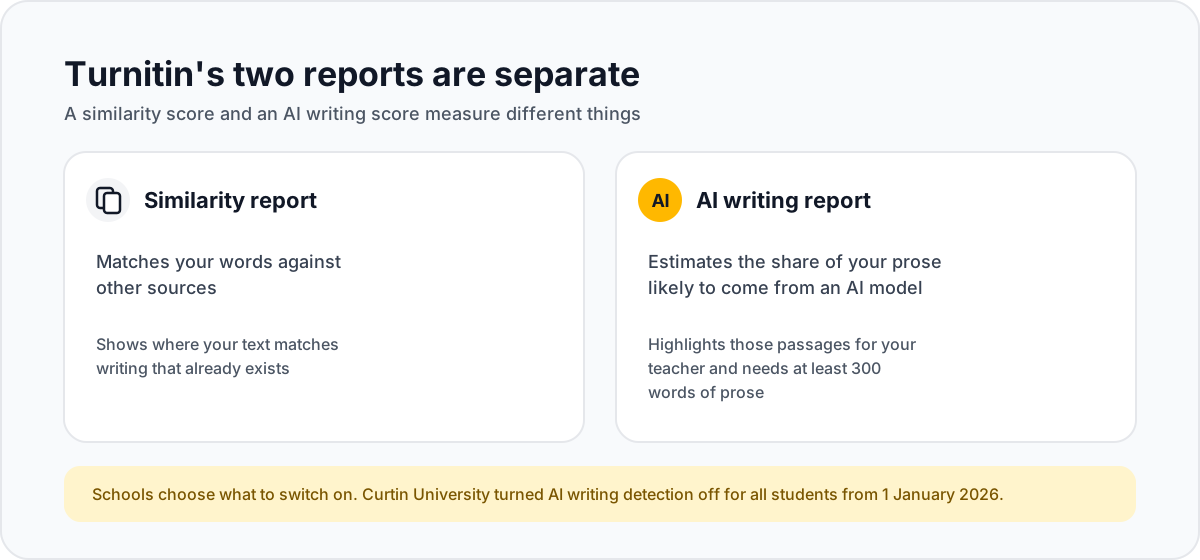
The report gives the share of the prose that Turnitin’s model judges likely to come from a large language model, such as the one behind ChatGPT, and highlights those passages for your teacher. It needs at least 300 words of prose, a minimum Turnitin set in 2023.
Low scores are hidden. A score from 1% to 19% appears as an asterisk with no number and no highlights, because Turnitin’s testing found more false positives in that range. Turnitin has also added detection for AI-written text that was reworded by an AI paraphrasing tool.
The AI score sits apart from the similarity score, which matches your words against other sources. Curtin University in Western Australia switched AI writing detection off for all students from 1 January 2026 and kept text matching on. Detection varies between schools, so ask your teacher whether it is on for your course.
You usually won’t see the AI score yourself. Turnitin’s help pages say the AI report isn’t shown to students, and a teacher who wants to share it can download it and send it to you. Ask your teacher if you want to see yours.
How accurate is Turnitin’s AI detection?
Turnitin’s published figures date from 2023. It said its false-positive rate was below 1% for documents where it found more than 20% AI writing, which it described as wrongly flagging about one human-written document in every 100. For single sentences it put the rate at about 4%, and 54% of the wrongly flagged sentences sat right next to real AI writing in documents that mixed the two. Turnitin said these figures could change as it updates the model.
At that rate, 200 honest essays could still produce up to two wrong flags. So a score works best as one piece of evidence, read alongside the work and your account of how you wrote it.
How many AI cases are penalized in England
Turnitin’s rate and Ofqual’s count measure different things. The first is how often the detector can be wrong about honest writing. The second counts only the cases where an exam board proved AI misuse and penalized it, which is the step a score alone can’t take.
In England’s summer 2025 exam series, exam boards penalized 100 GCSE, AS and A-level plagiarism cases involving AI misuse. That was 75.0% of plagiarism cases but only 2.0% of all student malpractice cases. Phones, by comparison, were involved in 44.3% of student cases. Ofqual counts only proven cases that ended in a penalty, so these numbers can’t tell you how many students used AI. Our exam malpractice statistics page has the full tables.
Can teachers detect AI without Turnitin?
Sometimes, but not reliably. Teachers can compare a piece with your earlier and in-class writing, check that the sources you cite exist and say what you claim, and ask you to explain or extend an answer. In a 2024 peer-reviewed study, neither 89 novice teachers nor 200 experienced teachers could reliably pick out essays written by ChatGPT among student essays, and both groups were overconfident in their judgments. A teacher’s suspicion, like a Turnitin score, is a reason for a conversation, which is why evidence of how you wrote the work matters.
What counts as AI misuse in your coursework
What is allowed is set by your school’s policy and the assessment brief. For GCSE and A-level coursework, the Joint Council for Qualifications (JCQ) allows AI only where your school permits it, and any use must be acknowledged. Our guide to academic integrity for students sets out the JCQ, College Board and NESA rules in full.
How to protect your own honest work
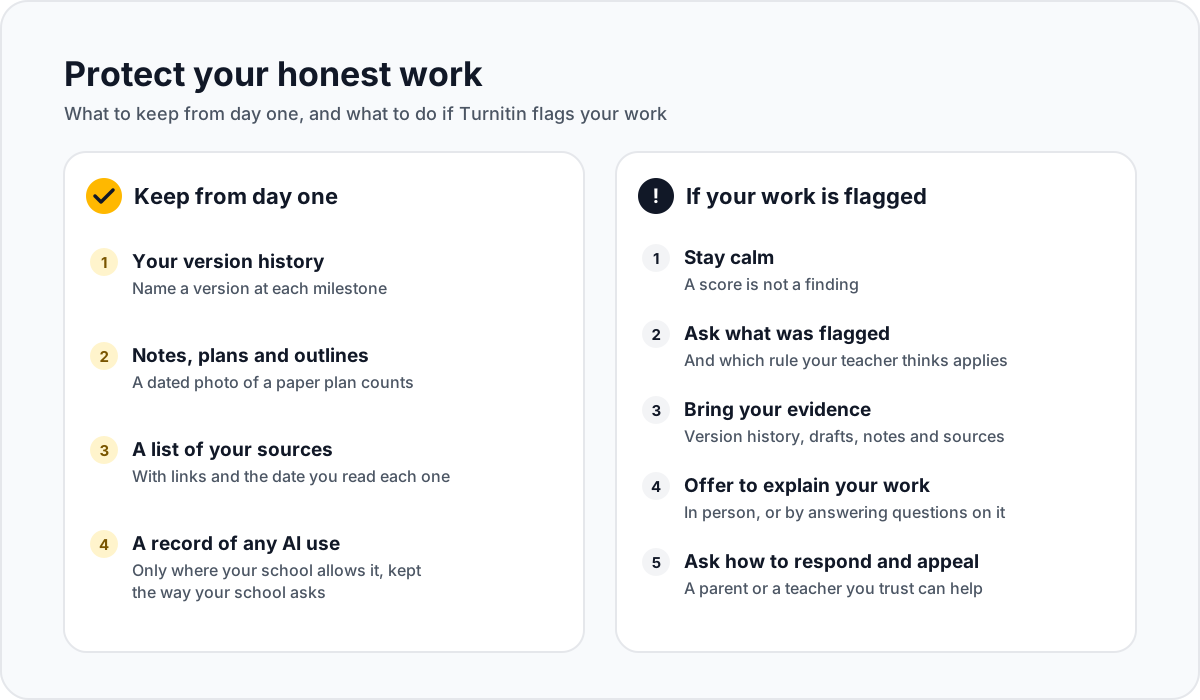
Your best answer to a wrong flag is evidence of how you wrote the work, collected from day one.
- Write in a document that keeps its version history. In Google Docs, click “Last edit” at the top right to see earlier versions, and name a version at each milestone. Never delete the history, because deletion is permanent. If your app doesn’t keep versions, save a dated copy of each draft.
- Keep your notes, plans and outlines, including handwritten ones. A dated photo of a paper plan counts.
- Keep a list of sources as you go, with links and the date you read each one.
- If your school allows AI for a task, follow its rule exactly and keep the record it asks for, such as the non-editable copy of your prompts and output that JCQ requires.
- Know your work well enough to explain it. You should be able to talk through your argument, your sources and why you made each choice.
- Ask before you use any AI tool on assessed work, and keep the answer in writing.
What to do if Turnitin flags your work
- Stay calm. A score is not a finding, and Turnitin says it should not be the only basis for action against a student.
- Ask which passages were flagged and which rule your teacher thinks applies.
- Bring your version history, drafts, notes and sources to the conversation.
- Offer to explain the work in person or to answer questions about it.
- Ask how your school’s procedure lets you respond and appeal. A parent, a teacher you trust or your university’s student advice service can help you prepare.
- Don’t delete, edit or invent any evidence of your process. If you did use AI in a way the task didn’t allow, say so early, because honest disclosure gives the school accurate information to work with.
Using AI to revise, not to write
Aripsy helps you study from your own notes. It turns them into revision notes, flashcards and practice questions, marks your practice answers, and Aripsy Tutor answers questions about your own notes. It doesn’t write essays or assignments, and nothing it makes is meant to be handed in. Quizzing yourself on your own notes is revision, not assessed work, so you can make practice questions from your notes and keep every assignment in your own words.
FAQ
Can Turnitin detect ChatGPT?
Yes. Turnitin launched its detector in 2023 for AI writing, including ChatGPT’s. The result is an estimate with highlighted passages, and Turnitin says it shouldn’t decide a case alone.
What AI percentage is acceptable on Turnitin?
There isn’t a safe percentage. Turnitin shows scores from 1% to 19% as an asterisk because they are less reliable, but your school’s policy decides what is allowed, and AI use the task doesn’t permit breaks the rules whatever the score.
Can a false positive get me in trouble?
It can lead to questions. Turnitin tells schools not to act on the score alone, so bring your version history, drafts and notes, and offer to talk through the work.
Sources
- Turnitin, Using the AI Writing Report (the asterisk for scores from 1% to 19%, the guidance not to use the score as the sole basis for action, and sharing the report with students)
- Turnitin Help Center, Why can’t I see the AI writing detection report? (the report isn’t shown to students)
- Turnitin, Understanding the false positive rate for sentences of our AI writing detection capability, 14 June 2023
- Turnitin, AI writing detection update from Turnitin’s Chief Product Officer, 23 May 2023
- Turnitin, AI paraphrasing detection
- Fleckenstein, Meyer, Jansen, Keller, Köller and Möller, Do teachers spot AI? Evaluating the detectability of AI-generated texts among student essays, Computers and Education: Artificial Intelligence, volume 6, 2024
- Curtin University, Update on Turnitin AI-Detection Tool, published 4 September 2025, read 5 November 2026
- JCQ, AI Use in Assessments: Your role in protecting the integrity of qualifications, “Revision two: 30 April 2025”
- Ofqual, Malpractice in GCSE, AS and A level: summer 2025 exam series, published 11 December 2025
- Google Docs Editors Help, Find what’s changed in a file, read 5 November 2026
Keep exploring
AI Study Tools
Compare AI study apps by the job they do, the material they accept, and how easily students can check the output.
Explore AI Study Tools guidesWritten by
Amin Mudassir
Amin Mudassir is the founder of Aripsy. Amin started Aripsy after seeing students spend hours turning PDFs, articles, and lecture material into notes before they could study.