How to Build an ACT Study Plan Around Your Weakest Sections
Take a full official ACT practice test in the current enhanced format, score it with the answer key, and sort every missed or guessed question by reporting category and cause. Prioritise repeated gaps in English, math and reading, which make up the Composite, add science only if your colleges want it, give the top one or two skills focused blocks each week, and retest with fresh timed sections.
 Aripsy Study Team

In this article19
A useful ACT study plan does not split your time evenly across the sections. It starts with an official practice test, finds the reporting categories and question types behind your missed and guessed answers, and gives those the most practice.
The ACT also changed in 2025. The enhanced test is shorter, science is optional, and the Composite now comes from English, math and reading only. A plan built on older advice or older practice tests can put hours into the wrong places. This guide uses the current format and does not promise a particular score or a fixed number of study hours.
Quick answer: how do you build an ACT study plan around your weakest sections?
- Take one full official ACT practice test in the current enhanced format, timed, in the format you will test in.
- Score it with the official answer key, then convert raw scores to scale scores with the conversion table.
- Sort every missed or guessed question by section and reporting category; the answer key labels each question’s category.
- Log the cause of each error: knowledge, method, reading, execution or time.
- Confirm the pattern with a fresh, timed set of official questions from the same category.
- Rank the confirmed gaps. English, math and reading each make up a third of the Composite; add science only if your colleges require or recommend it.
- Give the top one or two skills focused blocks each week, and keep the other sections in short mixed practice.
- Retest with a fresh official section or full test, then update the priorities.
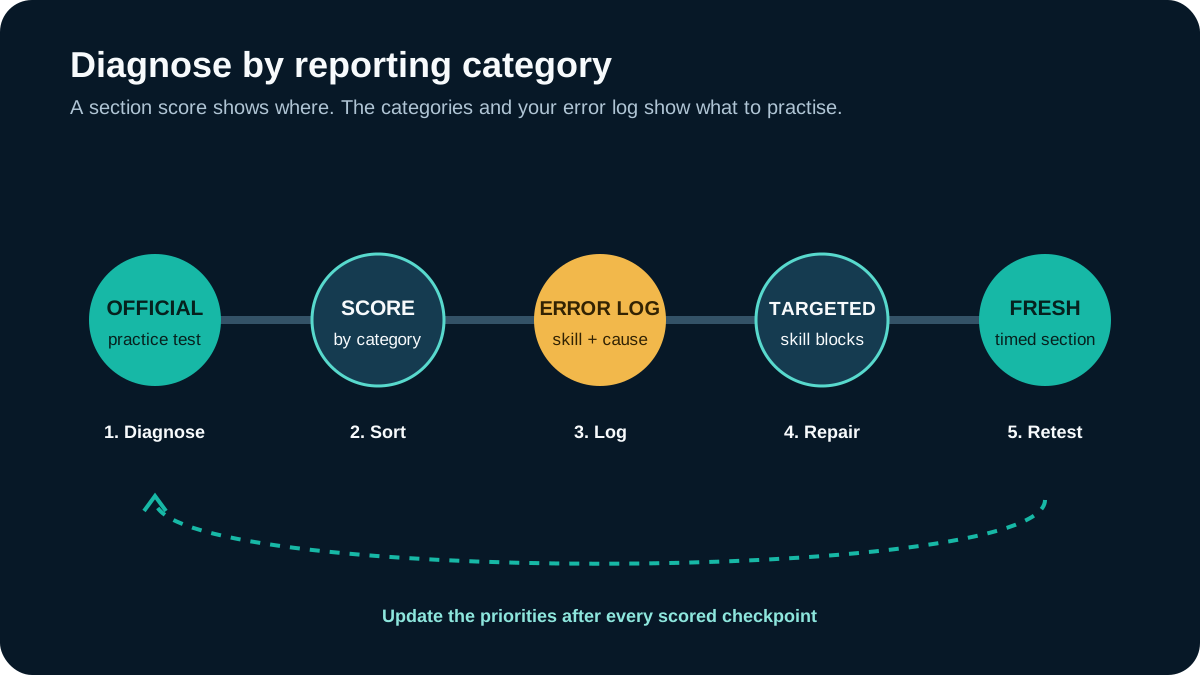
A practice score tells you where you stand. The categories and your error log tell you what to practise next.
The enhanced ACT at a glance
These official facts decide how your practice should be timed and scored, so check them before you plan.
| Section | Questions (scored) | Time | Pace, calculated | Counts toward |
|---|---|---|---|---|
| English | 50 (40) | 35 minutes | about 42 seconds per question | Composite |
| Math | 45 (41) | 50 minutes | about 67 seconds per question | Composite |
| Reading | 36 (27) | 40 minutes | about 67 seconds per question | Composite |
| Science (optional) | 40 (34) | 40 minutes | about 60 seconds per question | Science score and STEM score |
| Writing (optional) | 1 essay | 40 minutes | — | Writing score, 2–12 |
- Composite: the average of your English, math and reading scores, each on a 1–36 scale, rounded to the nearest whole number. Science is no longer part of the Composite.
- Science: optional. If you take it, you get a science score and a STEM score, the average of your math and science scores. Some colleges require or accept science or writing scores, so check the colleges on your list.
- Unscored questions: each multiple-choice section includes embedded field-test questions that do not count toward your score. They are not labelled, so treat every question as if it counts.
- Answering: each multiple-choice question has four answer choices, and there is no penalty for a wrong answer.
- Calculators: a permitted calculator may be used on math, though it is not required. Calculators are not allowed in science.
- Format: on national test dates you can register for paper, online at a test centre computer, or online on your own device.
The enhanced format began on national online tests in April 2025 and on national paper tests in September 2025. ACT says state and district testing moves to it from spring 2026.
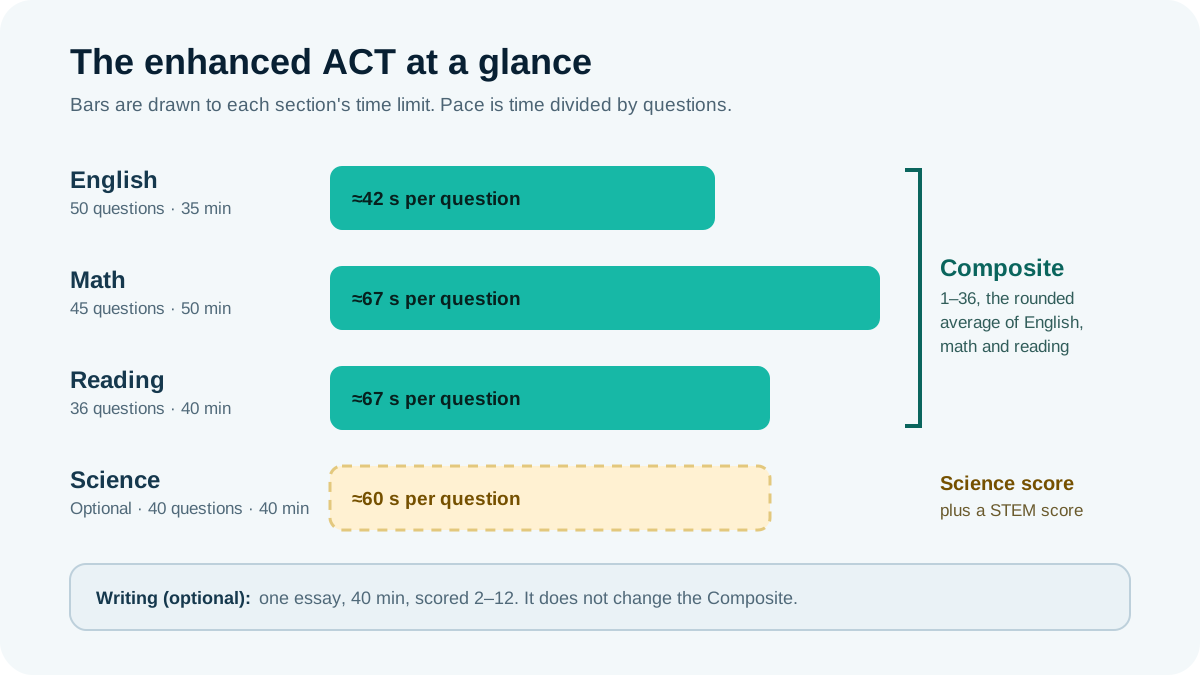
The pace figures are calculated from ACT’s official question counts and time limits. English is the fastest section per question.
Reporting categories
Each multiple-choice section reports category results as well as a section score. These categories are what your plan should name. ACT’s approximate shares:
| Section | Reporting categories |
|---|---|
| English | Production of Writing (38–43%); Knowledge of Language (18–23%); Conventions of Standard English (38–43%) |
| Math | Preparing for Higher Math (80%), split into Number and Quantity (10–12%), Algebra (17–20%), Functions (17–20%), Geometry (17–20%) and Statistics and Probability (12–15%); Integrating Essential Skills (20%); Modeling, which is counted across the other categories |
| Reading | Key Ideas and Details (44–52%); Craft and Structure (26–33%); Integration of Knowledge and Ideas (19–26%) |
| Science | Interpretation of Data (38–50%); Scientific Investigation (18–32%); Evaluation of Scientific Arguments and Models with Evidence |
“Weak at math” cannot guide a session. “Functions questions, mostly reading a graph’s key features” can.
ACT details can change, so recheck the current ACT sections and structure page before a later test date.
Step 1: take a full official practice test in the current format
ACT offers free official practice tests on its free test prep page: four full-length practice tests in digital and paper versions. The digital versions have timed and untimed versions of each section with a scoring guide and diagnostic tools; the paper versions come as PDF booklets with a scoring key. The free Preparing for the ACT Test booklet also contains a complete practice test, answer keys and self-scoring instructions.
To make the result useful:
- practise in the format you registered for: online or paper;
- use the official timing for each section;
- take English, math and reading in one sitting; ACT’s practice guidance suggests a 10–15 minute break between the second and third sections;
- add science only if you plan to take it on test day;
- do not look up answers or explanations during the test.
Be careful with older books and practice tests. Legacy ACT forms had longer sections, such as 75 English questions instead of 50. They are still useful for practising skills, but not for timing or for predicting a score on the enhanced test.
Step 2: score by reporting category, not only by section
Score each section with the official key. Count your correct answers to get a raw score, leaving out the questions shaded grey in the key, which are field-test items. Then convert each raw score to a 1–36 scale score with the conversion table. ACT explains that the table adjusts for small differences between test forms, so the same raw score can convert differently on another form.
Then go one level deeper. The scoring key labels each question with its reporting category, so you can count how many you got right in each category. On a real test, your score report shows the number of questions, the number correct and the percentage correct for each reporting category.
Treat small categories with care. One wrong answer in a category with only a few questions changes its percentage sharply. Use the category to point you at questions, then look at the questions themselves.
If you have already sat the ACT on a national test date, ACT My Answer Key (formerly Test Information Release) can be ordered for selected dates. It gives you the scored multiple-choice questions, your answers, the answer key and the conversion table, which makes it one of the most useful diagnostics there is. ACT lists October, December, April and June dates for 2026–27; check the My Answer Key page for current dates, fees and fee waivers.
Log every missed, guessed or slow question
For each one, write down:
- section, reporting category and specific skill;
- the cause: knowledge, method, reading, execution or time;
- what made the wrong answer attractive, or the right method hard to see;
- the correction, in your own words;
- the next practice task.
A correct guess is not secure knowledge. A wrong answer can also hide two problems, such as a weak rule plus rushing at the end of the section. For a fuller error log and retest queue, use the exam mistake-log workflow.
Try it: turn one corrected ACT error into targeted practice. Paste the correction you just wrote (the grammar rule, math method or reading move, in your own words) into Aripsy’s AI quiz generator. You get short-answer practice questions on that exact rule, and when you answer them Aripsy gives an estimated mark with the points you earned and missed. You can start free; full multiple-choice sets, the ACT’s own format, need Pro. To drill rules you keep forgetting, the flashcard generator turns the same notes into cards. Aripsy builds practice from what you paste; it is not official ACT content, so paste your own explanation rather than ACT’s question text, and keep official practice tests as your benchmark.
Step 3: confirm that the weakness is real
One test is a small sample. A category may have had only a few questions, or one passage may have been unusually hard for you. Before reorganising your week, confirm the pattern with fresh official questions: a section from another official practice test, ACT’s free sample questions by section, or a second full test.
| Evidence | Interpretation | Next action |
|---|---|---|
| Several errors on the same rule or method | Knowledge or method gap | Relearn it, then practise untimed |
| Easy questions correct, harder or longer ones fail | Application gap | Compare worked examples and practise varied questions |
| Accurate untimed, weaker under time | Pacing or execution issue | Short timed sets with a pacing checkpoint |
| Fresh set is mostly accurate | The first miss may be isolated | Keep it in mixed practice |
| Errors spread across categories in one section | Section-level pacing or reading habit | Practise the section approach, not one topic |
Step 4: rank the gaps by impact
Rank each confirmed gap using four kinds of evidence:
- Performance: how consistently does it fail on fresh official questions?
- Score impact: English, math and reading each count for a third of the Composite. Science matters only if you take it and your colleges use it.
- Category share: how much of the section does the category cover?
- Cause: is it a rule or method you can learn, an application problem, a timing problem or a careless habit?
A practical starting order:
- repeated gaps in a large category of a Composite section;
- rule-based gaps with a clear fix, such as punctuation or a specific math method;
- timing patterns that cost questions at the end of a section;
- isolated errors, kept in mixed practice;
- strong sections, kept with brief maintenance.
Do not assume your lowest section is automatically the best use of time. A section that is lower but has scattered, hard-to-fix errors can be a worse investment than a stronger section where most errors come from two rules you can learn this week. The evidence in your log decides. The weak-topic prioritisation guide covers this ranking in more detail.
Step 5: define one observable target for each priority
Write a target that describes the decision you need to make on the question.
Examples:
- Conventions of Standard English: decide whether each side of a punctuation mark is a complete sentence before choosing a period, semicolon, colon or comma.
- Production of Writing: decide whether a proposed sentence serves the paragraph’s purpose before judging how well it is written.
- Functions: read a graph’s key features, such as intercepts, maximums and where the function increases, before using the equation.
- Integrating Essential Skills: identify the reference quantity in a percentage or rate problem before calculating.
- Key Ideas and Details: locate the line that supports your answer before choosing it.
- Interpretation of Data: state the trend in a table or graph in words before reading the answer choices.
Attach a success check:
Answer a fresh official set at full difficulty and time, explain why the correct answer works, and say why each earlier error happened.
Step 6: build focused skill blocks
A 45–60 minute block can follow this structure. Adjust it to fit your schedule.
| Time | Activity | Output |
|---|---|---|
| 5 minutes | Review one error-log entry and state the target | One written objective |
| 10–15 minutes | Learn or clarify the rule, method or reading move | A short checked explanation |
| 15–20 minutes | Untimed targeted questions | Worked answers and reasons |
| 10 minutes | A short timed set at section pace | Timing plus accuracy evidence |
| 5–10 minutes | Review every answer and update the log | Cause, correction and retry date |
End every block with attempted questions, not only notes or videos. Use the section’s real pace in the timed part: about 42 seconds per English question is very different from about a minute per science question.
Step 7: turn the priorities into a weekly ACT study schedule
Start with the time you can reliably protect. A four-block week you keep beats a ten-block plan you abandon.
Example five-block week
| Block | Focus | Example |
|---|---|---|
| 1 | Priority skill A: learn and practise | Punctuation between clauses, then untimed English questions |
| 2 | Priority skill B: learn and practise | Functions from graphs, worked examples, then untimed questions |
| 3 | Priority skill A: timed retry | A fresh English passage at section pace |
| 4 | Priority skill B: timed retry | Mixed math set with a time limit |
| 5 | Mixed maintenance and error review | Reading passage plus mixed questions, then update next week’s priorities |
Every few weeks, replace a block with a full timed section or a full practice test so you rehearse the whole sitting, not just single skills. For the calendar method behind this, including working back from your test date, use the syllabus-and-exam-date study-plan guide.
Choose an appropriate timeline
No reliable formula turns a number of study hours into a number of ACT points. Starting level, target, study quality, consistency, test anxiety, accommodations and test-day conditions all matter.
| Time to test day | Planning emphasis |
|---|---|
| About 12 weeks | Diagnose, repair several skills in sequence, take spaced full practice tests and leave time for mixed practice |
| About 8 weeks | Focus on fewer repeated gaps, alternate targeted and mixed work, and retest midway |
| About 4 weeks | Triage the highest-impact confirmed gaps and practise full-section timing |
| Under 2 weeks | Review open errors, do short official timed sets, rehearse the test format and protect sleep |
There is no fixed rule for spacing practice tests. Leave enough time after each one to review every error and complete some targeted work before you measure again; with four free official tests, keep at least one for a late checkpoint.
Section-by-section notes
English
English passages are written to be revised. Questions sit alongside the passage, many offer “No Change” as an option, and some ask about the passage as a whole. Learn the rule behind each Conventions of Standard English error, and for Production of Writing questions decide what the writer is trying to do before judging the options. Watch your pace: English allows the least time per question.
Math
Math covers material typically learned up to the start of grade 12. Preparing for Higher Math is 80% of the section; Integrating Essential Skills, such as rates, percentages, proportional relationships, area and volume, is 20%. ACT notes that many problems are best done without a calculator, so use it to check rather than to think. Log whether each miss was a missing method, a misread or an arithmetic slip, because each needs a different fix.
Reading
Passages come with a heading naming the author and source, some sections pair two shorter passages, and one passage may include a graph or table. Questions do not test outside facts or isolated vocabulary, so every answer should be supported by the text. If you are accurate untimed but run out of time, the problem is your passage approach and pacing, not your reading ability.
Science (optional)
Science does not count toward the Composite, so decide first whether you need it. If you do, remember that it tests reading data, experimental design and competing explanations rather than recall of advanced facts, and that calculators are not allowed. Interpretation of Data is the largest category.
Writing (optional)
Writing is one essay in 40 minutes, scored 2–12 across four domains: Ideas and Analysis, Development and Support, Organization, and Language Use and Conventions. It does not affect the Composite. Practise it only if your colleges require or recommend it.
Worked example: a math gap inside one category
Illustrative example. A student’s practice test shows a lower math score. Sorting the misses by category reveals:
- four of six Functions questions missed, all involving reading a graph;
- two Integrating Essential Skills questions missed on percentage change;
- one Geometry slip where the right method gave a wrong number;
- most Algebra and Statistics and Probability questions correct.
“Do more math” is too broad. The revised plan:
- Priority skill: read a function’s key features from a graph before working with the equation.
- Secondary skill: identify the reference quantity in percentage problems.
- Execution rule: re-check arithmetic on every answer that came from a calculation.
- Blocks: worked graph examples, then untimed official questions, then a timed mixed set at about 67 seconds per question.
- Checkpoint: a fresh official math section two to three weeks later.
The section score located the problem. The category tally and question review made it specific.
Worked example: English rules versus English pace
Illustrative example. Another student’s English errors are almost all in Conventions of Standard English and fall in the last two passages. Untimed, the same student gets most of these right.
That points to two separate fixes. First, the four or five punctuation rules behind the errors, practised untimed until they are automatic. Second, pacing: timed single passages with a checkpoint at each one, so time is not lost early. Studying more grammar alone would not fix a timing problem.
Worked example: reading accuracy under time
Illustrative example. A student’s reading misses are spread across all three categories, and the last passage is mostly guessed.
Spread-out misses plus an unfinished section usually mean an approach problem, not a single weak skill. The plan uses timed single passages, a set time checkpoint per passage, and a rule to go back to the text for evidence before choosing an answer. Category-specific practice comes later, once the section is being finished.
Use the right official resource for each job
| Resource | Best use |
|---|---|
| Official practice tests 1–4 (digital) | Full or single-section practice with timing, a scoring guide and diagnostic tools |
| Official practice tests (PDF) and Preparing for the ACT Test | Paper practice with answer keys, category labels and raw-to-scale conversion |
| ACT sample questions by section | Short confirmation sets for one section |
| Your score report | Section scores and the number and percentage correct in each reporting category |
| ACT My Answer Key | The scored questions, your answers and the key from an eligible national test date |
These resources do different jobs. A short sample set cannot replace a timed full section, and a full test does not give enough repetition to rebuild one weak rule.
If you are also preparing for the SAT, the SAT study plan for your weakest skills applies the same loop to the Digital SAT’s Bluebook results.
Common mistakes to avoid
- Studying from legacy materials for timing. Older forms have different section lengths. Use them for skills, not pacing.
- Spending hours on science you will not take. Decide first whether your colleges need it.
- Treating the section score as the diagnosis. The categories and the questions are the diagnosis.
- Practising untimed only. English in particular needs fast, accurate decisions.
- Taking practice tests back to back. Without review and repair between them, a new test mostly measures the same gaps again.
- Using all four official tests at the start. Keep one for a late checkpoint.
Final-week adjustment
Take your last full practice test early enough to review it. During the final week:
- retry the most important open errors;
- use short official timed sets rather than back-to-back full tests;
- rehearse the format you registered for, paper or online, and check the calculator policy for math;
- check your test-day requirements and what to bring in ACT’s current guidance;
- keep stronger sections ticking over briefly;
- protect sleep and avoid starting a new study system.
The final week cannot guarantee a target score. Its job is to make what you already know easier to use and to reduce preventable mistakes.
FAQ
How do I find my weakest ACT section?
Take a full official practice test in the current enhanced format, score it with the answer key and convert to scale scores. Then count your correct answers in each reporting category, which the key labels, and review every missed and guessed question. Confirm the pattern with a fresh timed set before you change your plan.
Is science still on the ACT?
Yes, but it is optional on national test dates. Science no longer counts toward the Composite; if you take it you receive a science score and a STEM score. Some colleges require or accept science scores, so check your colleges before deciding. In state and district testing, the state or district decides whether science is included.
How is the ACT Composite calculated now?
The Composite is the average of your English, math and reading scores, rounded to the nearest whole number: fractions of one half or more round up, and smaller fractions round down. Science and writing do not change it.
Are older ACT practice tests still useful?
Yes, for practising skills and question types. They are not reliable for timing or score prediction, because legacy forms had longer sections and included science in the Composite. Use ACT’s current official practice tests for timed checkpoints.
How often should I take a full ACT practice test?
There is no fixed interval. Leave enough time after each test to review every error and work on your priorities, often a couple of weeks, and keep at least one official test for a late checkpoint.
Should I take the ACT on paper or online?
Choose the format you are most comfortable with and practise in that format. On national test dates you can register for paper, online on a test centre computer, or online on your own device; since September 2025, national paper and online tests both use the enhanced ACT.
Sources and further reading
Official pages checked on 24 October 2026:
- ACT: sections and structure of the ACT
- ACT: Preparing for the ACT Test 2025–2026 (practice test, scoring keys and conversion tables)
- ACT: understanding your scores
- ACT: free ACT practice tests and prep
- ACT: enhanced ACT FAQs
- ACT: comparison of the legacy and enhanced ACT
- ACT: My Answer Key
- ACT: registration, test formats and test dates
Keep exploring
Find a study workflow
Choose the source, output, or course route that fits your next study task.
Browse study workflows
Written by
Aripsy Study Team
The Aripsy Study Team creates practical revision guides designed to support learning, source checking, and active practice.


