How to Build an SAT Study Plan Around Your Weakest Skills
Take an official full-length Bluebook practice test, review it in My Practice, and use the domain bars plus question-level evidence to identify specific weak skills. Prioritise repeated and high-impact gaps, assign them focused learn-practise-review blocks, maintain stronger skills with shorter mixed sets, and update the plan after a later official checkpoint.
 Aripsy Study Team
In this article19
A useful SAT study plan does not give every domain equal time. It starts with official diagnostic evidence, identifies the exact skills behind missed, guessed, or slow answers, and assigns more practice where improvement is needed.
That does not mean ignoring everything you already do well. Strong skills need enough mixed practice to remain reliable, and full-length Bluebook tests are still necessary for the adaptive format, pacing, and interface. The goal is to balance targeted repair with realistic test rehearsal.
This guide shows how to build that plan without promising a fixed score increase or a universal number of study hours.
Quick answer: how do you build an SAT study plan around weak skills?
Take an official full-length practice test in Bluebook under realistic conditions. Open the result in My Practice and examine the Reading and Writing and Math domain bars, question-level answers, explanations, guesses, and timing problems. Confirm broad challenge areas with a small set of official questions filtered by domain, skill, and difficulty in the Student Question Bank. Then give the most important weak skills repeated learn → untimed practice → timed practice → error review blocks, while scheduling shorter maintenance sets for stronger domains. Reassess with another official practice test after enough time to complete useful study between tests.
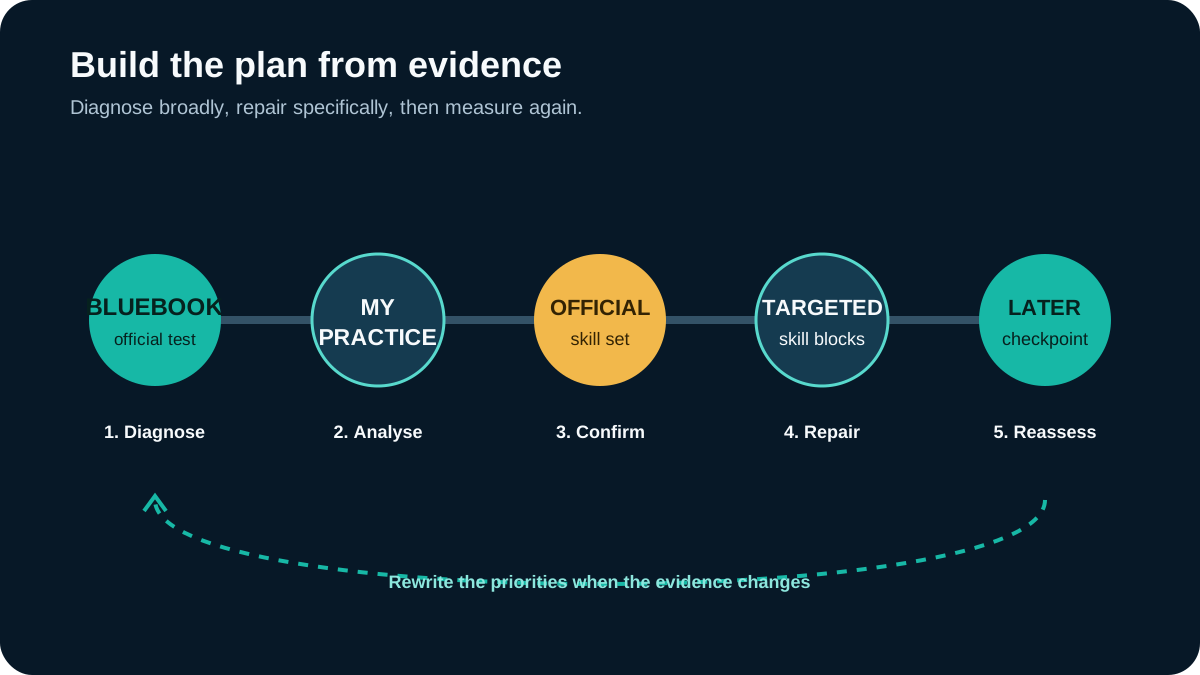
A practice score is a checkpoint. The useful plan comes from the domain and question evidence underneath it.
Start with the current Digital SAT structure
The SAT currently has two sections: Reading and Writing and Math. The total score runs from 400 to 1600, with each section contributing 200 to 800 points. Each section contains four content domains.
| Section | Domain | Approximate share of section |
|---|---|---|
| Reading and Writing | Information and Ideas | 26% |
| Reading and Writing | Craft and Structure | 28% |
| Reading and Writing | Expression of Ideas | 20% |
| Reading and Writing | Standard English Conventions | 26% |
| Math | Algebra | 35% |
| Math | Advanced Math | 35% |
| Math | Problem-Solving and Data Analysis | 15% |
| Math | Geometry and Trigonometry | 15% |
These are broad domains, not study tasks. “Weak at Craft and Structure” is still too vague. The related issue might be words in context, text structure and purpose, or cross-text connections. “Weak at Algebra” might mean linear equations, functions, systems, or inequalities.
Use the current College Board content-domain guide to translate each broad result into a specific skill. Recheck official sources if you are reading this for a later administration because test details can change.
Step 1: take a genuine diagnostic in Bluebook
Use an official full-length practice test in Bluebook for the starting point. It provides the closest available practice for the digital interface and multistage adaptive structure.
To make the result useful:
- use the device and setup you expect to practise with;
- follow the standard timing unless you have an approved accommodation you are practising;
- take the test in one sitting when possible;
- use only the tools and breaks permitted by the practice experience;
- record interruptions or unusual conditions;
- do not look up explanations during the test.
If you have already taken an official SAT or another assessment in the SAT Suite, its current score report can also provide domain information. Use the most relevant recent result, but remember that performance can vary between administrations.
Do not turn a raw number of correct answers into your own predicted SAT score. The test is adaptive, and official scoring considers question characteristics and the path through the modules. Use the score Bluebook reports for that practice test.
Step 2: analyse My Practice—not only the total score
After a Bluebook test, sign in to My Practice with the same credentials. College Board currently provides:
- practice scores;
- question-level selected and correct answers;
- explanations for answer choices;
- performance across content domains;
- tailored practice drawn from the Student Question Bank;
- links to matching Khan Academy review.
The domain progress bars show the difficulty level at which you demonstrated proficiency. They are not percentages correct and not separate domain scores. Use them to locate broad challenge areas, then inspect the actual questions to find the smaller skill and failure cause.
For every missed, guessed, or unusually slow question, record:
- section, domain, and specific skill;
- whether the issue was knowledge, reasoning, method, reading, execution, or time;
- what made the wrong option attractive or the correct method hard to select;
- the checked correction in your own words;
- the next official or verified practice task.
A correct guess is not evidence of secure mastery. A wrong answer can also hide more than one problem—for example, weak algebra plus an inaccurate calculator entry.
Use the exam mistake-log workflow when you need a fuller error diagnosis and retest queue.
Step 3: confirm that the weakness is real
One missed question does not prove an entire domain is weak. The wording may have been unusual, the skill may appear only once in that practice test, or the mistake may have been execution rather than understanding.
Use the official Student Question Bank to build a small set filtered by:
- SAT assessment;
- Reading and Writing or Math;
- domain;
- specific skill;
- difficulty.
Attempt the questions without answers visible. College Board’s study-plan guidance recommends exporting a custom set without answers and explanations first, then exporting the answer version after the attempt.
Classify the result:
| Evidence | Interpretation | Next action |
|---|---|---|
| Several errors on the same basic skill | Likely knowledge or method gap | Relearn the skill, then practise untimed |
| Basic questions correct, harder variations fail | Complexity or application gap | Compare examples and practise varied medium/hard questions |
| Accuracy drops only under time | Pacing or execution issue | Use short timed sets and a checking rule |
| Official set is mostly accurate | The diagnostic miss may be isolated | Keep it in mixed maintenance rather than making it the top priority |
| Wrong answers come from different skills in one domain | Broad domain result hides several gaps | Schedule separate skill blocks |
This confirmation step prevents a study plan from overreacting to one question.
Step 4: rank weak skills by impact
Do not use “hardest topic first” or a fixed 80/20 rule automatically. Rank each candidate using four kinds of evidence:
- performance: how consistently does the skill fail across official questions?
- representation: how much of the section does its domain approximately cover?
- dependency: does this skill support several other question types?
- cause: is the problem missing knowledge, application, timing, or execution?
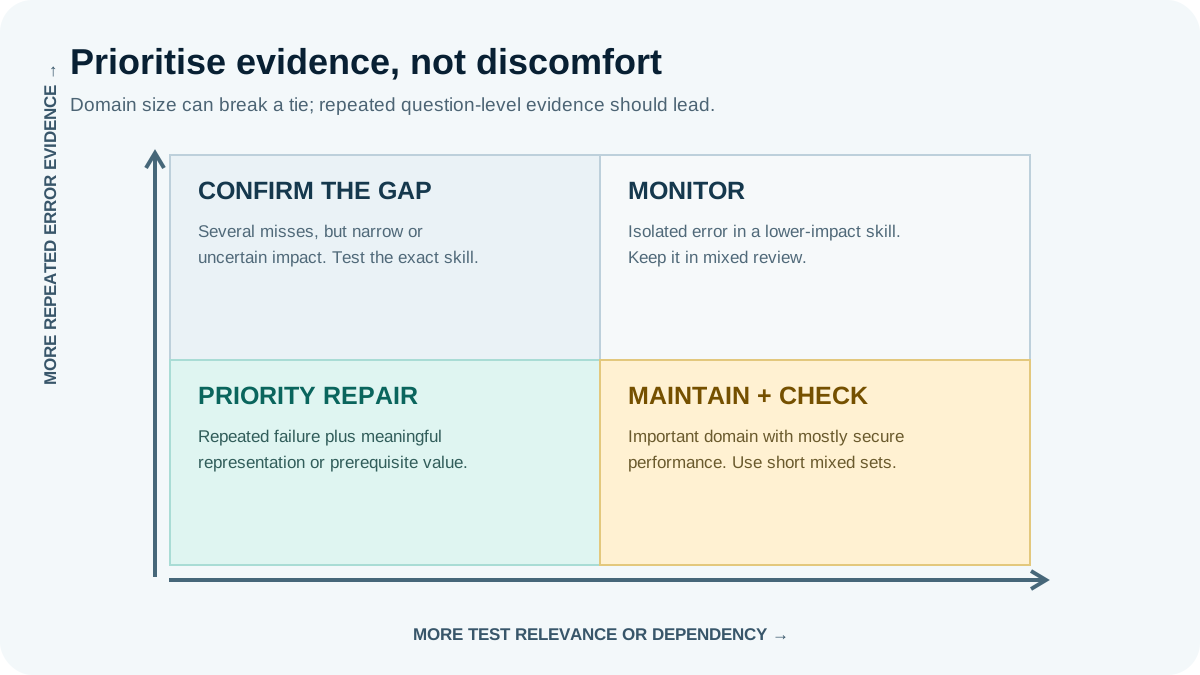
High priority means repeated evidence plus meaningful test relevance—not simply “this topic feels difficult.”
A practical starting order is:
- repeated foundational gaps inside a heavily represented domain;
- repeated skill-specific errors that have a clear repair method;
- timing or execution patterns affecting several skills;
- isolated errors for later mixed review;
- strong skills for brief maintenance.
Domain size can break a tie, but it should not erase individual evidence. Algebra and Advanced Math each represent about 35% of Math, yet a student performing strongly in Algebra should not replace a genuine Geometry gap with unnecessary Algebra review merely because Algebra is larger.
Step 5: define one observable target for each priority skill
“Improve SAT Math” cannot guide a session. Write a target that describes the decision or performance you need.
Examples:
- Boundaries: distinguish a complete sentence from a fragment, then choose a period, semicolon, colon, or comma based on sentence structure.
- Transitions: identify the logical relationship before looking at the answer choices.
- Command of Evidence: choose the evidence that directly supports the stated claim rather than merely matching its topic.
- Linear equations: translate a word relationship into an equation and verify the solution in context.
- Nonlinear functions: connect the equation, graph, and behaviour of a quadratic or exponential relationship.
- Percentages: identify the reference quantity before calculating a change.
Attach a success check:
Answer a fresh official set at the intended difficulty, explain why the correct method works, and identify why each previous error occurred.
Do not make a fixed accuracy threshold the only measure. A tiny set can make percentages misleading, and success should include reasoning, pacing, and transfer to fresh questions.
Step 6: build focused skill blocks
A 45–60 minute block can use this structure, but shorten or extend it to match your schedule and concentration:
| Time | Activity | Output |
|---|---|---|
| 5 minutes | Review one error and state the exact target | One written objective |
| 10–15 minutes | Learn or clarify the rule, method, or reasoning | Concise checked explanation |
| 15–20 minutes | Complete untimed targeted questions | Worked answers and reasoning |
| 10 minutes | Complete a short timed set | Timing plus accuracy evidence |
| 5–10 minutes | Review every answer and update the log | Cause, correction, and retry date |
The block should end with attempted questions, not only notes or videos. If the concept is still unclear, reduce the number of questions and spend longer on a checked explanation or worked example.
For Reading and Writing, explain why three choices fail as well as why one succeeds. For Math, show the method before relying on answer-choice recognition, then use Desmos or the built-in calculator strategically where appropriate.
Step 7: turn the priorities into a weekly SAT study schedule
Start with the time you can reliably protect, not an ideal number of hours. A sustainable four-block week is better than a ten-block plan you abandon.
Example five-block week
| Block | Focus | Example |
|---|---|---|
| 1 | Priority skill A: learn and practise | Boundaries rules plus official untimed questions |
| 2 | Priority skill B: learn and practise | Linear systems plus worked examples and official questions |
| 3 | Priority skill A: varied or timed retry | New boundaries set with explanation review |
| 4 | Priority skill B: varied or timed retry | Mixed systems questions with a time limit |
| 5 | Mixed maintenance and error review | Several domains, then update the next week’s priorities |
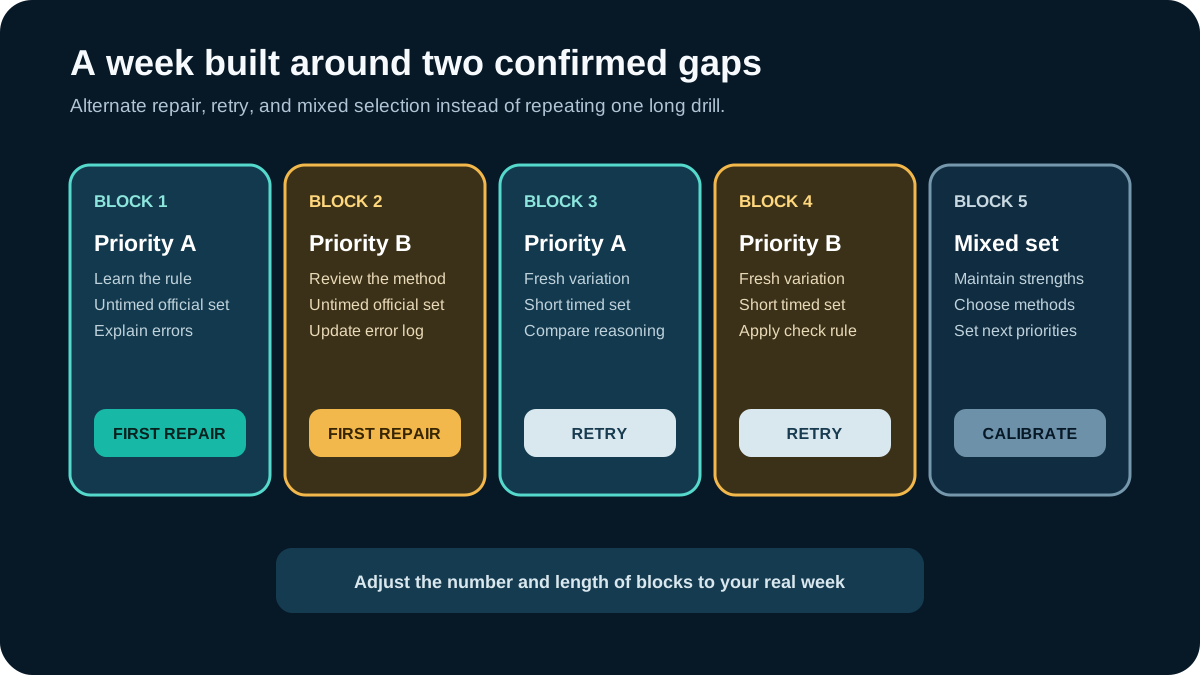
Do not spend every block on the lowest domain bar. Include:
- targeted repair for the top one or two skills;
- mixed practice so you learn to select a method without being told the topic;
- maintenance for stronger domains;
- error review so corrections return after a delay;
- periodic official simulation in Bluebook.
For the calendar method behind this schedule, use the syllabus-and-exam-date study-plan guide.
Choose an appropriate timeline
There is no reliable formula saying a fixed number of hours produces a fixed SAT gain. Starting knowledge, target, study quality, question exposure, language background, test anxiety, accommodations, sleep, and test-day conditions all matter.
Use the time remaining to choose the depth of the plan:
| Time remaining | Planning emphasis |
|---|---|
| About 12 weeks | Diagnose, repair several skills in sequence, use multiple spaced checkpoints, and leave time for mixed practice |
| About 8 weeks | Prioritise a smaller number of repeated gaps, alternate targeted and mixed work, and reassess midway |
| About 4 weeks | Triage the highest-impact confirmed gaps, practise essential timing and interface skills, and avoid trying to rebuild everything |
| Less than 2 weeks | Review current errors, use focused official questions, practise Bluebook tools, and protect sleep rather than cramming large new topics |
College Board currently recommends spacing practice tests by at least two weeks when the schedule allows. That gives you time to review the result and complete useful study before measuring again. Preserve some official tests for later checkpoints instead of consuming them all at the beginning.
Use the right official resource for each job
| Resource | Best use |
|---|---|
| Bluebook | Full-length adaptive practice and interface familiarity |
| My Practice | Scores, domain performance, question review, explanations, and tailored practice links |
| Student Question Bank | Official questions filtered by section, domain, skill, and difficulty |
| Official SAT Prep on Khan Academy | Lessons, examples, and skill practice when a concept needs rebuilding |
| Schoolhouse.world | Free guided peer tutoring when available and useful |
These resources are complementary. A question-bank drill does not replace a full adaptive practice test. A full test does not provide enough repetition to rebuild every weak skill. An explanation is not complete until you can use it on a fresh problem.
Track progress without fooling yourself
Keep a small dashboard for each priority skill:
- official domain and skill name;
- starting evidence;
- repeated failure cause;
- practice source and difficulty;
- untimed result;
- timed result;
- next retry date;
- later Bluebook checkpoint evidence.
Look for several signals together:
- fewer repeated errors of the same type;
- better explanations of why alternatives fail;
- stable performance on fresh official questions;
- less time lost to the same decision;
- stronger domain evidence on a later official test;
- an improving section or total score across comparable official checkpoints.
Do not declare a skill fixed because you remember the answers to one set. Change the wording, values, passage, difficulty, or surrounding topics.
If performance does not improve, change the diagnosis before adding more volume. You may be practising the broad domain while the actual problem is a prerequisite, misread question stem, calculator habit, vocabulary gap, or timing decision.
Worked example: from a low Math domain to a weekly plan
Imagine a Bluebook report shows a lower Algebra bar. Question review reveals:
- two errors translating word relationships into linear equations;
- one system solved correctly but too slowly;
- one copied negative sign;
- several other Algebra questions answered correctly.
“Do more Algebra” is too broad. The revised plan is:
- Priority skill: translate constraints into equations.
- Secondary skill: choose an efficient system-solving method.
- Execution rule: circle negative quantities before substitution.
- Block 1: review translations and annotate two examples.
- Block 2: complete a small official set filtered to the relevant Algebra skill.
- Block 3: solve fresh problems under a short time limit and apply the negative-sign check.
- Mixed block: include Algebra among other Math domains so the method must be selected without a label.
- Checkpoint: compare later official evidence before changing the priority.
The domain result located the problem. Question-level analysis made the plan specific.
Worked example: Reading and Writing weakness
Suppose Craft and Structure appears lower, but the missed questions are all Words in Context. The student repeatedly chooses a familiar definition rather than the meaning required by the surrounding sentence.
The target becomes:
Before reading the options, replace the tested word with my own phrase that preserves the sentence’s logic and tone.
The weekly work should use official Words in Context questions, record which context clue was missed, and later mix those questions with Text Structure and Purpose. There is no need to spend equal time on every skill in Craft and Structure when the evidence points to one narrower gap.
Where Aripsy can fit
Official College Board material should remain the benchmark for SAT format, scoring, domain labels, and final readiness. Aripsy can support the work between official sets when you have a checked rule, method, lesson note, or mistake explanation that needs additional retrieval practice.
For open and short-answer review, turn one corrected SAT mistake into skill questions. When answer-choice reasoning is the target, use the Digital SAT MCQ practice generator to draft four-option questions and inspect distractors.
Both tools create unofficial study material. Verify the prompt and answer against the checked source, and return to the Student Question Bank and Bluebook for official calibration. Do not upload restricted questions or content you do not have permission to process.
For a wider tool-selection decision, see the SAT study-app comparison.
Final-week adjustment
If possible, complete the last full Bluebook checkpoint early enough to review it; College Board recommends taking a practice test at least two weeks before test day when possible. During the final week:
- retry the most important open errors;
- use small official mixed sets rather than exhausting yourself with constant full tests;
- revisit timing and navigation problems that appeared in Bluebook;
- check device and test-day requirements in current official guidance;
- maintain strong skills briefly;
- protect sleep and avoid building a large new study system.
The final week cannot guarantee a target score. Its purpose is to make existing knowledge easier to retrieve and reduce preventable execution problems.
Copyable SAT planning checklist
- [ ] I used an official Bluebook result or current SAT score report as evidence.
- [ ] I reviewed domain bars and individual questions rather than only the total score.
- [ ] I logged missed, guessed, and slow questions by specific skill and cause.
- [ ] I confirmed broad weaknesses with several official questions.
- [ ] My priorities consider performance, domain representation, dependency, and cause.
- [ ] Every skill block ends with attempted questions and error review.
- [ ] Stronger domains receive brief maintenance practice.
- [ ] I use the Student Question Bank and Khan Academy for the jobs they are designed to do.
- [ ] I preserve Bluebook tests for spaced checkpoints.
- [ ] Generated questions are treated as unofficial and verified before use.
FAQ
How do I find my weakest SAT skills?
Take an official full-length Bluebook practice test and review it in My Practice. Use the domain bars to identify broad challenge areas, then inspect missed, guessed, and slow questions to find the specific skills and failure causes. Confirm the pattern with a small official set filtered by skill in the Student Question Bank.
How long should I study for the SAT to improve my score?
There is no dependable hours-to-points formula. Calculate the weeks and study blocks you can realistically complete, then prioritise confirmed gaps and reassess using official practice. Study quality, starting knowledge, target score, consistency, wellbeing, and test-day performance all affect the result.
What are the most common weak SAT areas?
There is no universal weakest domain for every student. Algebra and Advanced Math each make up about 35% of Math, while Reading and Writing domains range from about 20% to 28% of that section. Those weights show representation, not your personal weakness. Use your My Practice evidence.
Should I study strong or weak SAT skills first?
Give more time to repeated, high-impact weak skills, but keep short mixed practice for stronger areas. Ignoring strengths completely can reduce reliability and makes it harder to practise choosing among different methods and question types.
How often should I take a full SAT practice test?
College Board recommends spacing practice tests by at least two weeks when your schedule allows. Use the time between tests to review every error, rebuild specific skills, complete targeted official questions, and practise under shorter timed conditions.
Is Bluebook enough for SAT preparation?
Bluebook is essential for official full-length adaptive practice and interface familiarity, but it is not the only resource. Use My Practice to analyse results, the Student Question Bank for filtered official questions, and Khan Academy for lessons and skill practice.
Sources and further reading
- College Board: build your SAT study plan
- College Board: SAT content domains and skills
- College Board: My Practice score review
- College Board: Student Question Bank
- College Board: full-length practice tests in Bluebook
- College Board: Digital SAT assessment framework
- Khan Academy: Official Digital SAT Prep
Keep exploring
Find a study workflow
Choose the source, output, or course route that fits your next study task.
Browse study workflows
Written by
Aripsy Study Team
The Aripsy Study Team creates practical revision guides designed to support learning, source checking, and active practice.