How to Build an AP Study Plan Around Your Weakest Units
Collect official evidence from AP Classroom progress checks and released free-response questions scored with College Board's scoring guidelines. Log every lost point by unit, skill and cause, confirm each gap with a second official set, rank gaps by repeated evidence, unit weighting and dependency, then give the top one or two focused blocks each week while stronger units get short mixed review.
 Aripsy Study Team

In this article20
Most AP students can name the course that feels hardest. Far fewer can name the units and question types that are actually costing them points. A plan built on that feeling usually means rereading the units you dislike while the free-response skills the exam rewards get no practice at all.
A better plan starts with official evidence: progress checks, released free-response questions marked against College Board’s own scoring guidelines, and timed multiple-choice sets. Every lost point becomes a unit, a skill and a cause. The most important gaps get repeated practice, and the rest of the course stays warm with short mixed review.
This guide shows how to build that plan for any AP subject, with worked examples for AP Biology, AP Calculus AB and AP US History. It cannot promise a particular score, but it will show you where your next study hour is best spent.
Quick answer: how do you build an AP study plan around your weakest units?
- Collect official evidence: the AP Classroom progress checks your teacher unlocks, released free-response questions (FRQs) from AP Central, and timed multiple-choice sets.
- Score every free response point by point against the official scoring guidelines.
- Log each lost point by unit, skill and cause: content, skill, misread, execution or time.
- Confirm the gap with a second, fresh set of official questions before you rebuild your week around it.
- Rank the confirmed gaps by repeated evidence, the unit’s exam weighting and how much later content depends on it.
- Give the top one or two gaps focused blocks: relearn, practise untimed, retry under time, score it.
- Keep stronger units in short mixed sets so they stay reliable.
- Re-check with fresh official questions every few weeks, then update the priorities.
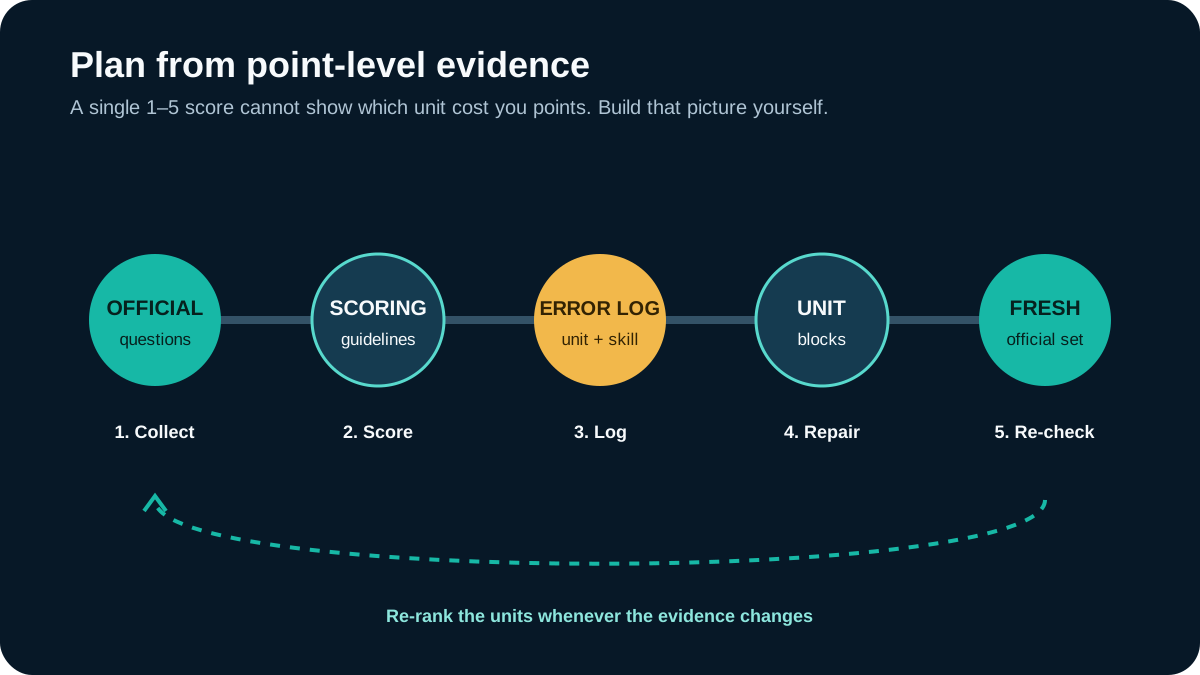
Your 1–5 score only arrives after the exam. The study plan has to come from the point-level evidence you gather before May.
Start with how your AP exam is built
Every AP course has a Course and Exam Description (CED) on AP Central. It lists the units, the skills the exam assesses and an exam weighting range for each unit. Use those labels in your plan. “AP Bio” cannot guide a study session; “Unit 3, Cellular Energetics, data analysis” can.
Here are the three courses used as examples in this guide, as College Board lists them for May 2027:
| Course | 2027 exam | Exam mode | Section I | Section II |
|---|---|---|---|---|
| AP Biology | Monday, May 3 (afternoon session) | Hybrid digital | 60 multiple-choice questions, 1 hr 30 min, 50% | 6 free-response questions (2 long, 4 short), 1 hr 30 min, 50% |
| AP Calculus AB | Monday, May 10 (morning session) | Hybrid digital | 42 multiple-choice questions, 1 hr 40 min, 50%: Part A has 29 with no calculator, Part B has 13 with a graphing calculator required | 6 free-response questions, 1 hr 30 min, 50%: Part A has 2 with a graphing calculator required, Part B has 4 with no calculator |
| AP US History | Friday, May 7 (morning session) | Fully digital | 55 multiple-choice questions in 55 min (40%), then 3 short-answer questions in 40 min (20%) | 1 document-based question, 60 min recommended including a 15-minute reading period (25%), and 1 long essay, 40 min (15%) |
In a hybrid digital exam you answer multiple-choice questions in the Bluebook app and handwrite free responses in a paper booklet. In a fully digital exam both sections are completed in Bluebook. Your AP coordinator confirms the exact times and rooms.
Two of these courses change in 2027. College Board says the AP Calculus AB update changes the number of multiple-choice questions and the timing, not the course content. For AP US History, all three short-answer questions are now required and there is one required long essay with a broad prompt; College Board describes the update as repositioning choice within the questions. Older released questions are still useful practice, but rehearse with the 2027 structure.
Unit weightings are ranges, not targets. In AP Calculus AB, Units 5 and 6 are each 15–20% of the exam score while Units 3 and 7 are each 5–10%. In AP US History, Periods 3 to 8 are each 10–17% and Periods 1 and 9 are each 4–6%. A weighting tells you how much a unit is represented. It does not tell you whether that unit is weak for you.
AP scores are reported on a 1–5 scale: 5 is “extremely well qualified”, 4 “very well qualified”, 3 “qualified”, 2 “possibly qualified” and 1 “no recommendation”. The score is a weighted combination of your results on the exam’s sections, and each college sets its own credit and placement policy. Because the result is a single number for the whole exam, it cannot tell you which unit cost you points. You have to build that picture yourself during the year.
Step 1: collect official evidence during the year
Use the official sources for the jobs they are designed to do:
- Progress checks in AP Classroom. Unit-level sets of multiple-choice and free-response questions that your teacher unlocks. Older College Board material calls them Personal Progress Checks. Depending on your teacher’s settings, you may see answer rationales and scoring guidelines afterwards. If none have been unlocked, ask; they are the closest thing to a unit-by-unit diagnostic.
- Released free-response questions on AP Central. Each course’s past exam questions page lists recent free-response questions with their scoring guidelines, and most years also include sample responses, scoring statistics and a chief reader report. Questions from earlier years are in AP Classroom.
- Practice exams and the AP Question Bank. Teachers can assign full practice exams and custom sets of real AP questions in AP Classroom.
- Bluebook test previews. Use them to learn the digital exam tools and timing. They are not a full diagnostic.
- Class tests and homework. Useful evidence, as long as you note which unit and skill each lost mark belongs to.
Write down the conditions for each attempt: timed or untimed, notes open or closed, calculator or not. A score earned with notes open is a learning exercise, not a diagnostic.
Do not paste secure progress-check or practice-exam questions into outside tools or share them. Released AP Central questions are the public material to practise with.
Step 2: score free responses against the scoring guidelines
Free-response points are awarded for specific elements, so marking an answer “about right” hides exactly the information you need. Put the scoring guideline next to your answer and go point by point:
- Did the response earn this point? Yes, no or partly.
- If not, what exactly was missing: a required element, a justification, a correct value, supporting work or evidence?
- What would a response that earns the point have said?
Then read the sample responses and the chief reader report for the same question. They show where students commonly lose points, which is often more useful than the model answer itself.
Be strict. If the guideline asks for a justification and you only stated a result, the point was not earned. If the guideline credits a specific use of evidence and your paragraph only mentions the topic, the point was not earned either.
Step 3: log every lost point by unit, skill and cause
A useful AP error log has more columns than “wrong” and “right”:
| Column | What to write |
|---|---|
| Course, unit and topic | AP Biology, Unit 3, photosynthesis |
| Question type | Free response, short answer: data analysis |
| What earned or lost the point | Lost: did not use the data to support the claim |
| Cause | Content gap, skill gap, misread, execution error or time |
| Checked correction | One or two sentences in your own words |
| Next task | Fresh official question on the same skill, plus a retry date |
The cause column matters most. A content gap needs reteaching. A skill gap, such as justifying a conclusion, analysing data or sourcing a document, needs practice across several units. A misread needs a reading routine, and an execution error such as a dropped negative sign needs a checking rule. Time pressure needs timed sets, not more notes.
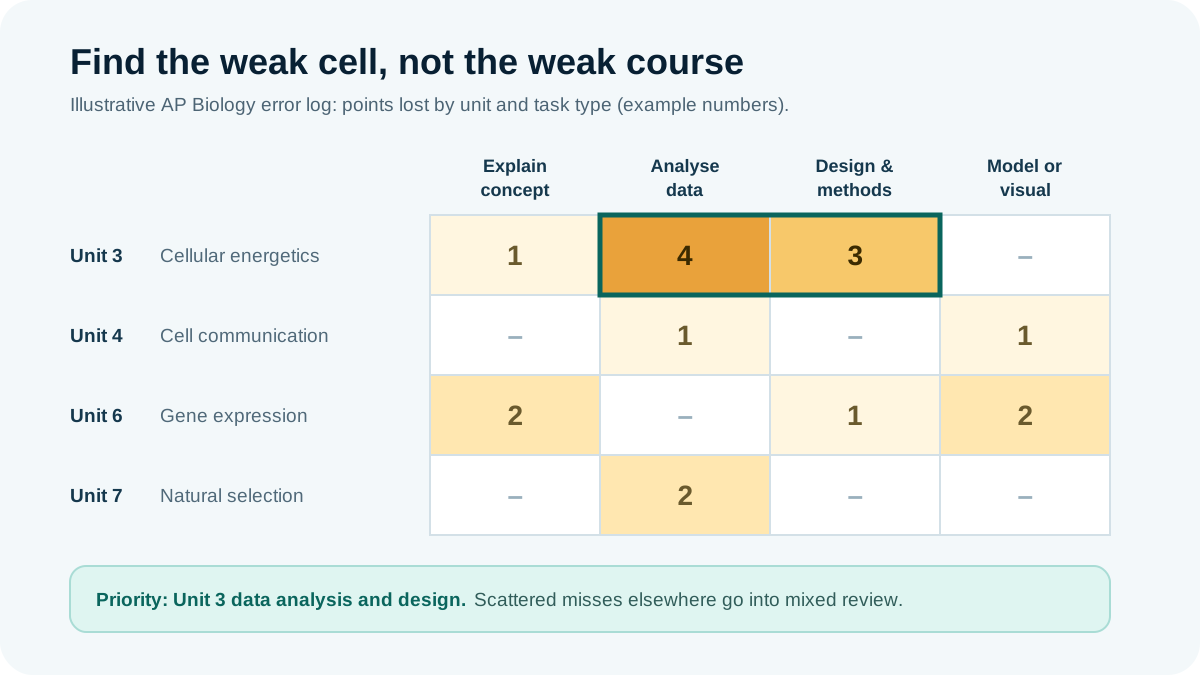
Illustrative numbers. Arranging the log as units against task types shows whether a weakness is a unit, a skill or one cell where the two meet.
When the lost points cluster in one row, the unit is weak. When they cluster in one column across several units, the skill is weak and should be practised everywhere. When they sit in one cell, you have found the most specific and most fixable target.
For a fuller diagnosis routine, the exam mistake-log guide shows how to turn each entry into a retest queue.
Try it: turn one corrected AP error into fresh practice. Paste the correction you just wrote, or your own checked class notes for that unit, into Aripsy’s AP study notes generator. You get structured notes, flashcards and short-answer practice questions on that material, and when you answer the short-answer questions Aripsy gives an estimated mark with the points you earned and missed. You can start free; full multiple-choice sets need Pro. For a second opinion on one of your own written answers, Mark my answer estimates a mark in the AP style. Both are unofficial practice built from what you paste, not College Board content or scoring: paste your own explanation rather than secure AP Classroom questions, and keep released FRQs and their scoring guidelines as your benchmark.
Step 4: confirm the gap with a second official set
One question can mislead you. The prompt may have been unusual, the unit may have appeared only once, or the lost point may have been a slip rather than a gap. Before reorganising your week, test the suspicion with fresh official questions on the same unit and skill: another released FRQ, a progress-check item your teacher reopens, or the sample questions in the CED.
| Evidence | Likely meaning | Next action |
|---|---|---|
| Lose the same point on several questions in one unit | Content or method gap in that unit | Reteach the unit, then practise untimed |
| Basic questions secure, multi-step or unfamiliar ones fail | Application gap | Compare worked examples and practise varied questions |
| Same skill fails across several units | Skill gap | Practise the skill in short sets across units |
| Accurate untimed, weaker under time | Pacing or execution | Short timed sets with a checking rule |
| Fresh set is mostly accurate | The first miss was probably isolated | Keep it in mixed review |
Step 5: rank weak units by evidence, weighting and dependency
Do not simply start with the hardest-feeling unit. Rank each confirmed gap on four things:
- Evidence: how consistently does it lose points on fresh official questions?
- Weighting: what share of the exam does the unit represent, according to the CED?
- Dependency: do later units build on it? Differentiation rules in AP Calculus AB, for example, are used throughout the later differentiation units.
- Cause: is the fix reteaching, skill practice, a checking rule or timing?
A practical order is:
- repeated gaps in heavily weighted units or units that later work depends on;
- skill gaps that cost points across several units;
- timing and execution patterns;
- isolated misses, kept in mixed review;
- strong units, given brief maintenance.
Weighting can break a tie, but it should not override evidence. A student who is secure in a 15–20% unit should not displace a confirmed gap in a smaller unit just because the bigger unit is bigger.
Step 6: write one observable target for each priority
“Revise Unit 3” cannot guide a session. Write the target as something you can do and check:
- AP Biology, Unit 3: from a data table on photosynthesis or cellular respiration, identify the variables and state a claim the data actually support.
- AP Calculus AB, Unit 5: use the first derivative test to justify a relative extremum, in words, from information about the derivative.
- AP US History, document-based question: write a thesis that makes a historically defensible claim and sets up a line of reasoning, then use at least two documents to support it.
Attach a success check:
Answer a fresh official question at exam difficulty, score it against the scoring guideline, and explain why each earlier lost point happened.
A single fixed percentage is a weak measure on a small set. Look for transfer: the same point earned on a question you have not seen before.
Step 7: build focused unit blocks
A 45–60 minute block can follow this structure. Adjust the times to your schedule and concentration.
| Time | Activity | Output |
|---|---|---|
| 5 minutes | Reread one error-log entry and state the target | One written objective |
| 10–15 minutes | Relearn the concept, method or rubric requirement | A short checked explanation |
| 15–20 minutes | Untimed official or checked questions on that target | Worked answers |
| 10 minutes | A short timed retry, such as one FRQ part | Timing plus accuracy evidence |
| 5–10 minutes | Score it against the guideline and update the log | Cause, correction and next retry date |
End every block with attempted questions, not only notes or videos. AP Daily videos and your textbook are good for relearning; the evidence that a gap is closing comes from questions.
Step 8: turn priorities into a weekly AP study schedule
Start from the time you can reliably protect. A sustainable five-block week beats an ideal ten-block plan you abandon in March.
Example week for one AP course
| Block | Focus | Example |
|---|---|---|
| 1 | Priority gap A: learn and practise | Unit 3 data analysis: worked example, then untimed FRQ parts |
| 2 | Priority gap B: learn and practise | Unit 6 concept explanation: relearn, then progress-check style questions |
| 3 | Gap A: fresh timed retry | A different released FRQ, scored against its guideline |
| 4 | Gap B: fresh timed retry | Mixed multiple-choice set including Unit 6 |
| 5 | Mixed maintenance and log review | Questions from several units, then re-rank next week’s gaps |
Example week for several AP courses
If you take more than one AP, plan by evidence and by exam date. In May 2027, AP Biology comes before AP US History, which comes before AP Calculus AB, so a course whose exam is earlier needs its priorities settled earlier. An illustrative week:
| Block | Course | Focus |
|---|---|---|
| 1 | AP Biology | Unit 3 data analysis: relearn and untimed practice |
| 2 | AP Calculus AB | Unit 5 justification: worked examples and untimed practice |
| 3 | AP US History | Document-based question thesis and evidence drill |
| 4 | AP Biology | Fresh timed short-answer FRQ on the same skill |
| 5 | AP Calculus AB | Timed no-calculator multiple-choice set |
| 6 | All courses | Mixed review and error-log update |
For the calendar side of this, including working back from each exam date, use the syllabus-and-exam-date study-plan guide.
Choose a timeline that matches the time left
There is no reliable formula linking hours studied to a particular AP score. Starting knowledge, the quality of practice, how much of the course has been taught, other exams and wellbeing all matter. Use the time remaining to set the depth of the plan:
| Time before the exam | Planning emphasis |
|---|---|
| Autumn to winter, while units are being taught | Log progress-check and test evidence unit by unit, and fix gaps while each unit is fresh |
| January to March | Rank gaps across completed units, schedule spaced retries and start timed FRQ practice |
| About six weeks | Fit in a full practice exam if your teacher assigns one, triage the confirmed gaps and practise the full timing |
| Final two weeks | Retry open errors, use short mixed official sets and protect sleep rather than starting large new topics |
Remember that you cannot diagnose a unit you have not been taught yet. Leave space in the plan for the units your class covers in the spring.
Worked example: AP Biology
Illustrative student and results.
A student’s Unit 3 progress check and two released free-response questions show:
- two points lost on a short-answer data analysis question about photosynthesis rates;
- one point lost on an experimental design question for not identifying an appropriate control;
- one Unit 3 multiple-choice error on the role of the electron transport chain;
- secure performance on Unit 4 and Unit 7 multiple choice.
“Revise cellular energetics” is too broad. The revised plan is:
- Priority skill: read a data table or graph, identify the variables and state a claim the data support.
- Secondary target: identify controls and explain why they are needed.
- Content fix: relearn the electron transport chain from class notes and the textbook, then explain it aloud without notes.
- Blocks 1 and 3: untimed, then timed, released short-answer data questions, each scored against its guideline.
- Mixed block: include Unit 3 questions among other units so the method has to be chosen without a label.
- Checkpoint: a fresh released FRQ set two or three weeks later.
The unit-level checks located the problem. The point-level scoring made the plan specific. If you need checked notes for this unit first, the AP Biology cellular energetics notes page shows how to turn your own material into a structured draft to verify.
Worked example: AP Calculus AB
Illustrative student and results.
A practice set shows multiple choice mostly secure, but free responses lose points on Unit 5 questions: correct answers about where a function is increasing or has a relative maximum, without the justification the scoring guideline asks for. There are also two no-calculator arithmetic slips.
The plan becomes:
- Priority skill: write justifications that connect the sign of the derivative to the conclusion, in words.
- Execution rule: before moving on, recheck signs and arithmetic on every no-calculator answer.
- Blocks: study scored sample responses for justification points, then write your own on released questions and score them strictly.
- Timing: practise the 2027 split, with no calculator for Section I Part A and Section II Part B and a graphing calculator for the other two parts.
The student did not need to relearn the whole of Unit 5. The weakness was the written justification and a checking habit.
Worked example: AP US History
Illustrative student and results.
Short-answer questions are mostly secure, but scored document-based questions lose points for the thesis and for using documents to support an argument rather than describing them. The long essay is reasonable on content but weak on contextualisation. Multiple-choice errors are scattered across periods.
The plan becomes:
- Priority skill: a defensible thesis with a line of reasoning, written in the first minutes of planning.
- Secondary skill: use each document as evidence for a point, not as a summary.
- Content support: rebuild a short timeline for the periods the next released prompts cover. Periods 3 to 8 carry the most weight.
- Blocks: timed thesis-and-outline drills on several released prompts, then one full document-based question each fortnight, scored against the rubric.
- 2027 format: practise all three short-answer questions and a single long essay. The 2027 exam no longer offers a choice between prompts in those sections; the choice now sits inside each question, such as which developments to focus on.
Use the right official resource for each job
| Resource | Best use |
|---|---|
| Course and Exam Description | Units, skills, exam weightings and sample questions |
| AP Classroom progress checks | Unit-by-unit diagnostics your teacher unlocks |
| AP Central past exam questions | Released FRQs with scoring guidelines, sample responses and chief reader reports |
| AP Classroom practice exams and Question Bank | Full or custom practice that your teacher assigns |
| Bluebook test previews | Familiarity with the digital exam tools and layout |
| AP Daily videos and class notes | Relearning a concept before you practise it |
No single resource does every job. A released FRQ cannot rebuild a missing concept, and a video cannot show that you can earn the point under time.
For third-party apps, see the AP study-tool comparison. If you are also preparing for the SAT, the same evidence loop is set out in the SAT study plan for your weakest skills.
Track progress without fooling yourself
For each priority, keep a short record: the unit and skill, the starting evidence, the cause, the practice source, your untimed result, your timed result and the next retry date.
Look for several signals together: the same point earned on fresh questions, fewer repeats of the same cause, clearer justifications, less time lost on the same decision and stronger results on a later progress check or practice exam.
If nothing improves after a few weeks, change the diagnosis before adding more hours. The real problem may be a prerequisite from an earlier unit, a misread command word, a calculator habit or the timing of one section.
Common mistakes to avoid
- Planning by course instead of by unit and skill. “More Biology” hides the cell that is actually losing points.
- Marking FRQs generously. If you cannot point to the guideline element you earned, you did not earn it.
- Treating weighting as weakness. Exam weighting shows representation; your error log shows weakness.
- Rereading instead of retrying. A gap is closed when you earn the point on a fresh question, not when the notes look familiar.
- Using every released question at once. Save some for later checkpoints so you can measure change.
- Ignoring the 2027 format. Practise the current structure, especially in AP Calculus AB and AP US History.
Final two weeks
During the last fortnight before an exam:
- retry the most important open errors from your log;
- use short mixed official sets instead of constant full-length practice;
- rehearse the timing and the calculator rules for each section;
- try the Bluebook test preview if you have not used the digital tools yet;
- keep stronger units warm with brief review;
- protect sleep and avoid building a new study system.
The final fortnight cannot guarantee a score. Its job is to make what you already know easier to retrieve and to remove preventable mistakes.
FAQ
How do I find my weakest AP units?
Use official evidence. Complete the progress checks your teacher unlocks in AP Classroom, score released free-response questions from AP Central against their scoring guidelines, and log each lost point by unit, skill and cause. A unit is weak when it keeps losing points on fresh questions, not when it simply feels hard.
How should I plan if I am taking several AP exams?
Rank gaps within each course first, then share your weekly blocks by evidence and exam date. A course whose exam comes earlier in the May window needs its top gaps settled earlier. Keep at least one mixed review block each week so stronger courses do not drift.
Should I study my strongest or weakest AP units first?
Give more time to confirmed, heavily weighted or foundational gaps, but keep short mixed practice for stronger units. Ignoring strengths completely makes it harder to choose the right method when a question does not tell you which unit it comes from.
Are old AP free-response questions still useful?
Yes, for practising skills and content. Check the current CED for unit and skill changes, and rehearse the current exam structure. In 2027 the AP Calculus AB timing and number of multiple-choice questions change, and AP US History requires all three short-answer questions and a single long essay.
How many practice FRQs should I do each week?
There is no official number. One or two carefully scored FRQs on your priority skills, followed by a fresh retry, is usually more useful than several marked quickly. Increase the volume as the exam approaches and timing becomes the priority.
When are the 2027 AP exams?
College Board lists the 2027 AP Exams over two weeks: May 3–7 and May 10–14, 2027. Check your course’s exam page and your AP coordinator for the exact day and session.
Sources and further reading
Official pages checked on 24 October 2026:
- College Board: 2027 AP Exam dates
- College Board: how AP exams are administered (exam modes)
- College Board: how to practise for AP exams
- College Board: AP Classroom resources
- College Board: AP score setting and the 1–5 scale
- College Board: AP Biology course, exam and past exam questions
- College Board: AP Calculus AB exam, including the 2027 update
- College Board: AP US History exam, including the 2027 update
- College Board: AP Calculus AB units and weightings
- College Board: AP US History periods and weightings
- College Board: AP Biology units and weightings
Keep exploring
Find a study workflow
Choose the source, output, or course route that fits your next study task.
Browse study workflows
Written by
Aripsy Study Team
The Aripsy Study Team creates practical revision guides designed to support learning, source checking, and active practice.


