Best AI Study Apps for SAT Preparation (2026): What Students Should Compare
The best SAT study setup usually combines official College Board practice with one tool for a specific gap. Gemini offers free on-demand SAT practice grounded in Princeton Review content; Khan Academy provides free official skill instruction; Acely and LearnQ offer dedicated adaptive SAT workflows; ChatGPT Study Mode supports guided explanations; and Aripsy turns your own checked notes and mistake explanations into reusable revision material. Bluebook and the Student Question Bank should remain the benchmark for test format and official questions.
 Aripsy Study Team
In this article16
The best AI study app for SAT preparation is not automatically the one with the longest feature list. The digital SAT is a timed, multistage adaptive assessment, so students need several different kinds of support: realistic test practice, accurate skill instruction, clear explanations, targeted drills and a way to revisit mistakes.
No single AI app is equally strong at all five jobs. A flexible chatbot may explain one algebra problem well but cannot reproduce official scoring. A dedicated SAT platform may offer extensive practice and analytics but cost far more than a student needs. A notes tool may help organise mistake explanations without providing a validated SAT question bank.
This guide compares six useful options by the job they perform. It also keeps Bluebook and College Board practice as the official benchmark rather than treating AI-generated questions as interchangeable with real SAT material.
Disclosure: Aripsy publishes this comparison and is one of the products included. We checked product features against official product, help or support pages on 29 September 2026. Prices, plan limits, availability and features can change. We did not run a controlled score-improvement study, and this article does not claim that one app will raise a student’s score by a particular amount.
Quick answer: which AI study app is best for SAT prep?
For most students, start with Bluebook, My Practice, the Student Question Bank and Khan Academy because they provide official test experience and free skill practice. Add Gemini when you want free, on-demand full-length SAT practice with feedback based on Princeton Review content. Consider Acely or LearnQ when you want a dedicated paid platform with adaptive planning, larger practice libraries and progress tracking. Use ChatGPT Study Mode for guided explanations. Use Aripsy when you want to turn checked lesson notes, formula summaries or mistake explanations into saved notes, flashcards and extra retrieval practice.
The right question is not “Which app is best overall?” It is “What is missing from my current SAT workflow?”
Six SAT study apps compared
| Tool | Best SAT use | Practice and feedback | Main limitation |
|---|---|---|---|
| Gemini | Free on-demand SAT practice and adaptive study notebooks | Full-length SAT practice grounded in Princeton Review content; feedback, explanations and study notebooks | Not official College Board practice; availability can vary by account and device |
| Khan Academy | Free official skill instruction | Official Digital SAT lessons, videos, hints and thousands of practice questions | Full-length adaptive simulation belongs in Bluebook, not Khan Academy |
| Acely | Paid adaptive SAT plan and extensive practice | Diagnostic, automatically updated plan, AI tutor, progress tracking and a large expert-written question library | Substantial paid commitment after limited free access |
| LearnQ | Gamified adaptive practice and AI doubt support | Diagnostic and sectional practice, adaptive questions, analytics and Mia AI tutor | Platform-produced practice still needs calibration against official material |
| ChatGPT Study Mode | Guided explanations and flexible tutoring | Can use uploaded files or images where available, ask questions and create practice | No official SAT question bank, test engine or reliable SAT score prediction |
| Aripsy | Turning your own checked SAT material into reusable revision | Structured notes, flashcards and questions; Pro adds MCQs and fill-in-the-blanks | Not a dedicated SAT course, adaptive simulator or official question bank |
The official baseline every SAT app should complement
Before comparing AI features, understand the test experience an app is supposed to support. The SAT has Reading and Writing and Math sections. Each section contains two separately timed modules, and performance in the first module helps determine the mix of difficulty in the second. College Board currently lists 54 Reading and Writing questions in 64 minutes and 44 Math questions in 70 minutes, excluding the break.
That adaptive structure matters. A collection of generated questions can help with algebra, transitions or vocabulary in context, but it does not automatically behave like the real test. Nor does a score on a third-party test necessarily mean the same thing as a score from official practice.
Use the official stack for four jobs:
- Bluebook: take official full-length digital practice tests and learn the testing interface.
- My Practice: review practice scores, questions and performance after a Bluebook test.
- Student Question Bank: filter thousands of official questions by section, domain, skill and difficulty.
- Official SAT Prep on Khan Academy: rebuild the skills exposed by practice results.
AI tools belong around this stack. They can explain a mistake, organise a plan, generate extra retrieval prompts or provide more practice between official tests. They should not make you less familiar with Bluebook or consume every official test before you have time to review it carefully.
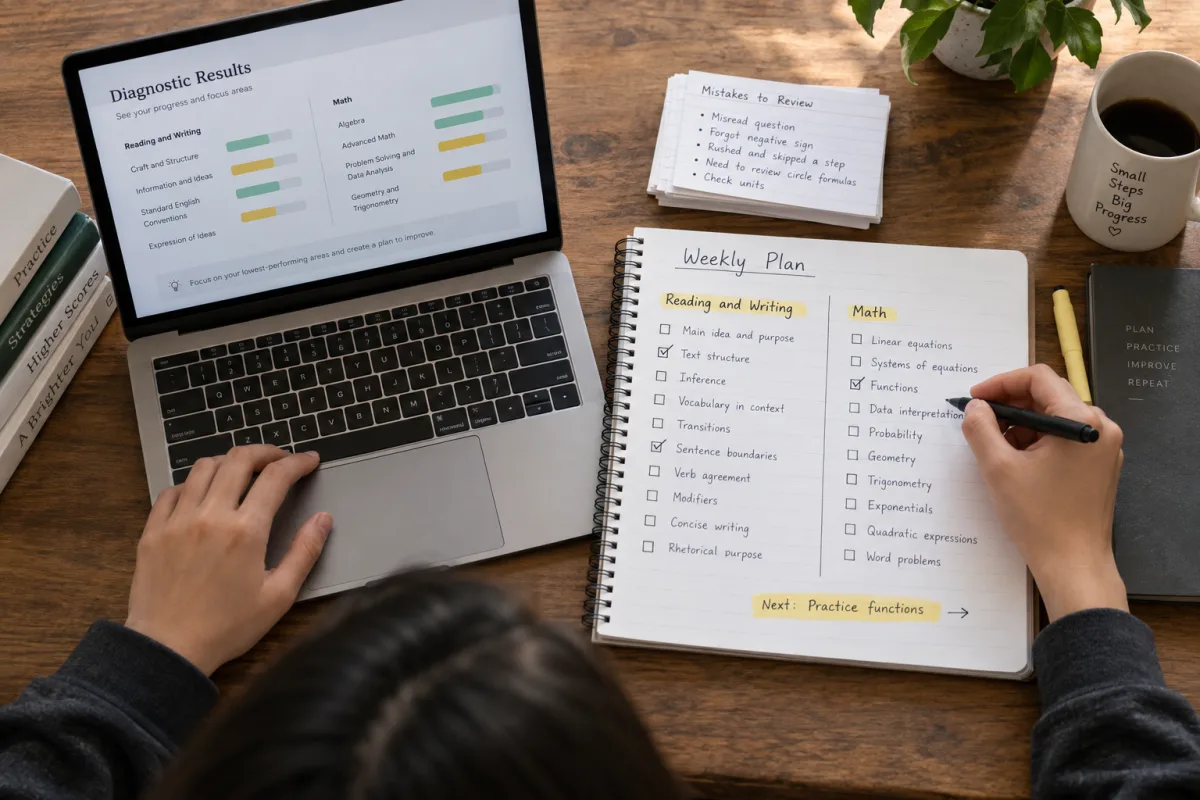
How we evaluated the apps
We compared each tool against six practical questions:
- SAT specificity: Is it designed around current Reading and Writing and Math skills, or is it a general study tool?
- Question provenance: Are questions official, expert-written, partner-provided or generated on demand?
- Adaptive value: Does performance change the next lesson, drill or recommendation?
- Explanation quality: Can the tool help a student understand why an answer failed without doing all the thinking for them?
- Progress workflow: Can a student identify weak domains, plan practice and revisit mistakes?
- Official-practice fit: Does the tool complement Bluebook and the Student Question Bank rather than claim to replace them?
We did not reproduce vendor score claims or testimonials as evidence that a product is better. Those outcomes depend on starting score, study time, test conditions, student selection and other factors that a feature comparison cannot control.
1. Gemini: best for free on-demand SAT practice
Gemini’s SAT practice tests are one of the clearest recent changes in this category. Google says students can request a full-length SAT practice test at no cost, receive immediate performance feedback and ask for explanations. The test content is grounded in material from The Princeton Review.
Gemini also offers study notebooks that begin with a diagnostic, generate personalised lessons and update focus areas as a student completes quizzes. Google says SAT preparation inside study notebooks is grounded in Princeton Review questions. This makes Gemini more structured than a blank general-purpose chat when the feature is available on your account.
The important distinction is provenance. “Vetted by an education provider” is not the same as “official College Board question.” Use Gemini to expand practice, diagnose topics and ask follow-up questions, then return to Bluebook and the Student Question Bank for the closest test benchmark.
Best for: students who want a no-cost AI-supported SAT practice option before deciding whether a paid platform is necessary.
2. Khan Academy: best free official skill-building resource
Official Digital SAT Prep on Khan Academy is the strongest free starting point for rebuilding tested skills. College Board describes it as providing thousands of practice questions, instructional videos, lessons and hints. Students can move from Bluebook results into targeted Khan Academy practice.
Khan Academy is especially useful when a practice result identifies a real content gap. If you repeatedly miss nonlinear equations, sentence boundaries or command-of-evidence questions, a structured lesson and targeted practice are more useful than asking an AI tool to produce another random mixed test.
It is important to separate skill practice from full simulation. Khan Academy does not replace taking official, timed, adaptive practice tests in Bluebook. Pair the two: diagnose in Bluebook, learn and drill in Khan Academy, then retest after a delay.
Best for: students who want free, official-aligned instruction and targeted practice before buying anything.
3. Acely: best for an intensive adaptive paid plan
Acely is a dedicated SAT and ACT preparation platform rather than a general study chatbot. Its current product page describes a diagnostic, personalised study plans that update with progress, an AI tutor, performance tracking, expert-written questions and full-length practice tests.
That integrated loop is the reason to consider it: assessment, planning, practice and analysis live in the same system. This may help a student who struggles to decide what to study each day or wants a large supply of structured practice over several months.
The trade-off is cost and commitment. Acely’s free access is designed as a limited trial of the workflow, while its full plans are a much larger purchase than free official resources. Before subscribing, complete the diagnostic, inspect several explanations, test the planner for a week and confirm that you will actually use the practice volume. Also compare any platform score estimate with official Bluebook results rather than treating it as interchangeable.
Best for: students willing to pay for a guided, high-volume SAT programme with an adaptive daily plan.
4. LearnQ: best for gamified adaptive drills and AI doubt support
LearnQ focuses specifically on the digital SAT. Its official pages describe diagnostic and sectional practice, adaptive questions, performance analysis and Mia, an AI tutor that explains missed questions and can suggest similar problems.
The gamified approach may suit students who avoid long conventional prep sessions but will complete shorter drills consistently. The question-level tutor is also more context-specific than copying a problem into a blank chatbot, because the explanation sits inside the practice workflow.
As with any third-party SAT platform, evaluate quality with a sample rather than relying on the size of the library. Check whether explanations identify the exact reasoning error, whether Reading and Writing questions match current passage length and skill labels, and whether Math practice encourages efficient use of the digital test environment. Keep official practice as the calibration point.
Best for: students who want focused digital-SAT drills, visible analytics and a more game-like study habit.
5. ChatGPT Study Mode: best for flexible guided explanations
ChatGPT Study Mode can ask questions, work through an answer step by step and use uploaded files or images when those inputs are available. For SAT preparation, that flexibility is useful after you have already attempted a problem.
A productive prompt is specific:
I missed this problem. Do not give me the answer first. Ask me what I noticed, identify the first incorrect reasoning step, then give me one similar problem without copying the original.
Study Mode can also compare two solution paths, explain a grammar rule, demonstrate a Desmos-friendly approach or quiz you on a checked mistake list. However, it does not provide an official SAT question bank, reproduce College Board scoring or guarantee that generated questions match the current test. OpenAI’s own guidance says Study Mode can make mistakes and important information should be checked.
For a broader workflow, see how to use ChatGPT for studying.
Best for: students who want an interactive explanation after attempting a question and can verify the guidance against a trusted source.
6. Aripsy: best for turning SAT mistakes into reusable revision
Aripsy is not a dedicated SAT testing platform. It does not offer official SAT questions, adaptive module simulation or SAT score prediction. Its role is narrower: turning your own checked material into organised notes and active-recall practice.
For example, after reviewing an official practice test, you could write a short source document containing:
- the skill attached to each miss;
- the rule or method you should have used;
- why your chosen answer was tempting but wrong;
- one corrected example you are allowed to reuse;
- the next action, such as “practise five advanced-math questions.”
Aripsy can turn that material into structured notes, flashcards and questions. Signed-in Free users can try one successful supported document upload; ongoing PDF, PowerPoint and Word uploads require Pro. Free includes notes and limited flashcards, while Pro adds MCQs and fill-in-the-blank practice within current plan limits.
The value is the saved correction loop, not simulated SAT authority. Verify every formula, grammar rule and explanation before repeating it. Do not upload restricted questions or personal score reports containing unnecessary identifying information.
Best for: students who already use official practice and want a repeatable system for retaining the lessons from their mistakes.
What students should compare before choosing
Official content versus extra content
Check where the questions come from. College Board questions are official. Khan Academy provides official Digital SAT preparation. Gemini identifies Princeton Review as the source behind its SAT practice. Dedicated platforms may use expert-written libraries. General AI tools generate content dynamically unless you give them a fixed source.
These sources can all be useful, but they are not equivalent. Label them clearly in your study plan so you know what is being used for simulation, instruction or extra practice.
Adaptive testing versus adaptive studying
The SAT adapts between modules within each section. A study app may also call itself adaptive because it changes lessons, question difficulty or recommendations over time. Those are different systems.
Ask vendors what adapts and when. Does the platform reproduce a two-stage section? Does it simply recommend a weak topic? Does it change the next question after every answer? The word “adaptive” alone does not prove realistic score prediction.
Explanations versus answer delivery
A useful explanation should identify the tested skill, show the decisive evidence or reasoning step and explain why distractors fail. It should then let you solve a related problem independently. An app that immediately reveals the answer can create familiarity without durable learning.
Practice volume versus review quality
Thousands of questions are not automatically better than a smaller reviewed set. If you complete questions without analysing errors, more volume can repeat the same weak method. Look for bookmarks, error categories, retries, spaced review or a practical way to export your mistake lessons.
Free access versus total study cost
Start with official free resources. Pay only when a product solves a demonstrated bottleneck: insufficient explanations, weak planning, too little targeted practice or poor consistency. Check renewal terms, trial conditions and regional pricing on the vendor’s current page before subscribing.
A practical SAT study stack
Use each tool for one clear job:
- Diagnose in Bluebook. Take an official practice test under realistic conditions and preserve some tests for later checkpoints.
- Review in My Practice. Identify the domain and reasoning behind each missed or guessed question.
- Repair the skill. Use Khan Academy, a teacher, tutor or a trusted explanation source.
- Add targeted repetitions. Use the Student Question Bank or a carefully evaluated SAT platform.
- Ask for guided help. Use Gemini, ChatGPT or a platform tutor after attempting the problem.
- Record the lesson. Maintain a concise error log and turn checked patterns into recall prompts.
- Retest after a delay. Use a fresh official set or test to see whether the skill transfers under time pressure.

One missed question can belong to several error types: content knowledge, misreading, inefficient method, calculator use, time pressure or an attractive distractor. Record the actual cause. “Careless” is rarely specific enough to change your next study session.
Common mistakes when using AI for SAT prep
- Replacing Bluebook with generated full-length tests. Extra tests can be useful, but official adaptive practice remains the better format benchmark.
- Requesting a predicted score from a chatbot. A plausible-looking number is not a validated score.
- Studying explanations without attempting questions. Retrieval and problem solving require an answer attempt before review.
- Trusting generated grammar or math rules automatically. Check important rules and methods against official or expert-reviewed material.
- Uploading restricted test content. Use questions and materials you are permitted to process.
- Ignoring the digital interface. Pacing, module navigation, flagging and calculator habits need practice in the environment used for the real test.
- Buying several overlapping subscriptions. One official stack plus one tool for your main gap is usually easier to maintain.
Final recommendation
Begin with the free official combination: Bluebook, My Practice, the Student Question Bank and Khan Academy. That gives you realistic test experience, official questions and structured skill review.
Then add one AI tool only if it solves a visible problem. Choose Gemini for free on-demand SAT practice and personalised study notebooks. Compare Acely and LearnQ if you want a dedicated adaptive programme with more analytics and practice. Use ChatGPT Study Mode when explanation is the bottleneck. Use Aripsy when your mistake notes and lesson material need to become a reusable active-recall system.
No app replaces consistent practice, careful review or official calibration. The best study stack is the smallest one that helps you identify a weakness, repair it and demonstrate the improvement on fresh questions.
FAQ
What is the best free AI app for SAT preparation?
Gemini is a strong free AI option for on-demand SAT practice and feedback. However, the best free overall starting stack is Bluebook, My Practice, the Student Question Bank and Official Digital SAT Prep on Khan Academy because it combines official practice with targeted instruction.
Can ChatGPT accurately predict my SAT score?
No. ChatGPT can explain questions and support practice, but it does not provide an official SAT scoring engine. Use scored Bluebook practice tests to establish the most relevant official practice benchmark.
Are AI-generated SAT practice questions reliable?
They can provide useful extra practice, but quality varies. Check whether questions are official, expert-written, partner-provided or generated dynamically. Verify questionable answers and use official College Board material to calibrate content, format and difficulty.
Should I use Bluebook or an AI SAT app?
Use both for different jobs. Bluebook is essential for official full-length digital practice and familiarity with the test interface. An AI app can add explanations, planning, targeted drills or a mistake-review workflow between official tests.
Is Khan Academy enough for SAT prep?
Khan Academy is an excellent free resource for learning and practising SAT skills, but students should also use Bluebook for official timed adaptive practice and the Student Question Bank for targeted official questions. Whether additional help is necessary depends on the student’s gaps and study habits.
How should I use AI after an SAT practice test?
First review the official explanation and identify why you missed or guessed each question. Then use AI to clarify the underlying skill, compare solution methods, create a similar non-copied problem or turn your checked mistake notes into recall prompts. Retest the skill later without assistance.
Sources and further reading
- College Board: full-length digital practice tests on Bluebook
- College Board: SAT practice and preparation resources
- College Board: how adaptive SAT scoring works
- College Board: SAT content domains
- Khan Academy: Official Digital SAT Prep
- Google: how to take full-length SAT practice tests in Gemini
- Google: SAT preparation with Gemini study notebooks
- OpenAI: using Study Mode in ChatGPT
- Acely: personalised SAT and ACT preparation
- LearnQ: digital SAT practice platform
Continue studying

Written by
Aripsy Study Team
The Aripsy Study Team creates practical revision guides designed to support learning, source checking, and active practice.