AQA GCSE Chemistry Revision Notes, Flashcards & Practice Questions
Aripsy turns your AQA GCSE Chemistry notes, textbook pages, or class handouts into revision notes, flashcards, and exam-style MCQs. Paste one topic or upload a supported PDF, PowerPoint (.pptx), or Word (.docx) file on Pro, then revise the AQA Chemistry topic structure with active recall.
AQA
GCSE
Subject topics
Chemistry
Exam practice
GCSE
Chemistry
GCSE / SAT
AQA
Turn one focused source into structured notes, key concepts, and recall prompts, then continue in the full study tool.
Short answer
How can Aripsy help me revise AQA GCSE Chemistry?
Aripsy turns your AQA GCSE Chemistry notes, textbook pages, or class handouts into revision notes, flashcards, and exam-style MCQs. Paste one topic or upload a supported PDF, PowerPoint (.pptx), or Word (.docx) file on Pro, then revise the AQA Chemistry topic structure with active recall.
Best input
Atomic structure: atoms contain protons, neutrons, and electrons. Protons have a relative charge of +1, neutrons have 0, and electrons have -1. Isotopes are atoms of the same element with different numbers of neutrons. Relative atomic mass uses the abundance of isotopes.
Responsible use
Use Aripsy alongside your AQA specification, class notes, course materials, and past-paper mark schemes. Check equations, units, and practical wording before revision.
How Aripsy helps you study this material
Aripsy turns your AQA GCSE Chemistry notes, textbook pages, or class handouts into revision notes, flashcards, and exam-style MCQs. Paste one topic or upload a supported PDF, PowerPoint (.pptx), or Word (.docx) file on Pro, then revise the AQA Chemistry topic structure with active recall.
Why use this tool?
How to create study notes from your material
Common Questions
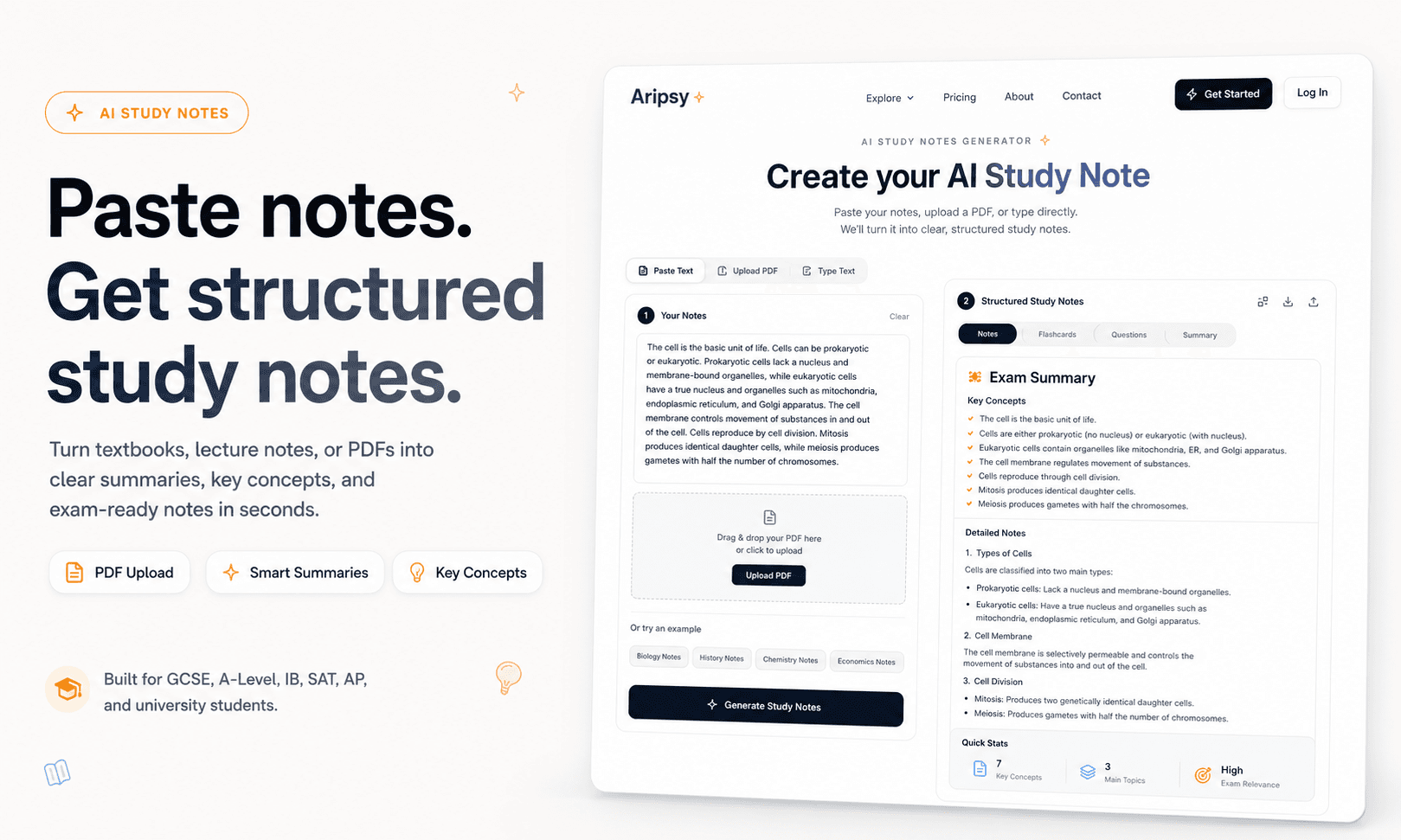
Product workflow preview
What the workflow looks like in Aripsy
GCSE Chemistry demands precise recall of formulae, reaction equations, and bonding explanations alongside practical method understanding. The screenshot shows the same Aripsy workflow students use to add material, choose study settings, generate notes, then build recall practice from the saved session.
Related topics
What is covered in AQA GCSE Chemistry?
AQA GCSE Chemistry is commonly revised across atomic structure, bonding, quantitative chemistry, chemical changes, energy changes, rates, organic chemistry, analysis, atmosphere, and resources. Aripsy helps students turn their own notes for each topic into shorter explanations and recall prompts.
AQA Chemistry Paper 1 revision topics
Paper 1 revision usually focuses on atomic structure, the periodic table, bonding, quantitative chemistry, chemical changes, and energy changes. Useful inputs include ion notes, bonding diagrams, mole calculations, electrolysis examples, and reaction profile diagrams.
AQA Chemistry Paper 2 revision topics
Paper 2 revision usually focuses on rates, equilibrium, organic chemistry, chemical analysis, the atmosphere, and resources. Students often need precise wording for collision theory, Le Chatelier explanations, chromatography, carbon-cycle evidence, and life-cycle assessment.
Sample AQA Chemistry flashcards
Example cards include: What is an isotope? Atoms of the same element with different numbers of neutrons. What is conservation of mass? No atoms are lost or made during a chemical reaction, so total mass is conserved.
Common mistakes to check before revising
Students often mix up mass number and atomic number, forget units in calculations, write unbalanced equations, or describe ionic bonding without electron transfer. Generated notes should be checked against the AQA specification, class notes, and mark schemes.
How to revise AQA Chemistry with Aripsy
Use one focused topic at a time. Paste your notes, generate a structured summary, check equations and units, then create flashcards or MCQs from the corrected material. This keeps the workflow active and source-grounded.
Useful student workflows
Atomic Structure & Bonding Revision
Convert notes on electron configuration, ionic and covalent bonding, metallic bonding, and intermolecular forces into structured definition cards and comparison tables.
Balancing Equations & Calculations
Generate step-by-step recall prompts for balancing equations, mole calculations, concentration formulae, and titration procedures.
Organic Chemistry & Atmosphere Topics
Summarize hydrocarbon cracking, alkenes vs alkanes, polymerisation, and Earth atmosphere composition changes into revision-ready notes.
Why Chemistry pages need real topic detail
A useful AQA GCSE Chemistry page should do more than say it creates notes. Students need topic lists, realistic flashcard examples, calculation checks, practical-method reminders, and source-checking prompts. That makes the page useful for revision rather than another thin keyword variation.
What to paste for better AQA Chemistry notes
The best input is a focused section from one topic: a class handout, textbook explanation, copied PDF text, required practical method, worked calculation, or corrected answer. Include formulae and units where possible, then verify generated equations before using them.
Turning Chemistry notes into active recall
After checking notes, turn definitions into flashcards, calculations into step prompts, and common mistakes into MCQs. For example, electrolysis can become ion movement recall, half-equation practice, and product-prediction questions.
Mastering the AQA GCSE Chemistry Specification
The AQA GCSE Chemistry specification (8462) spans ten topics across two papers. Paper 1 covers Atomic Structure and the Periodic Table, Bonding Structure and Properties, Quantitative Chemistry, Chemical Changes, and Energy Changes. Paper 2 covers The Rate and Extent of Chemical Change, Organic Chemistry, Chemical Analysis, Chemistry of the Atmosphere, and Using Resources. Chemistry demands a combination of conceptual understanding (why ionic compounds have high melting points), mathematical application (calculating relative formula mass and moles), and practical competence (describing titration methodology). Students who compartmentalise these three skill types during revision tend to perform more consistently across different question styles.
Why Chemistry Revision Needs Active Recall, Not Rereading
Chemistry has a uniquely high density of precise terminology and numerical methods. A student might understand the concept of electrolysis during a lesson but forget the specific electrode equations by exam day. Aripsy addresses this by converting your chemistry notes into atomic flashcards—each testing one specific fact, formula, or process step. For example, rather than a single card saying "describe electrolysis", Aripsy would generate separate cards for anode reactions, cathode reactions, electrolyte requirements, and industrial applications. This granular approach builds the precise recall that chemistry examiners reward.
Connecting Required Practicals to Exam Questions
AQA Chemistry includes eight required practicals ranging from chromatography to titration to temperature change measurement. Examiners test practical knowledge through both direct method questions and unfamiliar context questions where students must apply practical reasoning to new scenarios. Paste your practical notes into Aripsy to generate flashcards covering apparatus selection, safety precautions, measurement accuracy, and how to process results. Always verify chemical equations and safety information against the official AQA specification and your school laboratory risk assessments.
Sources and further reading
These independent education resources inform the study habits discussed on this page. Always follow your teacher, tutor, specification, or official exam guidance first.
AQA GCSE Chemistry Specification (8462)
Official GCSE Chemistry specification with topic content, required practicals, and mathematical requirements.
BBC BitesizeBBC Bitesize AQA GCSE Chemistry
Free revision guide structured by AQA GCSE Chemistry specification topics.
The Learning ScientistsRetrieval practice
Explains why pulling answers from memory is usually stronger than rereading notes.
Topics supported
Ready to revise with less friction?
Start with your own material and build a clearer revision workflow.
Turn one focused source into structured notes, key concepts, and recall prompts, then continue in the full study tool.
Supported Subjects
Biology, Chemistry, Physics, Mathematics, History, Geography, Economics, Business, Psychology, Computer Science and English Literature.